|
|
Naked Citi - The Rise and Fall of Citigroup
Citigroup's five-day death spiral last week was surreal. I know 20-something newlyweds who have better financial backup plans than this global banking giant. On Monday came the Town Hall meeting with employees to announce the sacking of 52,000 workers. (Aren't Town Hall meetings supposed to instill confidence?) On Tuesday came the announcement of Citigroup losing 53 per cent of an internal hedge fund's money in a month and bringing $17 billion of assets that had been hiding out in the Cayman Islands back onto its balance sheet. Wednesday brought the cheery news that a law firm was alleging that Citigroup peddled something called the MAT Five Fund as "safe" and "secure" only to watch it lose 80 per cent of its value. On Thursday, Saudi Prince Walid bin Talal, from that visionary country that won't let women drive cars, stepped forward to reassure us that Citigroup is "undervalued" and he was buying more shares. Not having any Princes of our own, we tend to associate them with fairytales. The next day the stock dropped another 20 percent with 1.02 billion shares changing hands. It closed at $3.77. Altogether, the stock lost 60 per cent last week and 87 percent this year. The company's market value has now fallen from more than $250 billion in 2006 to $20.5 billion on Friday, November 21, 2008. That's $4.5 billion less than Citigroup owes taxpayers from the U.S. Treasury's bailout program. Also rounding out the week's news on Friday was the revelation that after receiving $25 billion of taxpayer money, Citigroup would continue to honor its $400 million, 20-year commitment and pay out an installment of $20 million to have the new Mets' baseball stadium named Citi Field. (Flashback: April 7, 1999: Enron agrees to pay more than $100 million over 30 years to name a Houston stadium Enron Field.) It took the repeal of the Glass-Steagall Act, legislation crafted after the 1929 crash barring commercial banks from merging with their casino cousins (investment banks and brokerage firms) to bring Citigroup to life. Sandy Weill took Travelers Insurance, the Smith Barney brokerage firm (which had been combined with the Shearson brokerage firm), the investment bank Salomon Brothers and announced on April 6, 1998 that he would be merging all of these units with the commercial banking giant, Citicorp, owner of Citibank. Never one to let laws get in his way, Mr. Weill announced this deal despite the fact that this combination was not allowed at the time because of the Glass-Steagall Act. It would take "a village" in the Clinton administration to get Glass-Steagall repealed and allow the creation of the colossal financial monster that would take precisely one decade to pay its founder $1 billion and then implode in a sea of losses. The village included Treasury Secretary Robert Rubin who successfully lobbied for the repeal of the investor-protection law, then left his cabinet position in the Clinton administration and moved his game marker to the Board of Citigroup 17 days before the bill gutting Glass-Steagall was signed into law on November 12, 1999. Mr. Rubin would collect over $150 million from Citigroup in the next 9 years for his Board service, without ever drawing the go-to-jail card; not even when he picked up the phone and called a Treasury official and asked the government to stop the credit rating agencies from downgrading the debt of Enron, to whom Citigroup had major exposure. In that one instance, he was rebuffed. And, of course, the village included Alan Greenspan who rarely saw an investor-protection regulation to which he didn't proceed to take a machete. Now, after 19 years of making the country listen to his mutterings before Congress in verbose, convoluted academic-speak; after he has assisted handily in turning Wall Street into the Dollar Store and once thriving companies into a barren wasteland of receiverships, bankruptcies and collapsing stock prices, he offers a broken country a one-liner: he got it wrong. The Federal Reserve held hearings on the proposed merger of Citigroup on June 25 and June 26, 1998, at the Federal Reserve Bank of New York. Galen Sherwin, then President of the National Organization for Women in New York City, and I were protesting outside the hearings on June 26 over Mr. Weill's enforcement of private justice systems for his workers. Employees had to sign away their rights to sue the firm in court as a condition of employment and agree to secret tribunals called mandatory arbitration. We were holding very large and graphic protest signs when a kindly official came out and asked if we would like to testify on a panel where they had a few openings. Somewhat surprised by the invitation (perhaps it was to provide an unobstructed photo shot of the Fed Building for tourists), we seated ourselves in the auditorium and began to feverishly scribble our speeches on scrap paper. The Federal Reserve has maintained the original of my scribbled text on its web site all these years and I printed it out today as a sorrowful souvenir of our country's decade-long incarceration under corporate rule. With our protests signs propped against the testifiers' table and a Fed employee in a back area filming it all for posterity, here's an excerpt of what I told the Fed on June 26, 1998:
Like any other epic tragedy resulting from human hubris, this one deserves reflection and analysis if we are to claw our way out of the abyss. Offered in solidarity with anthropologist Gregory Bateson's theories on creating levels of learning, and anthropologist Laura Nader's cautions on keeping anger in a box, below are links to the unfolding crisis and Citigroup's pivotal role as filed here at CounterPunch beginning on November 6, 2007. November 6, 2007 November 28, 2007 January 3, 2008 January 21, 2008 February 2/3, 2008 March 17, 2008 June 21/22, 2008 September 20/21, 2008 October 17/20, 2008 Pam Martens worked on Wall Street for 21 years; she has no security position, long or short, in any company mentioned in this article. She writes on public interest issues from New Hampshire. She can be reached at pamk741@aol.com |
 |
 |

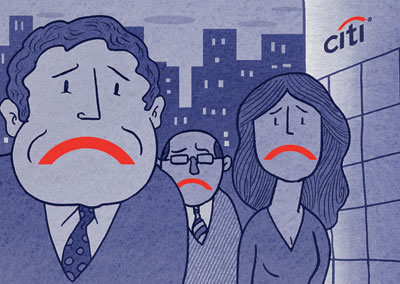 Citigroup's two best known ad campaigns, "Citi Never Sleeps" and "Live Richly," will hopefully become a cautionary warning for the next generation: don't take advice from sleep-deprived money managers and live within your means. As of last Friday's close, Citigroup had $2 trillion in "assets" and $20.5 billion in stock market value, strongly suggesting the term "assets" is a misnomer on Wall Street. Late last night the U.S. government agreed to dump hundreds of billions more into this black hole without any survival plan required of the company as demanded of the auto makers: apparently if you make those four wheel machines that get us to work you're suspect; if you manufacture losses in unintelligible derivatives, you're good to go.