|
|
Fear and Loathing in La Jolla - Bob Dylan, "Tangled Up in Blue"
In fact, they are among the angriest upper- and middle-class people I have ever seen. And the most frightened and worried. (In a way, they are now feeling the way ordinary workers have been feeling for years.) And why not? With the experiment of allowing a major investment bank, Lehman Brothers, to simply vanish, leaving huge holes in the portfolios of many other financial entities, Henry M. Paulson Jr., the Treasury secretary, threw the financial system into chaos. Yes, some people at Lehman undoubtedly did some bad things, but those kinds of people are found everywhere. Letting Lehman fail was almost incomprehensible. It took the federal government many decades, after the banking collapse leading to the Great Depression, to restore confidence in the financial system. Then, in one horribly misguided moment, Mr. Paulson, with the apparent agreement of Ben S. Bernanke, chairman of the Fed, demolished that confidence. Now, we have to spend $700 billion to try to get it back, and it’s by no means certain that even this enormous bailout plan will work. Confidence is incredibly important. In a way, it’s the only factor that counts in finance. Do markets and lenders have confidence in this plan? Do they have confidence that it will work successfully for the whole country and not just for the Wall Street buddy system? The results in the markets, post-bailout, are dismal. When confidence is gone, it’s really gone. We see the results all around us, in what seems to be a gathering slowdown. For those of us surveying the financial statements we can get online at any moment to destroy our sleep, the recession is already here and it looks a lot like a depression if we add in the losses on our real estate. So, as I drove home from La Jolla to the comfort of my dogs in Los Angeles, I thought, "Well, what now? Now that we are facing a situation of complete unpredictability with a financial system fluctuating between state socialism and chaos, what do I do?" I thought I should try to maintain my health so I could keep working and speaking longer and keep supporting my family longer, not to mention the many other people and lenders I help support. I also thought that I would like to keep as liquid as I prudently can, even if it often means selling stock at a loss. Cash is balm in this situation: it lets you sleep. I also thought that I wouldn’t be buying a ranch in Idaho, as my wife has wanted me to do - not for some time, if ever. But in my way, like my father before me, I’m a working man. My work, speaking and writing, is my pleasure. I plan to do it as long as I draw breath. My beloved father, a distinguished economist and writer, was working on differing expectations for inflation as they bear on the price of long-term bonds, with tubes in him in the I.C.U. I still have the blood-spattered pages of his written thoughts. He didn’t need the money. It was his passion. My ideal last day would be speaking and then drifting off to eternity with my economic statistics bulletin and my dogs by my side. Not everyone feels that way, however. Many people long for retirement. But clearly, many of them are in deep, deep trouble. Even before the recent crisis, the financial situation of large numbers of retirees was desperate. The data for boomers is grim, with only small percentages really able to retire in comfort. NOW, the case is far worse. People planning for retirement were told they could expect that their savings in broad indexes of common stocks would double roughly every 10 years. But we are now below where we were in 1998. If pre-retirees needed that doubling to get to their savings goals, they are now cut off at the knees. Unless the stock market stages a miraculous recovery, and I pray it does, a whole generation of boomers will be hopelessly far from its needs for savings. I wonder if Mr. Paulson with his hundreds of millions in the bank really understands the terror of those people in the room in La Jolla and the tens of millions like them. I wonder if Mr. Bernanke does. I wonder if, as they rolled the dice on Lehman and came up snake eyes, they thought of the fear that would spread throughout the land. What do people - decent, hard-working people - do now? The standard advice would be to buy when the market is down, and it’s probably good advice. But only "probably" because we have no idea how far down we’ll go or how long it will take to recover. Maybe it is better to be liquid now. But then again, maybe not. Uncertainty and fear rule. Frankly, I don’t know the answer. I just know that for a long time, we have paid Wall Street "experts" unimaginable sums for preparing for our retirement. They still have our money, and we have ashes. And I wonder whose side government is on, which is a bad thought to have, and I wish I didn’t have it. As the song goes, there is revolution in the air.
In 1973 and 1974, he was a speech writer and lawyer for Richard Nixon at The White House and then for Gerald Ford. (He did NOT write the line, "I am not a crook.") He has been a columnist and editorial writer for The Wall Street Journal, a syndicated columnist for The Los Angeles Herald Examiner (R.I.P.) and King Features Syndicate, and a frequent contributor to Barrons, where his articles about the ethics of management buyouts and issues of fraud in the Milken Drexel junk bond scheme drew major national attention. He has been a regular columnist for Los Angeles Magazine, New York Magazine, E! Online, and most of all, has written a lengthy diary for twenty years for The American Spectator. He currently writes a column for The New york Times Sunday Business Section and has for many years, a column about personal finance for Yahoo!, is a commentator for CBS Sunday Morning, and for Fox News. He has written, co-written and published thirty books, including seven novels, largely about life in Los Angeles, and twenty-one nonfiction books, about finance and about ethical and social issue in finance, and also about the political and social content of mass culture. He has done pioneering work in uncovering the concealed messages of TV and in explaining how TV and movies get made. His titles include A License to Steal, Michael Milken and the Conspiracy to Bilk the Nation, The View From Sunset Boulevard, Hollywood Days, Hollywood Nights, DREEMZ, Financial Passages, and Ludes. His most recent books are the best selling humor self help series, How To Ruin Your Life. He has also been a longtime screenwriter, writing, among many other scripts (most of which were unmade ) the first draft of The Boost, a movie based on Ludes, and the outlines of the lengthy miniseries Amerika, and the acclaimed Murder in Mississippi. He was one of the creators of the well regarded comedy, Fernwood Tonight. He is also an extremely well known actor in movies, TV, and commercials. His part of the boring teacher in Ferris Bueller's Day Off was recently ranked as one of the fifty most famous scenes in American film. From 1997 to 2002, he was the host of the Comedy Central quiz show, "Win Ben Stein's Money." The show has won seven Emmies. He was a judge on CBS's Star Search, and on VH-1's "America's Most Smartest Model." He lives with his wife, Alexandra Denman ( former lawyer,) six cats and three large dogs in Beverly Hills. He is active in pro-animal and pro-life charitable events. Would you like Ben Stein to speak at your gathering or host an event? Click here for more information! |
 |
 |

 A FEW days ago, I spoke to a large gathering of investors in the San Diego suburb of La Jolla, and was startled by the audience’s furious anger at the powers that be. The Wall Street-Treasury-
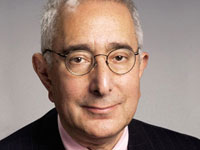 Ben Stein (Benjamin J. Stein) was born November 25, 1944 in Washington, D.C., (He is the son of the economist and writer Herbert Stein) grew up in Silver Spring, Maryland, and attended Montgomery Blair High School. He graduated from Columbia University in 1966 with honors in economics. He graduated from Yale Law School in 1970 as valedictorian of his class by election of his classmates. He also studied in the graduate school of economics at Yale. He has worked as an economist at The Department of Commerce, a poverty lawyer in New Haven and Washington, D.C., a trial lawyer in the field of trade regulation at the Federal Trade Commission in Washington, D.C., a university adjunct at American University in Washington, D.C., at the University of California at Santa Cruz, and at Pepperdine University in Malibu, CA. At American U. He taught about the political and social content of mass culture. He taught the same subject at UCSC, as well as about political and civil rights under the Constitution. At Pepperdine, he has taught about libel law and about securities law and ethical issues since 1986.