U.S. Home Vacancies Hit 18.7 Million; Whats the Real Story?
Mike Shedlock
 Bloomberg is reporting U.S.
Home Vacancies Hit 18.7 Million on Bank Seizures. Bloomberg is reporting U.S.
Home Vacancies Hit 18.7 Million on Bank Seizures.
More than 18.7 million homes stood empty in the U.S. during the second quarter
as the steepest recession in 50 years sapped demand for real estate and banks
seized properties from delinquent borrowers.
The number of vacant properties, including foreclosures, residences for
sale and vacation homes, was little changed from 18.6 million a year earlier,
the U.S. Census Bureau said in a report today. The quarterly homeownership
rate was 67.3 percent, seasonally adjusted.
More than 14 percent of homes were vacant in the period, the Census said.
Home values dropped 33 percent since 2006, according to the S&P/Case-Shiller
index, and the unemployment rate in June rose to the highest in almost 26
years. Tumbling home prices and rising job losses have thwarted government
efforts to reverse the housing decline at the heart of the longest U.S. recession
since the 1930s.
There were 130.8 million homes in the U.S. in the second quarter, the Census
Bureau said. In addition to the 1.9 million empty properties for sale, the
report counted 4.4 million vacant homes for rent and 4.6 million seasonal
properties that are only used for part of the year.
Graphs From Calculated Risk
As is typical, Calculated
Risk has posted some great charts showing the trends.
The homeowner vacancy rate was 2.5% in Q2 2009.
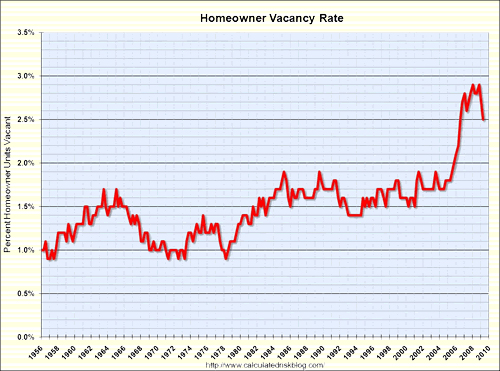
This is the lowest vacancy rate since mid-2006, but still very high. A normal
rate for recent years appears to be about 1.7%.
This leaves the homeowner vacancy rate about 0.8% above normal, and with
approximately 75 million homeowner occupied homes; this gives about 600 thousand
excess vacant homes.
The rental vacancy rate increased to a record 10.6% in Q2 2009.

It's hard to define a "normal" rental vacancy rate based on the historical
series, but we can probably expect the rate to trend back towards 8%. According
to the Census Bureau there are close to 40 million rental units in the U.S.
If the rental vacancy rate declined from 10.6% to 8%, there would be 2.6%
X 40 million units or about 1.04 million units absorbed.
These excess units will keep pressure on rents and house prices for some
time.
Dip In Vacancy Rate Reflects Rise In Rental Rate
It appears as if there is improvement in the homeowner vacancy rate, but the
main reason for the dip in homeowner vacancies is consumers have given up on
trying to sell their homes and instead are attempting to to rent them. Furthermore,
the record 10.6% rental vacancy rate is pressuring rental prices as Calculated
Risk noted above.
Of course there are many finished condo building that were for sale that are
instead for rent as apartment buildings. Many of those anticipated condo sales
will never be sold. Oversupply of condos is especially rampant in places like
Florida, Las Vegas, and San Diego. That adds to various localized pressures.
I spoke with Calculated Risk this morning and asked "How many of those vacancies" are
even livable. Neither of us could find an answer.
Yet the question is an important one as 50
Cities Must "Shrink to Survive".
The government looking at expanding a pioneering scheme in Flint, one of
the poorest US cities, which involves razing entire districts and returning
the land to nature.
Local politicians believe the city must contract by as much as 40 per cent,
concentrating the dwindling population and local services into a more viable
area.
The radical experiment is the brainchild of Dan Kildee, treasurer of Genesee
County, which includes Flint.
Having outlined his strategy to Barack Obama during the election campaign,
Mr Kildee has now been approached by the US government and a group of charities
who want him to apply what he has learnt to the rest of the country.
Mr Kildee said he will concentrate on 50 cities, identified in a recent
study by the Brookings Institution, an influential Washington think-tank,
as potentially needing to shrink substantially to cope with their declining
fortunes.
Banks Walk Away On Foreclosures
For further proof many homes are worth nothing (or a liability) please consider Banks
Walk Away On Foreclosures.
City officials and housing advocates in cities as varied as Buffalo, Kansas
City, Mo., and Jacksonville, Fla., say they are seeing an unsettling development:
Banks are quietly declining to take possession of properties at the end of
the foreclosure process, most often because the cost of the ordeal - from
legal fees to maintenance - exceeds the diminishing value of the real estate.
Astonishing Home Prices In Detroit
Also note that Median
Home Prices In Detroit Fall To $6,000 as Detroit heads towards bankruptcy.
Totaling Unlivable, Worthless Home
How many homes for sale in Detroit are unlivable with liabilities that exceed
the asking price or are simply unlivable at all? What about Flint, LA, Memphis,
Toledo, and even places like Danville, Illinois?
There is simply no way to know what that total is.
Looking ahead, how many more foreclosures will we see as the unemployment
rate heads towards 11% in 2010?
These are the kind of factors that are not readily apparent when one looks
at the headlines such as "Home Vacancies Hit 18.7 Million on Bank Seizures" and
then sees a dip in vacancies.
The real story is things are much worse than they look in many ways, even
if one could figure out how to subtract vacant "unlivable worthless" homes
from the totals. globaleconomicanalysis.blogspot.com |