|
|
The Nascent Depression: Be Ready to Barter and Adopt the Rhodesian View
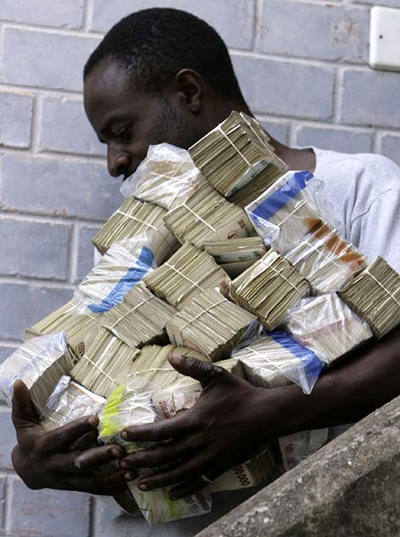
Try to start looking at prices in terms relative value. In a world of hyperinflation where everyone is a millionaire, absolute prices area almost meaningless, but watching relative prices and values is crucial. For example, a loaf of bread and a gallon of gas have sold for roughly the same amount, since the late 1970s. This outlook on prices is what I call The Rhodesian View. To explain: Those who have lived in Zimbabwe (formerly Rhodesia) since before the change of government eventually learned to adjust their conceptions of "price" and "value". This new outlook was necessitated by the destruction of the national currency by Comrade Mugabe. His hopelessly inept and horribly corrupt government embarked on a systematic looting of the country, which included mass inflation that later became hyperinflation. At one recent point, the Zimbabwean dollar was inflating so rapidly that it lost half of its value each few hours. (An annual inflation rate of more than 200 million percent.) Similarly, nine years of hyperinflation and multiple currency recalls in Argentina had the net effect that to buy what had cost 1 Peso in 1983 would have cost the equivalent of 100,000,000,000 Pesos in 1992. After having been accustomed to a very gradually eroding dollar for so long, it will be difficult for may people to adopt the Rhodesian View. Once inflation sets in, nearly all assets denominated in dollars will suffer horribly. This will be particularly true for dollar deposit accounts, and pensions. Those folks that don't adapt quickly will get blind-sided by inflation. Some investments like stocks will be re-valued and still retain some value because of the intrinsic value of the underlying assets (such as company's inventory, equipment, land, and facilities). Thus, they might be able to "keep up with inflation", at least in the early stages of an inflationary spiral. But most other dollar-denominated investments will be wiped out in a mass inflation. I've said this often in SurvivalBlog: The time has come to begin sheltering part of your net worth in practical tangibles. These include firearms, common caliber ammunition, precious metals, full-capacity firearms magazines, high quality tools, and productive farm or ranch land that can double as a survival retreat. Once inflation kicks in, prices set in dollars will become almost meaningless, and saving "money" will become a pitiful joke, as the dollar's value melts in the fiery furnace of inflation. Start thinking in terms of relative value, potential usefulness/productivity, ounces, and gallons, instead of dollar digits. Get used to bartering. It is a valuable skill that will become crucial in the next decade. Practice barbering now, rather than after a crisis begin. (Learn from your mistakes now, while the consequences are small and not life threatening, rather than later, when the consequences could be much greater.) Develop savvy about precious metals. Buy the references and tools you'll need be able to spot fakes. Practice calculating relative values. You must get handy with a pocket calculator and some standard references. (I have several listed later in this post.) For example, you should be able to calculate the values of a one ounce silver "trade dollar" round versus pre-1965 silver quarters versus a box of of .45 ACP 230-grain ball ammunition. And, with just the knowledge of the day's closing New York spot prices for silver and gold, you should be able to quantify the number of 90% silver dimes that would equal the value of 10 gallons of gasoline or the gold contained in a 1/2-ounce Gold Canadian Maple Leaf or a 2-Franc French "Rooster" or a Swiss Vrenelli. Does this sound daunting to you? If so, then you need to study and practice! As you build up your stockpile of barter goods, you must simultaneously build your knowledge base about barter goods--especially ammunition, guns, fuel, canned foods, and precious metals--since those will all be sought-after, in a monetary crisis. Assemble a reference library that can serve you both for establishing the authenticity of goods, and for establishing their relative values. Be sure to print out some useful data and weight conversion formulas, and keep those pages in a reference binder. In my estimation, if you don't already have your own copies of the following books at home, then you are behind the power curve:
In closing, remember that it will take time and practice to get accustomed to dealing in a barter economy, and thinking in terms of real value rather than "dollars". In times when dollars are like grains of sand in an hourglass, tangibles will represent a fixed yardstick. Take the time to practice bartering now, when the stakes are low. Start attending gun shows, coin shows, antique shows, and flea markets. And be sure to gather those key reference books now, while they are still readily available. Someday, you may be very glad that you did! |
 |
 |

 I receive several e-mails each day from readers asking whether the currently-unfolding economic depression will be inflationary or deflationary, whether it will last long, and whether or not the US Dollar will be supplanted by a new currency. My answer is simple: "All of the above." Back in early 2008,