
Stage is set for a stock crash A market implosion is rare, but years of risk and denial, helped along by the Fed's recklessness, have made a wipeout far more likely.
Thus I wrote in my daily column on my Web site that day: "It seems to me that there's almost no chance of escaping a stock crash at this point." From denial to deluge Then the sell-off spiraled viciously Thursday. It was led by technology, after Cisco Systems' (CSCO) admission that problems faced by the financial institutions that constitute its largest customers were impacting the company's business. Speculation expired as it finally dawned on tech-stock bulls that if the economy is weak, businesses will be hurt and stocks won't go higher. Thursday's sell-off was even more significant than Wednesday's because it was an indication of (a) dots being connected and (b) the speculative fever being broken. It was the last piece of the puzzle that I was looking for in signaling that a dislocation or a crash may be coming. I know I've talked about this fairly often and that it hasn't happened. Such events have an extremely low probability of occurring. But the stage has been set by the reckless policies pursued by the Greenspan Fed in the past decade and a half. These have enabled the risks to pile up while rewarding folks for ignoring them. The Fed's efforts to stave off small forest fires have guaranteed a gigantic one. The problems in our financial system and our currency have overtaken the "success" of speculation. Denial had enabled folks, over the past 10 months, to ignore the ramifications of the subprime-mortgage debacle. At every step they had pronounced the mortgage problems contained and insisted we were at the bottom. But that bubble burst last week, taking the containment thesis with it. A recipe to rue That said, we have a very long way to go in terms of Wall Street finding and acknowledging the real damage from all of this mortgage-related collateral and its offspring.Also, the insurers of this mortgage paper and other forms of credit insurance don't have nearly enough capital, relative to the policies they've written, so we can expect the credit-rating agencies to issue even more downgrades all across Bondland. That's a recipe for lots of losses inside the financial system. We are at a moment in time when a crash is far more likely to happen than at any time in years. Does this mean it will happen? No. But it'd be wrong for folks to think a crash isn't possible. I am not rooting for this, but it feels like a crash could be right around the corner. What I am rooting for is the return of sanity, which is something that only a large wipeout might bring about. At some point we have to stop the cycle of bailing out risk takers, and that is where we are now. Eventually "too big to fail" becomes "too big to bail out." That's where I think we are. In search of a biotech playbook Turning to losses in the biotech sector, Nastech Pharmaceutical (NSTK) has reported disappointing news since I wrote about the company Oct. 8. The company announced Wednesday that Procter & Gamble (PG) was ending its partnership to develop PTH, an osteoporosis treatment, and Nastech's stock was slaughtered after this negative development. I was quite surprised to learn about Procter's decision. I believe Nastech was, too, because Nastech CEO Steven Quay had recently noted his company was in talks with P&G to decide how to proceed with PTH. Readers who own Nastech will doubtless want more information about what to do, and here are my thoughts: First, I would not buy the stock right now, because there's too much up in the air. This important development has ramifications for how the company proceeds and may affect what it does with its RNAi spinoff, etc. There are too many moving parts to make a final decision on the stock. But if somebody has an inordinately large position, perhaps they should get smaller. Hopefully, in the next week or two, the best course of action will become clearer. Then I will evaluate what news is forthcoming and decide what to do -- whether that be to buy more shares, to sell them or to just sit tight. At the time of publication, Bill Fleckenstein owned shares of Nastech Pharmaceutical. |
 |
 |
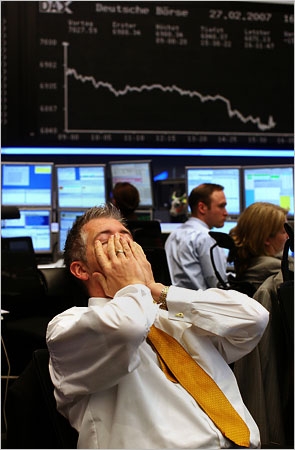 As I looked at my screens during Wednesday's rout in stocks, it occurred to me that our financial system was in the process of imploding. With credit contracting, many businesses in that arena are in the process of being destroyed - and, without a financial system, there is no capitalism.