|
|
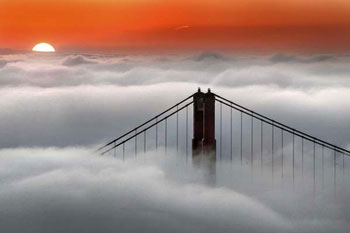
The Fog of Financial War
What we're thinking about is that we have entered a much more dangerous and troublesome period in world financial history. The planet was leveraged up. Now it is going to be de-leveraged. We have been talking about the battle between the forces of inflation and the forces of deflation. It is not clear which way it will go...or when. The feds - who favor inflation - seem to have the upper hand one week. The next week, Mr. Market - who seems to have thrown his lot in with the force of deflation - seems ahead on points. Meanwhile, many of the foot soldiers are lost, separated from their units...shooting at their own men...and often blowing themselves up. Many don't know which side they are on and are willing to switch sides at any minute. But in the fog of war you always get a lot of people bumping into one another. That's why we get such peculiar reports from the front - such as when the feds cut short rates (which is inflationary)...but long rates nevertheless go up (which is deflationary). Or when the unemployment numbers go up (which is deflationary)...causing the dollar to fall (because investors expect another inflationary rate cut!) No, we don't know exactly which way it will go (so don't ask us when gold will hit $2,000...or when the Dow will break below 10,000). But it scarcely matters. Because, we're like the innocent civilians caught in the crossfire. Sooner or later, our assets are going to be shot down...and our liabilities are going to blow up. In other words, dear reader, this is not a war in which you should try to speculate on which side will win...this is a time to keep your head down. It's a Liquidation War...in which mistakes will be corrected BOTH by inflation and deflation. Take stock prices, for example. Our guess is that they'll be taken down - either by inflation or deflation, or both. Prices will fall either in nominal terms, in other words, or relative terms. Already, adjust the Dow to the price of gold, or wheat, or oil, or copper and you get a very different picture. Instead of being flat over the last 10 years...the Dow is down a half to two-thirds. "It's the Greater Depression," said Doug Casey at dinner Monday night, with a satisfied look on his face. "I've been expecting it for a long time. I was a little early. But now, it seems to be finally getting going." What happens in a Greater Depression? We don't know, but we think we're going to find out. And we imagine its most important feature will be a general markdown of debt and the relative value of Western assets - stocks, houses, currencies, and labor. The East and developing world is on the rise; even if it stays put, the West, in relative terms, will sink. Some assets will go into default - which is what is happening in the financial industry lately. UBS (NYSE:UBS) alone has lost 38 billion. Hedge funds are going broke. And the captains - present and past - of the financial industry are pointing fingers at each other. Many people say we've seen the bottom for equities, and the financial sector in particular. Maybe in nominal terms. And maybe in the East and the developing world. But in America, in real, inflation-adjusted terms, we'd expect more of a selloff. The S&P is still selling for more than 18 times earnings; there is still plenty of room on the downside. The financial sector looks particularly bad; there's probably a lot more bad news coming. And since it was the big winner for the 25 years, it probably needs a bear market of at least 5 or 10 years. At the beginning of the boom in finance, which began roughly during the first Reagan Administration, people still wanted their children to grow up to be doctors, lawyers and businessmen. At the end of it, every mother's son was encouraged to into 'finance.' But now, the bubble in finance is over. It will probably take many years before values appear and prices begin to rise - just look at what has happened in the NASDAQ. Or look at our favorite example - Japan. Many people thought Japanese stocks were a once-in-a-lifetime bargain after the Nikkei Dow crashed in 1990. Well, they're an even bigger bargain today! Señor Bonner...I have to tell you. I won't be able to work here any more." Francisco, who has been our ranch foreman, quit. He explained why:
We took a look at farm prices. Even with the huge recent increases most farm prices are still much lower - in real terms - than they were 100 years ago. What made them go down? Technology...cheap, abundant water and fuel...and huge new areas of the world became accessible to mechanized agriculture. We're just wondering if those advantages have been pumped out. As to technology...breakthroughs don't always come when you want them. Except for parts of Africa, there are few areas that haven't already been introduced to the plow. Australia...Brazil...Russia...North America...Argentina - millions of square miles were brought into service during the last two centuries. Much of this land is less fertile today than it was 100 years ago - requiring higher inputs of fertilizer. Some of it has been taken for cities and highways. Some has been made unusable by overwork or contamination. If we haven't achieved it yet, we assume we are getting close to maximum usage of the world's arable surface area. As to new technology, we doubt that mechanization has much more to offer. And genetically-modified plants may lead to much higher yields, but who knows at what price? But it may be the constraints imposed by water and fuel that really hobble agricultural output in the future. Colleague Byron King has some thoughts on this subject:
Running out of time? Aha! Here is the sense of urgency. Every day is a lost day. One day closer to...well...to what? We can't see any farther ahead than Byron or anyone else. But when we read in the paper about food riots breaking out in various countries, we think we are getting a peek. Until tomorrow, Bill Bonner
|
 |
 |

 We are way out in the high desert with no access to the news. This gives us a chance to think.
 Bill Bonner is the
founder and president of
Bill Bonner is the
founder and president of