|
Chinese cars and bubbles What happens when the Chinese economy collides with reality?
Globalisation means different things to different people. For optimists, it means a friendly worldwide sharing of goods, services, ideas and cultures. To America, it means the globalisation of American culture. To the multinational corporations, it means a chance to make a quick buck in new markets. To the multinationals that have roamed the planet for the last two decades, a free market is one where they are free to buy up local key enterprises at bargain basement prices, operate without obeying environmental, business or labour laws and then suck all the profits back to their own country. The amazing thing about this process is that the multinationals present themselves as the kind and generous friends of the developing world. Small countries often don't have much say in the matter; the World Bank is essentially the public relations wing for the same multinationals; when a country goes to the World Bank for help, the prescription is always the same: "let the multinationals buy up your key assets and operate within your country without restriction, and you can have the crumbs that fall from their table." Oddly enough, countries like China and Russia don't quite share the same enthusiastic view of foreign investments; they see the Western companies as greedy invaders, keen to bleed China and Russia dry. It's not that China or Russia have any better morals than America or Europe; it's just that they are big enough not to have to take crap from multinational corporations. Thus, when the Western car companies wanted to expand into China, the Chinese weren't silly enough to simply allow them to simply set up shop. As far as China was concerned, if the Chinese workers, resources and environment were going to be used and abused, then they were going to be used and abused by Chinese businesses, not Western ones. There are three concepts that are almost totally missing from the Chinese language: Intellectual Property, Human Rights & Value for Money. If the Western carmakers had contemplated these three omissions, they might have saved themselves a lot of grief. The Buddha said that desire clouds the mind, and the desire for expansion into rich new markets seems to be particularly mind-numbing. Over the last few years, Western & Japanese carmakers have poured billions into the Chinese car industry. This investment is partly to manufacture cars and parts for the greater Asian market, but mostly to tap into the fastest growing car market in the world. The modern China that Westerners see on television consists of bustling, prosperous cities and Chinese millionaires in Rolls-Royces. These tv programmes somehow miss that fact that the Chinese economic boom exists only in the cities, and even then only for the minority that have benefited from it. The Chinese boom has largely passed over the majority of the Chinese population who live in rural areas. Even in the cities most Chinese still live in poverty and most private cars in China are sold as semi-luxury items - proof of economic success in a country where the average wage is around US$1500 per year. There are 1.3 billion people in China but only 38 million cars. Thus the potential Chinese car market is huge. However, China is one of the most densely populated countries on the planet, and no one seems to have worked out exactly how these millions of extra cars are going to fit down the already-overcrowded Chinese roads, let alone park. Strange bedfellows When the Western carmakers wanted to set up shop, the Chinese government insisted that these foreign carmakers went into 'partnerships' with local manufacturers. Most of these partnerships were with China's 'big three' car companies, which between them make over 50% of China's cars:
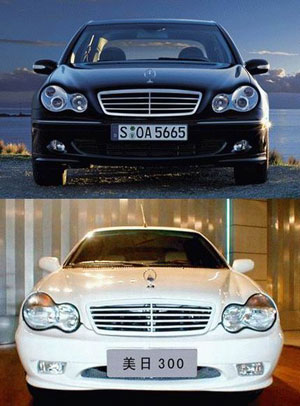
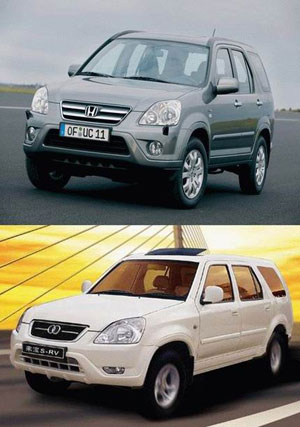
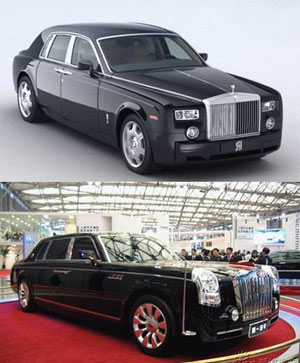
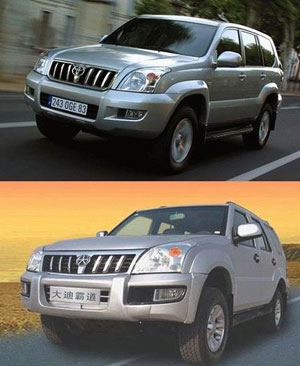
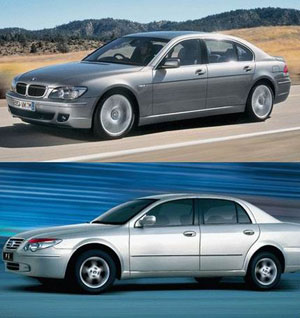
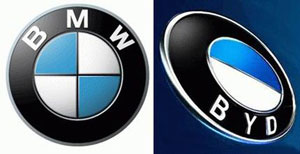
However, there are lots of minnows as well: there are a total of 120 significant carmakers in China. There have also been a number of other Chinese industrial companies that have started building cars independently of the Western carmakers: Changfeng, Geely, Chery & Hafei Motor. It didn't take long for China's true intentions to become clear: ChryslerDaimler, for example, set up a Jeep manufacturing plant in China, only to discover a short time later that the locals had set up a copycat plant around the corner making - you guessed it - exact copies of the original at a substantially reduced price. The plant was closed after ChryslerDaimler protested, but you can be sure that another one quietly eased into production somewhere nearby. And that incident was just the tip of the iceberg. At a German car show recently, rumour had it that some Chinese car companies would be barred because the models they were offering were blatant copies of Western vehicles. When the show opened, most of the Chinese copy cars were still there. A spokesman for the manufacturer said: "Maybe they want to block the Chinese cars in Europe, but BMW is also trying to sell cars in China, and now the Chinese people are beginning to think, what can we do in China also? I think it is not good for BMW and it's not good for the competitive market." At this point, many Western carmakers probably got their first real understanding of how little intention the Chinese have of playing 'fair' by Western standards. As long as Western carmakers are operating within China, the Chinese will set their own rules. The message from China that came through that incident was: "Don't try and stop us selling our copies of your cars in the West, or we'll stop you selling your legal ones in China." The threat wasn't quite that blatant, but the underlying warning was pretty clear. The Western carmakers have already tried appealing to China's hopelessly corrupt legal system, and lost. No matter how blatant the copy, Chinese courts, by and large, don't enforce copyright lawsuits from Western carmakers. The bottom line is that the Chinese, culturally, don't share the West's concepts on either human rights or intellectual property. The Chinese see no shame in copying a Rolls-Royce; quite the opposite, they see it as an accomplishment. "See! We copied a Rolls-Royce, therefore we have aquired the status of a Rolls-Royce." Not quite, at least yet. The Chinese also don't understand the Western concepts of quality or value for money, but they sure understand the importance of price. This means that all or most of China's Western car partnerships are going to end in tears for the Western partner. China's big three carmakers have already begun producing models in competition with their foreign partners. SAIC is furthest ahead, with their Rover-based models. Right now these cars are something of an automotive joke, but there was a time when cars from Toyota were something of an automotive joke, too. In five years time China will have no need for the Western carmakers at all. Whether the Chinese throw them out gradually or suddenly, the end result will be much the same. The Chinese probably won't have to throw out the Western carmakers at all: the Western carmakers will simply withdraw voluntarily because they can no longer compete with their Chinese rivals who are selling copies of Western models for two thirds of the price. The Chinese bear market There's always a time in an economic boom when it seems natural and inevitable that it will go on forever. People with easy money in their pockets assume the boom will be permanent, because they'd like it to be so. Historically, it's always around this time, when the booming market seems to be an unstoppable force, that it suddenly corrects, taking the dreams of its investors with it. By the time the American stockmarket crashed in 1987, it was long overdue. Cautious economists had been predicting the crash for years but had been attacked for being negative. Yet the government of the time could have seen the crash coming and taken steps to prevent it; instead the politicians chose to simply ignore the basic rule of economics, which is: 'what goes up, must come down.' Thus they allowed themselves to be driven by the frenzy that inevitably led to the crash. And with the crash of America's stockmarket, many of the world's stockmarkets crashed too, with the aftershocks felt for a decade. It's difficult to look at China's meteoric growth over the last decade without drawing parallels to 1987. The same basic scenario is in place: a previously regulated stockmarket is suddenly free from constraints. Investors pour money into the economy; entrepreneurs launch bold new ventures; employment booms; wages rise. The resultant economic bubble is taken as proof that the economy works best without government interference. Then the bubble bursts, along with the dreams of the people who invested in it, while the economists who hailed the latest economic bubble a few months earlier, now duck for cover, unwilling or unable to take responsibility for the chaos they helped cause. Even more troubling is the Chinese stockmarket. Since January of 2006 it has grown by many hundreds of percent. Chinese brokers are reportedly opening 350,000 new accounts per day, as factory workers and schoolteachers make easy money from the bubble. Right now the Chinese stockmarket can do no wrong, but it's still basically a house of cards, certain to come tumbling down soon. Here's how American economics writer Steven Goldberg described it: "Chinese stocks aren't much like U.S. stocks. The [Chinese] government owns big stakes in almost all the companies. The kind of reporting and accounting transparency we're accustomed to in the U.S. and other developed nations is absent in mainland China. If you own [some] of these [shares], I suggest you sell now." Like much of the Chinese economy, the Chinese stockmarket is in bubble mode, and the one inescapable economic reality is that every bubble must eventually burst. We talked to an accountant who has extensive dealings with China. These were his words of caution:
China's business base is a lot shakier than Westerners believe, he adds. "In my estimation anywhere up to 40% of new Chinese businesses are bubble companies - that is, they can exist only in boomtimes and will probably not survive a downturn."
However, that won't be the end of it, he says: "Next to go will be the manufacturers whose business model is based on ever-growing turnover. These companies have massive American contracts to supply things like cheap televisions, and their profit margin on each set is probably two or three percent. These businesses are currently thriving because they sell more sets each month, but if there's the slightest hiccup they'll collapse overnight." Any setback in the Chinese economy will hurt the whole world. In February of 2007 a 9% slide on the Shanghai Composite Index prompted a massive drop in stockmarkets around the globe. What damage would a 30% drop do to the world's economy, and its demand for oil? What if the Chinese stockmarket drops 400%? Any severe economic downturn in China is likely to see its domestic car market decimated as consumers stop buying luxuries, and existing car buyers default on hire purchase loans. The West is so used to being in control of much of the world's commerce that Western governments fail to grasp the true significance of the Chinese economic explosion. Or the significance of a Chinese downturn. Hundreds of millions of Chinese still live in horrific poverty. Although wages have risen, so have costs; many Chinese are no better off than they were twenty years ago, and for many life has become worse. If the promised benefits of economic liberalisation are lost in a Chinese economic crash, then massive upheaval and possibly total revolution in China seems a highly likely prospect. The Chinese may crave economic growth, but they are a nation of hardworking survivors and pragmatists. If times go bad they will simply revert to more conventional forms of commerce, transport and farming. It's difficult to see large numbers of Americans swapping their cars for bicycles anytime soon, yet many Chinese still own the bicycles they grew up with. It would not take much of an economic shock to switch Chinese car owners back to two wheels. Then China will slowly and painfully continue on its path to the top. China's second economic boom is likely to be far slower and more sustainable, with less of an emphasis on vodka bars and Mercedes Benzes. If China can avoid disintegrating internally after an economic crash, it will eventually recover, but the Chinese people, once burned, will be twice shy. This article was reprinted from the 2008 Dog & Lemon Guide; dogandlemon.com April 23, 2008 |
 |
 |