Send this article to a friend:
July
21
2014

|
Send this article to a friend: July |
|
Must-know: 3 reasons silver isn't the same as gold
In recent weeks, many investors reluctant to add to their gold positions are asking me if they would be better off getting their exposure to precious metals through silver instead. While I don't have strong views on the direction of silver prices, I think it's important to distinguish between gold (IAU) and silver (SLV) rather than assume that the two metals are interchangeable.
The previous graph shows the five year gold and silver ratio. The ratio is often used by investors to determine if either of the metals is undervalued compared to the other. The gold and silver ratio measures how many ounces of silver you can buy with one ounce of gold. The ratio was as low as 32-to-one versus gold in 2011. It has been steadily climbing since. It currently stands at 63-to-one levels. Despite it's relative abundance, gold (IAU) is more expensive than silver (SLV). Gold is most widely used in jewelry and is considered to have more storage of value than silver. As a result, it's in high demand by both central banks and individual investors. It's important that investors in precious metal exchange-traded funds (or ETFs), such as the iShares Silver Trust ETF (SLV) and the iShares Gold Trust ETF (IAU), understand that these two metals aren't interchangeable. To be sure, it's not unreasonable that gold and silver (along with platinum) are often lumped together in the precious metal basket. Silver, like gold, is viewed as a store of value and indeed has acted as a form of monetary base in the past. (History buffs will recall the late 19th advocacy of "free silver", a debate memorialized by William Jennings Bryan in his famous Cross of Gold speech at the 1896 Democratic National Convention). But while silver shares many characteristics with gold, there are a few important differences between these two metals. The movements in gold can be accessed by the SPDR Gold Shares Trust (GLD) which carries an expense ratio of 0.40%, the iShares COMEX Gold Trust (IAU) which carries an expense ratio of 0.40%, and the ETFS Physical Swiss Gold Shares (SGOL) which carries an expense ratio of 0.39%. On the other hand, silver can be accessed by the ETFS Physical Silver Shares (SIVR), which holds silver bullion and the iShares Silver Trust (SLV) which gives exposure to physical silver bullion. Read on to find out the differences that distinguish the two often interchangeably used metals. Here, we discuss about the main differences in gold (IAU) and silver (SLV) in monetary variables as well as investor preferences.
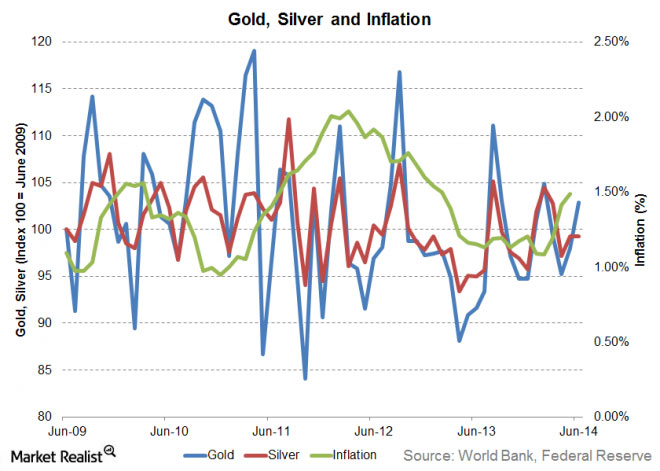
The following graph shows the relationship between gold and inflation, and silver and inflation over the years. The relationship between gold and inflation is much stronger than silver and inflation.
The silver market is an extremely small one. According to the Silver Institute, in 2012 the total silver mined worldwide was 787 million ounces. Taking a price of $20 per ounce, that's only ~$16 billion. On the other hand, according to the U.S. Geological Survey, the amount of gold mined annually is about 2,500 tons with a market value of well over $120 billion.
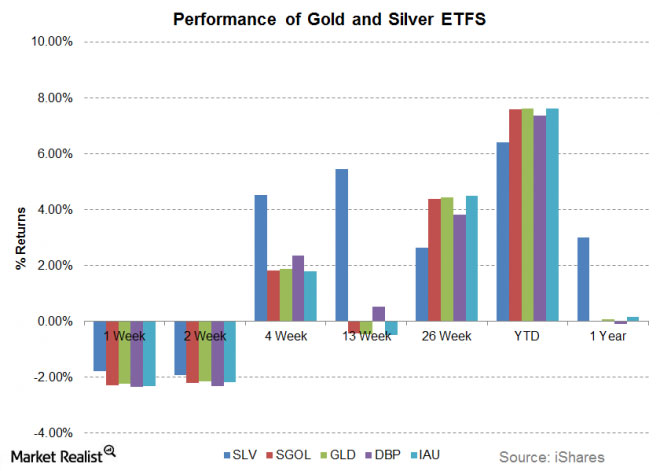
Read on to know where understanding these differences leaves investors. Overview: An investor's outlook—gold or silver Whether investors should consider exposure to silver or gold, or both, partly depends on why they are allocating to precious metals in the first place. Those investors that view their position in precious metals, primarily as an inflation hedge may want to consider gold, which, at least historically, has done a better job of hedging portfolios against rising prices. However, investors that are looking to play a cyclical rebound in the global economy may want to consider silver because silver prices are likely to benefit more from an uptick in manufacturing. For investors who want to grab exposure to both silver and gold, you could consider the PowerShares Precious Metals ETF (DBP), which holds future contracts in both silver and gold. Investors could also consider moving to exchange-traded funds (or ETFs) including the Physical Swiss Gold Shares (SGOL) because it owns the gold, unlike the iShares Silver Trust (SLV) and the SPDR Gold Shares Trust (or GLD) which lease the gold. The Central Fund of Canada (CEF), which holds both gold and silver in the Canadian mint, is another avenue for investors to access gold and silver markets. For investors wishing to enter the physical gold and silver markets, physical funds such as the silver Sprott fund (PSLV) and the gold Sprott fund (PHYS) are good options. The following graph is a performance comparison of the Physical Swiss Gold Shares (SGOL), the iShares Silver Trust (SLV), the iShares Gold Trust (IAU), and the SPDR Gold Shares Trust (or GLD).
To understand the place for gold in a long term investor's portfolio, read our series Retirement pick: Gold and the long-term investor.
|
|---|
Send this article to a friend:
 |
 |
 |