Send this article to a friend:
June
16
2014

|
Send this article to a friend: June |
|
The Next Great American Industry
And we'll end today's episode by learning how one tech entrepreneur just unleashed an orgy of innovation that'd headed for the energy, car and computer industries… Reminding us what makes societies great, economies boom and that modern-day heroes are alive and well and fighting for "team earth." Why has America flourished for so long? We're convinced it was the culture that made all the difference. America was founded in the spirit of enlightenment scholarship, with roots that stem back to the Epicureans of Ancient Greece… from a time when Democritus conceived of atoms, long before microscopes had been invented.
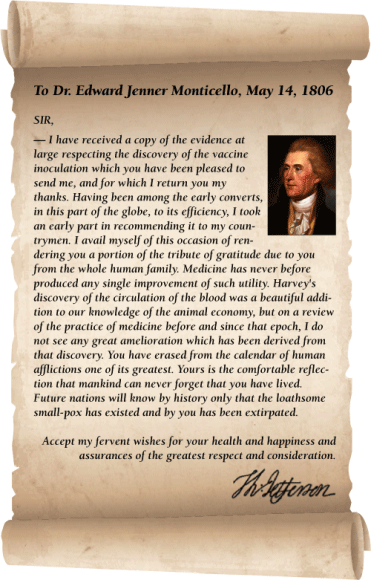
The Constitution of the U.S., and its other founding documents, reflected the same love of free inquiry, free expression, scientific experiment and the right to pursue and test these things. It was an act of defiance against classic conflicts such as disease, ignorance and stupidity, unnecessary suffering, and tyranny… all in favor of uplifting the human condition. The Founding Fathers believed it was the right of any individual to pursue these trials… to constantly be on the verge of a great harvest of knowledge and wisdom, that doing these things for their own sake was emancipating in itself. And without question, empowering. It's no coincidence that these were men and women who were interested in biology, medicine, law and engineering — to name a few. Thomas Jefferson, for example (it's said that to write about America is to write about Jefferson in some form or another), was skilled in all those fields and more (the criteria for president, it seems, have degraded over the generations). Even, and especially, when the country was in extraordinary transition were these subjects explored. Is there anyone reading these words that doubts we are in such a transition today? Without hesitation, for instance, Jefferson eagerly organized a system for a valid method to produce, transport, cool and keep cool the smallpox vaccine so that it would not lose its efficacy. This vaccine, it's worth mentioning, he would extend to all the slaves at his Virginia home, Monticello. With Jefferson's support, Dr. Edward Jenner, "the father of immunology" — who took to heart his mentor John Hunter's Enlightenment command: "Don't think; try," — was able to, according to some, "save more lives than the work of any other man" with his pioneering work. The knowledge of the smallpox vaccine would expand to and through Europe and beyond. Nearly 200 years later, in 1979, through the collaboration of like-minded individuals who carried the torch for human progress, smallpox was declared an eradicated disease by the World Health Organization.
Imagine the innovations now in the works that will, like Jenning's smallpox vaccine which Jefferson supported, one day eradicate other diseases… and countless other limitations on the human condition. It's not as hard to imagine the resistance that these advances bump up against… the knee-jerk fear we all have to some extent of the unknown. Back in Jefferson's day, there was, of course, controversy surrounding the smallpox innovation. Some accused Dr. Jenner of interfering with God's will. But it seems clear that the Founders believed people must take responsibility for themselves if they were to protect and maintain their God-given rights. They must increase man's power over nature, and as some might say, decrease man's power over man. The more educated a nation's citizens, the less control a population would need (we'll be revisiting this theme next week when we discuss the future of education). Yes, while human nature is a slow-moving evolution, the American Experiment overcame these limitations through its culture of liberated ideas. To borrow a colorful metaphor from Matt Ridley's The Rational Optimist, prevailing progress throughout U.S. history can be traced back to how "ideas have sex." "Exchange is to cultural evolution as sex is to biological evolution," he says. Rather than genes, it is ideas that are exchanged between human minds that breed innovation and economic growth.
This philosophy of tearing down barriers in order to allow ideas to breed… is what makes societies great and economies boom. That's also the credo that was also embodied in a computer revolution happening around the same time that Steve Jobs and Bill Gates were making a name for themselves. It has grown over time. Maybe you've heard of it? If not, don't worry. It's called the open source movement… Back when computers were first being built in the 1970s, the technology was so new that people would pass their software around to one another at places like the Homebrew Computer Club. It wasn't until the late 1970s or early 1980s that people started "closing" their software and forbidding others to look, change or even fix it. Bill Gates was one of the biggest proponents of proprietary software. In a famous open letter to hobbyists, he asked anyone using Window's software to pay up. But a loose confederation of hackers challenged Windows by collaborating on what's called "open source" software. This label extends to many different technologies… but most famously, it was adopted by Linux (which far exceeded investors' expectations when its stock went public). To make it easier to understand how open source is different than proprietary software, people use the play on words "copyleft" to describe it:
Basically, the idea of "copyleft" was that not having intellectual property rights over software would actually encourage people to collaborate and change the technology based on how they want to use it. In a free market context, it could be considered a form of "hypercapitalism". And with each time it passed through peoples' hands, it was modified, improved and passed on again. So why on earth have I told you this story? Because our favorite tech entrepreneur just announced yesterday that he's going "open source." The implications for the future cannot be overemphasized. The markets are in for a tsunami of innovation that will disrupt the energy, automotive and computer industries.
That's right. Musk just enlisted a militia of innovators to take and improve upon his electric vehicle designs. But there is a savvy business tactic in here as well. Tesla Motors has established infrastructure to benefit from new demand from electric vehicle users. The company is getting into the big battery business, and it already has electric charging stations throughout the country. As Musk said recently while being interviewed about his $5 billion battery factory, "There will have to be hundreds of [similar] Gigafactories." Tesla is at the top of the food chain, and it's giving away free seeds to grow an ecosystem that it can ultimately feast upon. Below, we've copied Elon Musk's announcement that his electric vehicle patents are going open source. Read on… It'll make you proud to be a Tesla owner and/or shareholder… or simply a more optimistic, temporary resident of a threatened planet:
Regards, Josh Grasmick
|
|---|
Send this article to a friend:
 |
 |
 |
 I’d like to begin this essay by honoring those free-thinkers who have made all our lives better, despite most of us not really knowing them or how they did it.