|
A Warning Sign For The World
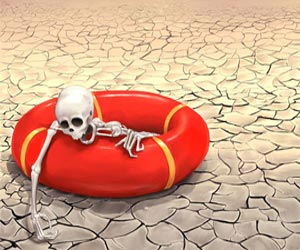
Any financial system that is based on debt is doomed to fail. Today, we are living in the greatest debt bubble that the world has ever seen, and if all of a sudden people could not use credit to buy things our economy would immediately ground to a halt. Unfortunately, no debt bubble can last forever. When this current debt bubble finally bursts, faith in the financial system is going to disappear, credit is going to freeze up and there is going to be a massive wave of bank failures. Right now, Greece is a warning sign for the world. Nobody wants to lend money to Greece, the Greek banking system is dying, one out of every four businesses has already shut down, unemployment is soaring and the Greek economy has now been in recession for five years in a row. Sadly, the economic implosion in Greece is rapidly accelerating. The Greek economy shrunk at a 7 percent annual rate during the 4th quarter of 2011. That wasn't supposed to happen. Things were supposed to be getting better in Greece by now. But instead the Greek depression is getting even worse, and very soon the rest of the world is going to be going through what Greece is currently experiencing. Unfortunately, most in the mainstream media are treating what is happening in Greece as an "isolated incident" rather than as a very serious warning sign for the world. Thankfully, there are at least a few reporters out there that are realizing the gravity of the situation. The following is how one reporter from the New York Times recently described what life is like in Greece now....
Can you imagine? Greece is experiencing a full-blown economic collapse and nobody can see a light at the end of the tunnel at this point. As I have written about previously, the overall rate of unemployment in Greece has now risen above 20 percent and the youth unemployment rate in Greece has soared to an astounding 48 percent. Deleveraging can be an extremely painful process. Greece has been forced to try to reduce the size of its budget deficit, but every time it cuts government spending that causes economic activity (and thus government revenues) to slow down as well. Now the EU and the IMF are demanding that even more very painful austerity measures be implemented in Greece even though Greece is already experiencing a full-blown depression.
Of course all of those cuts are going to make the short-term economic conditions in Greece even worse. The rioting, looting and burning of buildings that we are witnessing right now in Greece is likely to continue for quite some time as exasperated citizens attempt to express their frustrations to politicians that simply do not seem to care. According to the National Confederation of Greek Commerce, recent rioting resulted in damage to 153 businesses in Athens. 45 of those businesses were totally destroyed. You can view some stunning footage of the current rioting in Greece right here. Despite all of the austerity measures that have already been implemented, the truth is that Greece is very likely to default soon anyway. There is a very good chance that the new austerity agreement that the Greek parliament just approved will never be implemented. There are new elections scheduled for April and the current party in power is polling in the single digits. The new Greek government is likely to look much different from the current one, and nobody knows for sure if the new government will follow through on any of the promises being made by the current government. In addition, the German parliament must approve this new deal with Greece, and the German parliament is not scheduled to vote on it until February 27th. Considering the mood in Germany right now, approval is not guaranteed. So there are all kinds of things that could go wrong with the "deals" that are currently being discussed. The truth is that a Greek default in the coming months seems to become more likely by the day. Some in the financial world almost seem eager for a Greek default. The following is what Jon Moulton, the chairman of Better Capital, recently told CNBC....
But a disorderly Greek default would not be a pleasant thing for the global economy at all. A recent article in the Guardian detailed what some of the consequences of a Greek default and exit from the eurozone might be....
And the financial crisis in Europe is going to continue to spread well beyond Greece. Moody's Investors Service just downgraded the credit ratings of six European nations. The following is how Bloomberg described the downgrades....
Countries such as Italy, Spain, Portugal, Ireland and Hungary are heading down the exact same road that Greece has gone. Greece was the first one to experience a full-blown depression, but soon Greece will have a lot of company. Greece is most definitely a warning sign for the world. If you keep recklessly piling up debt, eventually a day of reckoning comes. It is inevitable. But Barack Obama does not seem to understand this. He continues to pile another 150 million dollars on to our national debt every single hour. He knows that cutting spending significantly right now would hurt the economy and that would significantly hurt his chances for another term. Needless to say, Barack Obama is not likely to do anything that is going to significantly hurt his chances for another four years in the White House. So we continue to roll on toward disaster. The U.S. financial system is like a car with no brakes that is heading straight toward a 5,000 foot drop at 100 miles an hour. It is all going to seem like fun and games to some people until we hit the canyon floor. Once that happens, nobody will be laughing. |
 |
 |