China Conducts War Drills Around Taiwan, Simulating A Blockade Of Key Ports
Tyler Durden
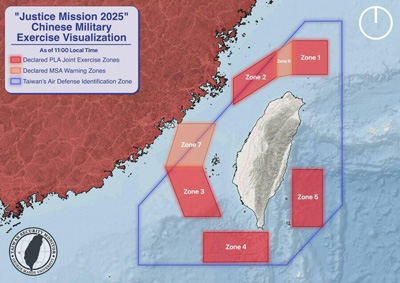 China launched large-scale military drills around Taiwan on Monday, showcasing Beijing's ability to simulate a full blockade of the self-ruled island's key ports. The live-fire exercises come just one week after the U.S. announced an $11.1 billion arms sale to Taipei. China launched large-scale military drills around Taiwan on Monday, showcasing Beijing's ability to simulate a full blockade of the self-ruled island's key ports. The live-fire exercises come just one week after the U.S. announced an $11.1 billion arms sale to Taipei.
According to Taiwan's Defense Ministry, at around 15:00 local time, 89 Chinese military aircraft appeared on radar near Taiwan. Officials said 14 People's Liberation Army warships and 14 Chinese coast guard vessels were also sailing nearby.
PLA activity is occurring in and around the Taiwan Strait, one of the world's busiest shipping routes. So far, the exercises have not disrupted maritime traffic.
Senior Colonel Shi Yi of the People's Liberation Army's Eastern Theater Command stated that the "Justice Mission-2025" exercises serve as a "stern warning against 'Taiwan independence' separatist forces and external interference."
The multi-day live-fire exercises and simulated strikes are intended to prepare China for a blockade of Taiwan's main ports. The drills come one week after the U.S. announced an $11.1 billion arms sale to Taiwan, the largest-ever U.S. weapons package to the island. The package includes HIMARS rocket systems, howitzers, Javelin anti-tank missiles, Altius loitering munition drones, and other weapon systems.
"They are sending a strong message on external interference," Chieh Chung, a researcher at Taiwan's Institute for National Defense and Security Research, told Reuters. He noted that China had "completely cut off" air and sea routes with Japan across three zones north of Taiwan.
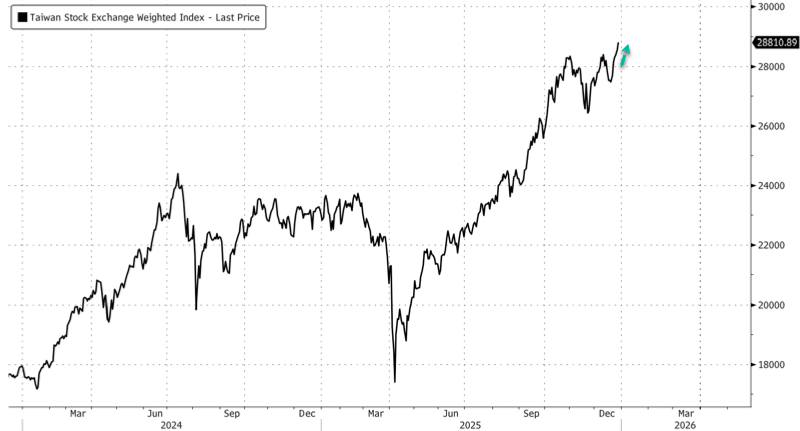
Despite live-fire exercises, the Taiwanese stock market rose to record highs, reflecting a solid AI market theme that remains intact amid traders' disregard for Beijing's invasion-related fears.
Taiwan's president said the drills underscore the need to continue strengthening defense capabilities amid Beijing's continued pressure on what it considers a breakaway province.
 our mission: our mission:
to widen the scope of financial, economic and political information available to the professional investing public.
to skeptically examine and, where necessary, attack the flaccid institution that financial journalism has become.
to liberate oppressed knowledge.
to provide analysis uninhibited by political constraint.
to facilitate information's unending quest for freedom.
our method: pseudonymous speech...
Anonymity is a shield from the tyranny of the majority. it thus exemplifies the purpose behind the bill of rights, and of the first amendment in particular: to protect unpopular individuals from retaliation-- and their ideas from suppression-- at the hand of an intolerant society.
...responsibly used.
The right to remain anonymous may be abused when it shields fraudulent conduct. but political speech by its nature will sometimes have unpalatable consequences, and, in general, our society accords greater weight to the value of free speech than to the dangers of its misuse.
Though often maligned (typically by those frustrated by an inability to engage in ad hominem attacks) anonymous speech has a long and storied history in the united states. used by the likes of mark twain (aka samuel langhorne clemens) to criticize common ignorance, and perhaps most famously by alexander hamilton, james madison and john jay (aka publius) to write the federalist papers, we think ourselves in good company in using one or another nom de plume. particularly in light of an emerging trend against vocalizing public dissent in the united states, we believe in the critical importance of anonymity and its role in dissident speech. like the economist magazine, we also believe that keeping authorship anonymous moves the focus of discussion to the content of speech and away from the speaker- as it should be. we believe not only that you should be comfortable with anonymous speech in such an environment, but that you should be suspicious of any speech that isn't.
www.zerohedge.com
|