Send this article to a friend:
August
21
2014

|
Send this article to a friend: August |
|
Think Like a Pirate 
The "Saddle Ridge Hoard" of 1,400 US gold coins was recently discovered by a couple in California, buried in several old, rusty cans. The cans were happened upon by the couple who were walking their dog, and when it was all dug up, over 1,400 U.S. gold coins were recovered from them. Why would someone bury these coins during a time of the classical gold standard? Ponder this, from the throughout that timeline, up until about World War I, both gold and silver coins could be obtained from any bank by simply redeeming your certificates(your dollars) in exchange for them. The shocking answer to what the original owners of the Saddle Ridge Hoard were seeking safety from still has implications for you and your wealth here in 2014…. Striking It Rich! You've heard this story countless times: a lone man, with a map and a shovel, starts to dig feverishly. As the hole he's working in grows deeper, he only becomes more energized, more excited. Suddenly, "clang!", his spade hits something man-made and metallic under the earth. As he brings out the container, he uses his digging tool to hammer off the rusted lock, and pry open the chest. Screams of excitement fill the air, as he sings and dances like a schoolboy, knowing that the riches he's just unearthed will change his life forever. Yes: buried treasure. There are few things in this world that can set our hearts and imaginations aflame quite like it. Many of such tales are true stories, while others are just entertainment. But we love them all, whether true or not. We love them because we want to believe that we too could strike it rich. These stories represent all the best possibilities of life, and that our own lives could be filled with adventure. Consider the latest, real-life, hidden treasure that was discovered in California just months ago, by a retired couple. This hoard, dubbed the "Saddle Ridge Hoard" (please do yourself a favor, and visit their site, the pics alone are worth it), was just there, lying in several old, rusty cans. The cans were happened upon by the couple who were walking their dog, and when it was all dug up, over 1,400 U.S. gold coins were recovered from them. These coins weren't simply precious for their gold content. They were also exquisite collector's items due to their pristine (for you, Matt) condition. In fact, some of these coins are now believed to be the very best-kept examples of their kind in the world. All in all, the coins at auction are expected to fetch more than $10 million dollars.
The Psychology of Burying Treasure There's another reason why I've always loved buried treasure so much: there are untold stories(and questions) behind every single of them. Right? Three of the most important questions(untold stories) about every buried treasure are: 1) Who buried these valuables? 2) Why did they bury them in the first place? And, perhaps most importantly.. 3) Why did they never come back to get it? Now, the 2nd question is always easiest to answer to a degree. Everyone buries something because they want to keep it safe. They want to make sure that they alone can access this wealth, if they're put into a compromising situation. Think about it, in the days before modern banking/storage facilities, there wasn't always adequate assurance that the owners of wealth could hang onto it safely. Sure, they had safes, or good hiding places, but those could be forced open or discovered. The ultimate solution for finding peace of mind about your valuables, was to bury them. The reasons for seeking the safety of leaving your wealth within the earth itself, has varied throughout history. Oftentimes money was buried due to the threat or reality of military invasion. Would you want all your family's net worth to be plundered by a hostile force of foreigners who were ransacking your country? Right, neither did these people. Others buried their wealth for very different reasons. Some did so because they were running from something or someone, and needed to "lose the evidence". While other hoards were buried, because they were illegally obtained in the first place, and the perpetrator wanted to keep the authorities from returning the "swag" to the rightful owners(i.e. pirates). Detective Questions for the Saddle Ridge Hoard: When I first read about the Saddle Ridge Hoard though, something about it didn't sit quite right with me. So, knowing that the U.S Mint in San Francisco had ruled out a burglary a century ago, I started asking myself some questions about possible motivation for burial:
Unless…unless there was a more disturbing reason they didn't wish to do that. There was something else going on here, some key to this puzzle that seemed missing. Then all at once, it hit me like a ton of bricks:
I’ll also tell you this right now: I am alone in my theory, as it contradicts the prevailing theory by other “expert” commentators. This never concerns me too much, as experts are people just like everyone else: fallible. How many times have experts changed their theories about how the Pyramids were built? Or Stonehenge(or even what it was for)? How many financial experts were caught with their pants down in the Great Financial Crisis of 2008? Most of them, actually. So, let’s not be afraid to be bold in our assertions, if they happen to differ from prevailing opinion. Prevailing Belief So, just what is the prevailing theory? Well, surprisingly, there's no unified, cohesive explanation as to where the gold came from, who buried it, or even why. While there are some colorful guesses out there(including some about Jesse James, the Golden Circle secret society, or robbery), they're all complete shots in the dark. The only thing many of the experts seem to agree upon, is “when” it was buried. Most of the accounts I’ve read state that they believe the treasure was buried slowly, over long periods of time, rather than all at once. No one, it appears, can seem to discern an answer to the most basic pertinent question of all: what was the motive for even doing this? If it was possible to make an educated guess as to motive, more details could then be surmised, and eventually a plausible patchwork of a story could be cobbled together. At this time, there is no patchwork story, because no one has dug any deeper. Everyone gave up at “digging” once the physical treasure was brought up, but there’s far more to be dug up, isn’t there? Like an explanation for its existence at all! I’m going to attempt to do just that in the paragraphs below. Shall we put on our detective hats, then? What we know:
Ok, let’s just use these facts alone, to start with. Firstly, I’ll tip my hand a little bit here: it appears highly likely to me that this treasure was buried all at once, in a single action, rather than over time, as some experts have postulated. I’ll go into why I think that in a moment, but first, let’s address the biggest reason some experts have made the case for the treasure being buried slowly over time. The big reason that some believe that this treasure was buried over time, is that most all the coins, from the oldest to the newest, are in above average condition for similar coins struck in those years. That since a gold coin, say, from 1847, is in better shape than other 1847 specimens, it was likely buried soon after mintage, rather than later with the newer coin strikes. However, let’s take a closer look at this linchpin detail. Why Condition Alone Misses the Mark On the surface, that sounds reasonable for sure, but it doesn’t stand up to scrutiny. Why do I say that? Three reasons, mainly:
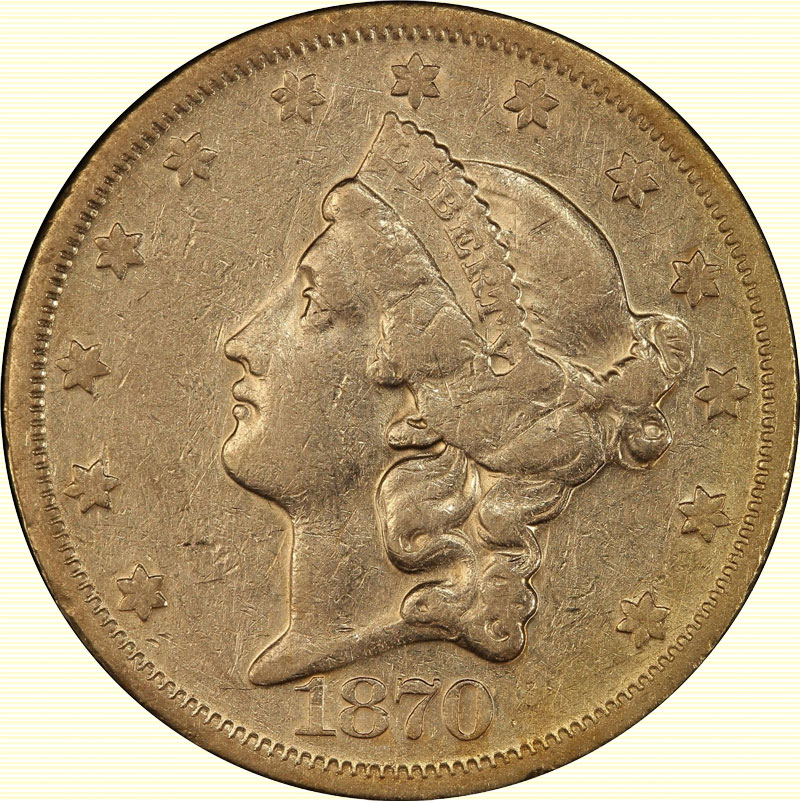
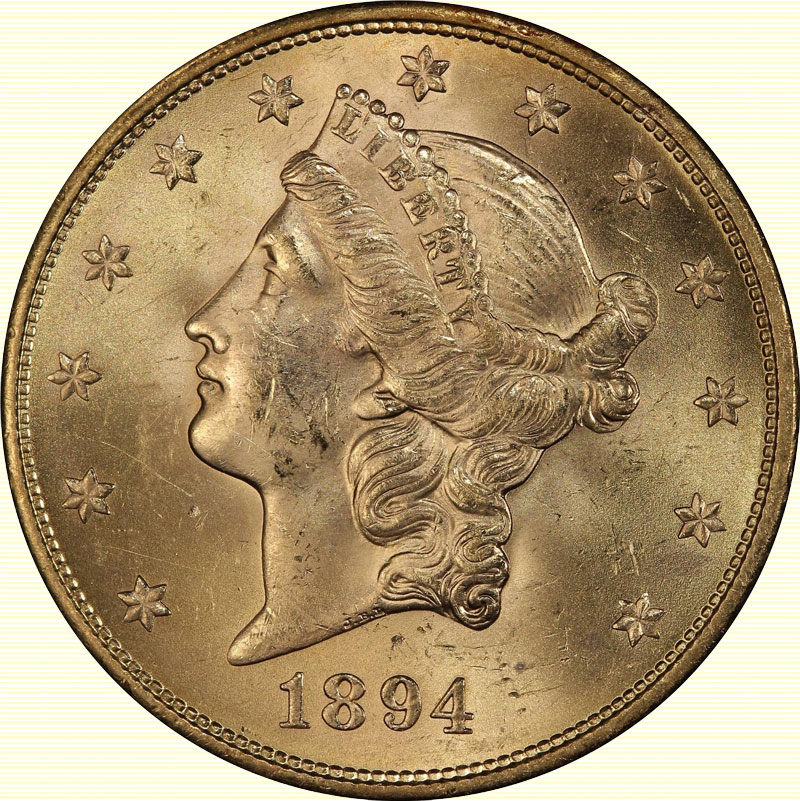
A quick look at average salaries from an unskilled laborer of the 1890′s, shows that one could expect to make a grand total of roughly $400 in an entire working year. This is key, because in the massive trove of coins in the cans, all but 54 of them were one of the largest gold coins that the U.S. ever struck: the $20 gold piece. The $20 gold piece would be equivalent, in our context, to roughly a $1000 bill(or even higher)! Now $1,000 bills aren’t being printed by the Federal Reserve yet(don’t worry, just give them a few more years), but this gives us a clearer picture of how often the common working man would’ve seen, let alone used, the type of coin in this hoard. Think about your own life: how many times in a year are you engaged in a transaction in which the price is at least $1,000? Unless perhaps you’re buying a new car, computer, or are going overseas, you probably don’t have many transactions like these. The same was true for most folks in the 1800s: silver was used for the every day transaction, and gold was used only for luxury items. Since silver did most most of the grunt work, silver coins would’ve received most of the wear. Silver was the “checking account”, and gold was the “savings account”. Savings accounts aren’t touched very often, and neither were many of these coins. She’s Seen a Few Miles While it’s true that the earlier dates are in better condition than one would normally expect a similar gold coin to be, many still had considerable wear on them, compared to the later-dated years. Do yourself a favor, and click this link. It will take you to a list on Amazon.com, which still has numerous coins from this hoard on sale. Feast your eyes on them. They’re masterpieces, to be sure, but look at the earliest listed, from 1870, the mere mid-date of the collection. Compare that to the 1893 & 1894 coins. Here, I’ll show you, underneath.
There is quite a difference of wear, isn’t there? That first beauty, though lovely, has plenty of mileage on it, plenty of use, comparatively speaking. While the second coin is almost “hot off the dies”, isn’t it? There are plenty of such mid-worn coins, just in the ones still listed for sale. Would that sort of wear show up on the 1870 coin, if it had been buried say, only 5 or even 10 years after being struck? Not likely. The Coffee Cans Let me ask you this: if you had a stack of bills or coins you wanted to bury for the long haul, for decades…would you resort to using a coffee can? Not once or twice, mind you, but several times, over many, many years? Would you trust a coffee can to do the job, to protect the condition of the valuables you were burying? Would you trust it to fight off the elements, the moisture, the corrosion? I wouldn’t, under any circumstances. I’d never put the equivalent of a generational estate of wealth into the ground in a can of Maxwell House, many different times! Furthermore, would you be content to leave that can underground for years, and not dig it back up to check on it during future such burials? Nope. I wouldn’t do that either. Wouldn’t you opt eventually, for a better, more permanent container? Yes, I would too! The bottom line here is: if you were going to go through the trouble of burying something for the long haul, you’d make doubly sure it was fully protected for the long haul. The very crude and brittle nature of the containers used for storage suggests to me, that the party responsible for burying them didn’t do so for the long haul. Rather, it appears that these cans were originally intended simply to be a quick, convenient way to get these coins safe…for the time being. It was done in haste, not in preparation, and as a temporary solution, not a lifelong ritual. Size Does Matter So, if we don’t assume the treasure was buried over time, I believe the evidence above suggests that the treasure was all buried in close proximity to the latest date that was found among the coins. That date being 1894. Why do I say that? Well, firstly, it was the latest date among the collection. How likely is it that if the treasure was buried in, say, 1904, that there would be no coins whatsoever from the years 1895-1904? Sure, in a smaller collection, the spread could be more wild, and dates might not matter as much, but the thing which gives me a high degree of certainty that nothing was buried beyond the latest coin date is the size of the collection itself. Think about it: during elections, when pollsters call voters to ask them questions about how they’ll vote, they always make sure to include a broad sampling of the population. Why is that? The reason is because the higher the number of folks that are sampled, the more accurately the results will reflect the voters’ true feelings. Calling 10 people within one neighborhood will not give them a true reflection of the community’s mood, but calling 800 people, from dozens of neighborhoods, will ensure greater accuracy. The greater the sample size, the greater the likelihood that the information is sound. What was the sample size of the Saddle Ridge Hoard? 50 coins? 100 coins? Try 1,427 coins! It is the single, largest such sampling ever discovered in the United States. Due to the extremely high sample of pre-1895 coins at our fingertips, my conclusion is that the entirety of the burial almost certainly occurred in 1894. In Conclusion Again, let’s return to motive. Why would someone do this? Burying one’s wealth, is such a radical act, that it demands a radical explanation, especially during a time where the paper dollars you had were instantly redeemable in gold coin specie. What could’ve possibly caused someone to take several kilos of gold, and opt literally to hide it away from the safety of their local bank’s vault? Was there some sort of catastrophic event at that time which would’ve scared bank depositors so drastically, that they would’ve actually chosen burial over a bank vault for safekeeping? I’m glad you asked, friend, because as it turns out, there was just such an event! There’s an Order to Things Have you ever watched a baseball game, and seen a batter crack a screaming pop-fly ball into the outfield, and thought:
Of course not. We all instinctively know that “what goes up, must come down”. Now sometimes, it may seem like that ball is taking its sweet time on the way back down, but you never doubt the end result. This great, old world God has made is governed by ironclad rules set in place. Whether it’s gravity, the laws of thermodynamics, or the Golden Rule, there are laws which keep things ordered, and give us a deep sense of comfort. The same is true in economics. There are laws in place which may be fought, denied, or lied about, but in the end, reality always reasserts itself, and there’s nothing anyone can do about it. Which brings us to the critical juncture of our bid to understand what might’ve possibly caused someone to bury so much gold in the Sierra Nevada hills of 1894 California, in the first place. A New Paradigm? The year was 1893, and things were booming in the United States. The railroad industry, it seemed, was on an unstoppable tear, as thousands of miles of new track were being built every year. The modern age of travel had certainly dawned, and with it came new opportunities and investment. Banks and financiers all lined up to extend credit to railroad companies, in hopes of getting a piece of the action. Everyone got on board this “train”, so to speak, and very soon a speculative bubble had developed around the railroad sector. The railroad scene was simply “overbuilt”. As with all other bubbles however, it didn’t simply stay in the railroad sector, but rather spilled into most other areas. With confidence surging like a rushing water, money also surged into stocks, which, by then, had reached all time highs. It also spilled over in the form of credit and loans that were over-extended to developing markets, particularly South American markets, such as Argentina. After many years of these practices, the whole situation became strained and tenuous: this baseball had reached its zenith in this particular “pop fly”. The bubble had been blown all over the world. All that was needed was a pin, any pin, to reassert reality. The Pin In this case, the pin came in the form of one “Baring Brothers” bank, in London. During the boom, Baring Brothers had given a great deal of high-interest loans to the markets in Argentina. Unfortunately for them, Argentina had reached its borrowing limit, and was forced to default on its debt. When Argentina went down, Baring was down for the count too. With the failure of Baring Brothers, the City of London realized that “the music had stopped”, and a scramble for liquidity(gold) was on. As the understanding of the problem spread quickly, so did the fear: the fear of being caught in an insolvent banking system, and losing your gold. So much gold was withdrawn from the banking system, that the Bank of England was actually forced to go to the Bank of France for a gold loan, in order to continue to meet withdrawal demands. It was at this time that those same banks in London began to “circle the wagons”, and cut any and all risk plays, in order to maintain adequate gold holdings. Many companies in the U.S. began to have their loans “called”, and gold, not paper dollars, were demanded as payment. Since folks quickly realized that the fractional reserve banking system had laid far more claims(dollars) upon each ounce of gold than could possibly be honored, they all rushed to get their money(gold) out of the banks. After all, when it’s your money in question, you don’t want to be the one left “holding the bag”, do you? The Fallout in the U.S. Very soon after these developments, major railroad companies and banks started failing as well, and for the same reason: too many claims were placed upon a pile of gold which was too small to back them. While the banks further east in the U.S. got the word earlier, and began to build up their gold coffers to weather this storm, many of the banks further west and south fared less well on the whole, due to delay of the news. Then, all at once, the dominoes started going down. On May 9th, the Chemical National Bank of Chicago closed its doors, followed two days later, by Columbia National Bank, also in Chicago. The bank run became a rout, as every able-bodied person rushed to get what was rightfully theirs, before their neighbors beat them to it. Within weeks, the entire financial system was paralyzed. Many banks, which by now had reached the lowest gold reserve they were legally permitted to, began to suspend payments of gold specie entirely. If you didn’t have your gold by this point, you weren’t going to get it. Not for a long while, anyway. Anyone who didn’t move fast enough to extricate their gold, was caught in the banking system as it went down. The very lucky, simply ended up having to wait day after agonizing day, hoping that “perhaps this day will be the day I’ll be able to get my gold out”. Even those people however, found themselves facing an unfortunate reality: their deposits, which were trapped in “Hotel California”, were now selling at a steep discount to gold already withdrawn. After all, there were many opportunists(the smart money, in this case), who were willing to bet that sooner or later, this crisis would pass, and got their gold out before the worst hit. Doing that now allowed them to offer the gold they had to others, in exchange for their deposits trapped in the bank, but at a steep premium to what those depositors would normally have paid. This was an unfortunate, yet totally understandable practice, one which, I’m sure, helped a great many people from going completely under during this time. As the terror spread like a wave from coast to coast, businesses were shuttered, many thousands of them, and the stock market sold off considerably. A brief paragraph below gives a good idea of the carnage that the average depositor would’ve lived through during this time:
Unbelievable, isn’t it? This was a capital “D” Depression. In fact, before the Great Depression, this was the largest peacetime depression ever to hit the United States, by a wide margin. By later that year, even though the worst of the bank closings had come, unemployment continued to worsen for several years, and stayed in the double digits for most of the decade. People were angry, and demanded answers. The picture at the top of this article was a poster for a Broadway Melodrama, produced in 1896, which attempted to explain this great Panic. This is very similar to how Hollywood later made several films chronicling the Great Financial Crisis of 2008, with efforts such as “Margin Call”. Needless to say, the fear was palpable, and the victims of the Panic numbered in the millions. The scars which this Depression left on the populace were felt for decades afterward. Our Mystery Hero Which brings us to the hero of our story: the person who buried this substantial hoard! Seen in this context, can you now see how completely logical and understandable it was to have buried this kind of treasure in a time such as that? As the venerable professor, Antal Fekete, has wisely observed: in times of great crisis, the gold(and silver) of the world isn’t deployed, but rather goes into hiding. In this particular case, that phrase became quite literal. The “Saddle Ridge Hoard”, was a large enough treasure, that it ensured whoever buried it was at least a “lower-upper” class party. Perhaps he was a ranch owner. Perhaps he was even a banker, or some other skilled laborer. Maybe it was simply someone who’d inherited the wealth from someone else. Who knows? To be honest with you, it doesn’t really matter that much. The only thing we need to understand was that he had considerable wealth, the safety of which was giving him many sleepless nights. A look at the Saddle Ridge Hoard amazon site, reveals that of the remaining coins in this tranche for sale, there are currently 166 specimens still available(as of August 15, 2014). Of that 166, there remains only 1 coin which is dated 1894, while there are many lovely 1893-dated coins. This suggests several possibilities to me. Perhaps he was able to get most of his fortune out in 1893, and only acquired the few 1894 coins(due to the close proximity to the San Francisco Mint) when the banks began paying gold coins again later on. Resorting, finally, to burial of them all, once he had the entirety of the wealth he aimed to collect. It’s possible. However, there’s also a much worse scenario that’s highly probable here: it seems to me, that this person was also likely one of the unfortunate souls who didn’t act quickly enough to get their gold out of the system, and that part(or all) of this fortune was frozen in the banking system for some time. Can you imagine your entire life’s work, utterly trapped? With no possible way to recovery it? Can you imagine spending weeks, or even months, wondering if that one fateful day your local bank teller had told you, “I’m sorry, but management has decided to suspend gold withdrawals until further notice”, was the day that you went from being wealthy to being permanently destitute? Can’t you just imagine the person’s hair turning whiter, the new wrinkles appearing on their face during such an ordeal? I can, and the thought is completely unnerving. If that is the case, then it seems even more understandable. That after pacing the floor every, single night for many months, our hero would’ve been up, bright and early in the morning, waiting for his bank to open, having heard the announcement: “gold withdrawal will now recommence!” Can’t you see him literally kissing the coins which the banks finally presented to him? It seems even more reasonable that in a fit of unbridled elation, he would’ve loaded the coins into a satchel, and ran from the bank to the nearest trade store: grabbing a shovel, and a few cans of coffee off the shelves, and mounting his horse, headed somewhere….anywhere! Anywhere there wasn’t another possible human soul around, is where he was bound! After all the holes were dug, and the dirt was tamped down, can’t you just hear him exclaim aloud: “By God, never again!” Yes. It all seems so very reasonable, now. Doesn’t it? Conclusion This explanation doesn’t answer all our questions, to be sure, like: why was the treasure never recovered? I don’t know, but in the end, I kind of like it that way. After all, this whole story, and the treasure which excites us, wouldn’t exist had they returned to reclaim it. Our job has been merely to search for plausible motive, and this fits the bill better than anything I’ve heard presented. There is one question I’d like to ask you, though: Do you realize, at this very moment, there’s a very good chance that you’re in danger of facing the same nightmare scenario as the unfortunate soul described in this story? |
|---|
Send this article to a friend:
 |
 |
 |
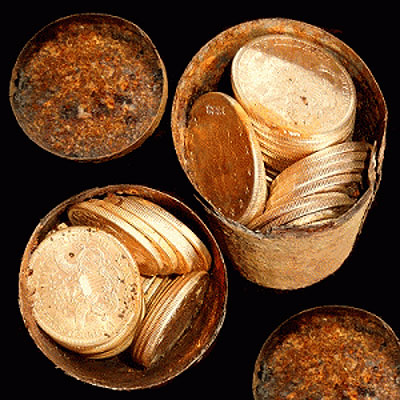
 Now friends, before we continue to investigate the probable cause of this burial, I must tell you that there’s no “smoking gun”, no definitive proof for any of what I’m about to say. Remember though, there are few unsolved mysteries in life which suddenly become solved by definitive proof miraculously springing up from nowhere. What any detective must do (who is worth his salt), is build a strong case for a highly probable explanation built upon a foundation of known facts and other forensic evidence. To my knowledge, I haven’t seen anyone else in the blogging world compile the case I’m about to lay before you, so this could very well be the first time it’s been stated this way. However, when all’s said and done, all I can do is make the case. It is you who must decide the most likely scenario.