|
Keep Your Eye on Global Dow and Treasury Yields
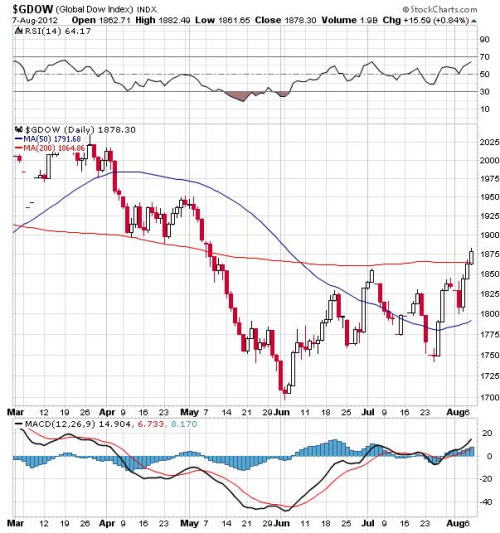
"A man is seldom so harmlessly occupied as when he is making money." Samuel Johnson It's amazing the way this stock market is working. The pro traders buy the Dow — just in case the Fed triggers QE3. No pro can afford to miss a big rally. Then near the close, when QE3 is NOT triggered, the frustrated traders dump their stocks, and prepare to do the same thing the next day. The retail public thinks the action is good, so they come in and buy the "bluechip stocks." But they don't dump when the traders exit the market, so the retail buyers are left high and dry with daily losses. Below is our new friend, GDOW. I liken GDOW to a world industrial average of 150 blue chip stocks (it includes the 30 D-J Industrials plus over 100 international blue chips). GDOW took a spill in June, but since then it appears to have carved out a bottom. Yesterday GDOW closed above its 200-day MA, which is probably a good omen for world trade and business. But I still put my faith in the D-J Averages. If the Dow Averages are in trouble, the rest of the world is on the edge. Or has the world changed, and are the US and the D-J Averages no longer the "big guns" in world business and commerce? At any rate, it will pay to keep our eye on GDOW. This is the world of commerce, and the D-J Averages still tend to deal with the US alone. Gosh, I remember the good old days when all I had to do was watch the D-J Averages. Even the Olympics have changed. Can you believe it? China has more medals, so far, than the US. The fastest men on earth are from little Jamaica. And the best distance runners on the planet are from Africa.
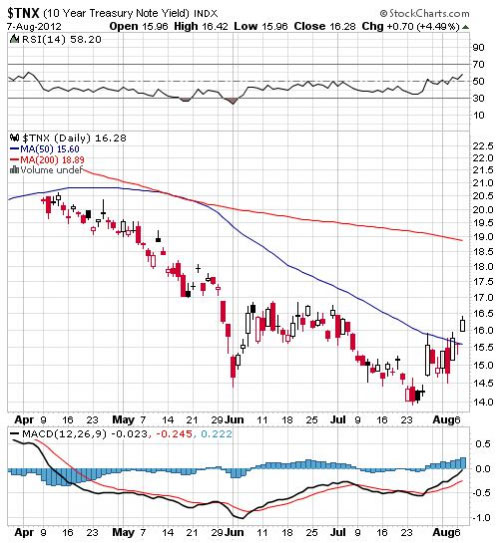
Once again, here's the yield on the bellwether ten year T-note. And darned if it didn't gap up yesterday — it gapped clear out and above its 50-day MA. Is the market telling us that the bond boom is over? Has the bond bubble burst, and are interest rates heading UP? Quick, refinance your mortgage. Wait, don't laugh away this little gap up in the ten-year T-note. Up until recently, US Treasury debt has represented the world's ultra-safest haven, the safest place on the planet to store your money. So could this little rally in the yield of the 10-year T-note mean that the world no longer believes US Treasuries are the number one safest place to store money? Remember, last year S&P lowered the US's credit rating from AAA to AA+, the first time in history that the rating on the sovereign debt of the US has been lowered. Now, we're moving ever-closer to the "fiscal cliff" — when taxes will be raised and spending will be cut, thereby almost guaranteeing a severe recession. Will the politicians in Washington let it happen? Well, stranger things have occurred. On June 8th, S&P issued its latest warning. There's a one in three chance the S&P will cut the US's rating again by 2014. Let me put it this way — S&P does not like the way things are shaping up. Time is growing short. And the yield on the 10-year T-note is rising. And that's not just talk, it's the market issuing an early warning.
To read the rest of Richard Russell's Dow Theory Letters, click here to subscribe.
Russell began publishing Dow Theory Letters in 1958, and he has been writing the Letters ever since (never once having skipped a Letter). Dow Theory Letters is the oldest service continuously written by one person in the business. Russell gained wide recognition via a series of over 30 Dow Theory and technical articles that he wrote for Barron's during the late-'50s through the '90s. Through Barron's and via word of mouth, he gained a wide following. Russell was the first (in 1960) to recommend gold stocks. He called the top of the 1949-'66 bull market. And almost to the day he called the bottom of the great 1972-'74 bear market, and the beginning of the great bull market which started in December 1974. The Letters, published every three weeks, cover the US stock market, foreign markets, bonds, precious metals, commodities, economics --plus Russell's widely-followed comments and observations and stock market philosophy. In 1989 Russell took over Julian Snyder's well-known advisory service, "International Moneyline", a service which Mr. Synder ran from Switzerland. Then, in 1998 Russell took over the Zweig Forecast from famed market analyst, Martin Zweig. Russell has written articles and been quoted in such publications as Bloomberg magazine, Barron's, Time, Newsweek, Money Magazine, the Wall Street Journal, the New York Times, Reuters, and others. Subscribers to Dow Theory Letters number over 12,000, hailing from all 50 states and dozens of overseas counties. A native New Yorker (born in 1924) Russell has lived through depressions and booms, through good times and bad, through war and peace. He was educated at Rutgers and received his BA at NYU. Russell flew as a combat bombardier on B-25 Mitchell Bombers with the 12th Air Force during World War II. One of the favorite features of the Letter is Russell's daily Primary Trend Index (PTI), which is a proprietary index which has been included in the Letters since 1971. The PTI has been an amazingly accurate and useful guide to the trend of the market, and it often actually differs with Russell's opinions. But Russell always defers to his PTI. Says Russell, "The PTI is a lot smarter than I am. It's a great ego-deflator, as far as I'm concerned, and I've learned never to fight it." |
 |
 |
 |