Send this article to a friend:
April
01
2026
|
Send this article to a friend: April |
The Food Supply Chain Is Breaking... Again
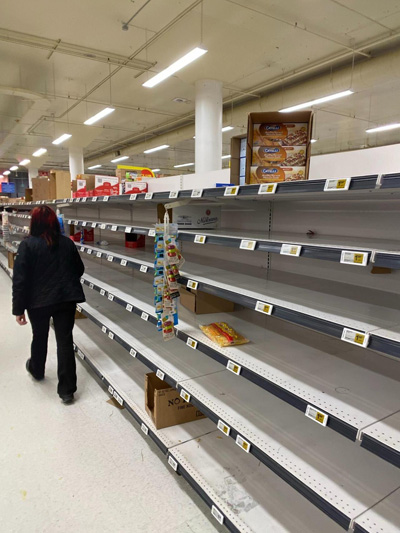
They’re hungry and will only grow to their full nutritional potential if they’re well fed. But that, apparently, isn’t happening, as fertilizer supplies are interrupted by yet another pointless Middle East war. The result? Global food shortages that might dwarf the COVID-era Costco-hoarding mess of recent memory. Here’s an overview: BREAKING: The nitrogen trap just closed. Three locks snapped shut simultaneously. The planting window is closing behind them. And the food the world eats next year is now being decided by molecules that cannot reach the soil in time.
The biological calendar does not negotiate. Corn requires nitrogen at the V6 to VT growth stage or kernel set is permanently reduced. Wheat requires it at tillering and jointing or grain fill collapses. Rice requires it at transplanting or yield drops 20 to 40 percent in low-input systems. These are not economic models. They are cellular processes. The plant either receives nitrogen during the window or it does not. If it does not, no subsequent application, no price increase, no policy reversal can recover what was lost. The damage is written into the biology of the seed. The US Corn Belt window closes mid-April. European top-dressing is happening now. Indian Kharif preparation begins in May. Bangladeshi Boro rice transplanting is underway this week. Every one of these windows is closing while the three largest sources of nitrogen on Earth are simultaneously locked: Hormuz by military blockade, Russia by export decree, China by trade ban. The USDA Prospective Plantings report arrives March 31. The FAO Food Price Index publishes April 3. These will quantify what the molecules already know: the nitrogen did not arrive. The yield loss is locked in. The 5 to 10 percent global drag will concentrate where the buffers are thinnest: subsistence farms in Bangladesh, Sub-Saharan Africa, South Asia, where a 20 percent shortfall does not mean lower profits. It means hunger. Sri Lanka banned synthetic fertiliser in 2021. Rice yields collapsed 40 percent. The government fell. In 2008, fertiliser and oil spiked simultaneously and food riots erupted across 30 countries. In 2026, the strait blocks fertiliser while Russia and China withdraw the alternatives, and the planting windows close on a planet with nowhere else to turn. The war is fought with missiles. The famine is fought with molecules. The molecules are trapped behind three locks on three continents, timed to the one calendar that cannot be paused, extended, or negotiated: the calendar written into the DNA of every seed in the soil. Read a deeper dive here... This is Why We Should Have Gardens…and Gold, Goats, and GunsEven after the pandemic, many (most?) people in the developed world continue to view “food supply chain disruption” as a tin-foil-hat concern. They’re apparently wrong. Again. And note that higher food prices are just the first-order effect of a fertilizer shortage. The second and third-order impacts are geopolitical and possibly military. So let this latest “peak complexity” signal encourage you to keep prepping. Anticipate shortages, higher prices, even more chaotic politics, and take some of the steps we’ve been discussing here.
DollarCollapse.com is managed by John Rubino, co-author, with James Turk, of The Money Bubble(DollarCollapse Press, 2014) andÊThe Collapse of the Dollar and How to Profit From It (Doubleday, 2007), and author of Clean Money: Picking Winners in the Green-Tech Boom (Wiley, 2008), How to Profit from the Coming Real Estate Bust (Rodale, 2003) and Main Street, Not Wall Street (Morrow, 1998). After earning a Finance MBA from New York University, he spent the 1980s on Wall Street, as a Eurodollar trader, equity analyst and junk bond analyst. During the 1990s he was a featured columnist with TheStreet.com and a frequent contributor to Individual Investor, Online Investor, and Consumers Digest, among many other publications. He currently writes for CFA Magazine.
|
Send this article to a friend:
 |
 |
 |