|
Fattening Wall Street; Starving Main Street:
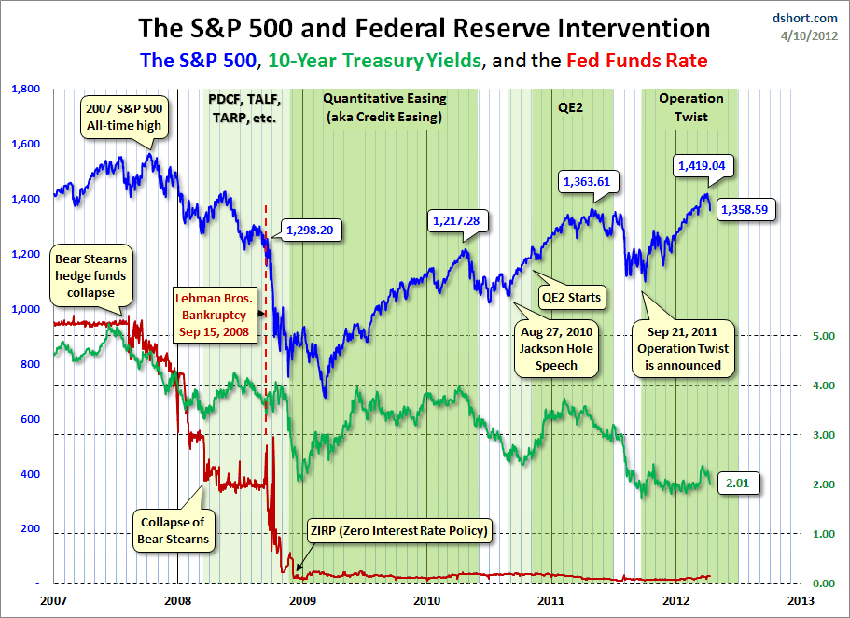
Do you want to understand what the Fed is doing, but don’t have time to wade through volumes of tedious economics writing? Well, now the pros at dshort.com have made all that possible. They’ve reduced 4 years of monetary policy into one chart that illustrates exactly what the Fed is up-to and who benefits from the policy. See the chart below. The chart shows how the Fed’s lending facilities, zero interest rates and $700 billion bank bailout (TARP) helped to put a bottom under a market that had fallen off a cliff. Then came the first round of Quantitative Easing (QE1) during which the Fed purchased $1.25 trillion in mortgage-backed securities (MBS), $200 billion in US Treasuries and $150 billion in agency debt (Fannie and Freddie) This massive infusion of liquidity triggered a sharp rebound in equities starting on March 9, 2009. It also transformed the Central Bank’s balance sheet into the largest waste treatment facility on planet earth. By May 2010, the Fed’s adrenalin rush began to wear off and stocks began to sag once again. That led to a second round of QE, a $600 billion mainline injection which sent equities soaring until midyear 2011. When the markets tailed off in May, Fed chairman Bernanke initiated a third round of QE (Operation Twist) which buoyed stocks with another $400 billion in liquidity. Operation Twist is set to end in mid-June, after which Bernanke will undoubtedly find some excuse to launch yet another round of bond buying to keep stock prices artificially high. Many of the big banks and bond funds have already started buying up distressed MBS in anticipation of QE3. It’s not likely that Bernanke will disappoint them.
So, there you have it; 4 years of policy in one picture. What I find so interesting about Bernanke’s policy is that no one (who follows the markets) even disputes what he’s doing anymore. You know, there used to be a debate about whether the Fed was “juicing” the market or not. There’s no debate anymore. Even the folks over at the Wall Street Journal seem to agree that fundamentals no longer matter. What matters is liquidity, boatloads of virtual liquidity provided gratis via the Fed’s printing operations. As one of the WSJ’s journalists noted just this week; stocks go “up when the whiff of government intervention is strong, (and) down when it recedes.” (“Sowing Seeds of the Next Major Crisis”, Wall Street Journal) And the way this plays out is that– even when the economic data is bad– stocks still climb higher if the Fed signals that more help is on the way. Now check out this brief commentary by Northern Trust’s (former) chief economist Paul Kasriel who tries to answer the question: “Has the Fed Boosted the Stock Market?”
Actually, I suspect many people DO have “a problem with that.” While one can certainly make the case that the Fed was justified in taking action during the throes of the financial crisis in 2008; how does one defend Bernanke’s ongoing interventions which have distorted prices and rewarded the investor class at the expense of ordinary working people? What’s important is not merely the “credibility of the markets” which have been greatly compromised by Bernanke’s not-so-invisible hand, but the basic “unfairness’ of the present policy; a policy that showers wealth on the filthy rich while keeping working people in a permanent state of near-depression. Does that sound fair to you? The stock market doesn’t need more help. The Dow Jones has more than doubled in the last 3 years while the S and P and Nasdaq are not far behind.. So, why is the Fed still pumping up stock prices? Wouldn’t it make more sense to implement policies that stimulate demand and get more people back to work instead of just adding more liquidity to markets that are already swimming in capital? Sure, it would. But that’s not the policy. The policy is to keep the investor class happy while preaching austerity to the masses. Here’s an excerpt of Bernanke’s comments at a recent Congressional hearing:
Have you ever read such nonsense in your life? So what is Bernanke saying? He’s saying that it’s okay when the Fed loads up on $2.3 trillion in putrid MBS and other toxic gunk from underwater banks and other crooked financial institutions, but “not okay” when the government spends money on public infrastructure, food stamps, health care, Social Security and other vital services that help real people. Doesn’t it seem like Bernanke’s got his priorities all wrong? The real economy is in more distress than ever. The homeless shelters are bulging, the food kitchens are maxed out, and 46 million people are on food stamps. Enough with the stock market already! It’s the real economy that needs help. And–despite the faux debate in the media about “belt tightening” and budget deficits–economists generally agree about what needs to be done. We need more fiscal stimulus. Here’s a clip from an excellent paper by Pimco’s Paul McCulley and Zoltan Pozsar titled “Does Central Bank Independence Frustrate the Optimal Fiscal-Monetary Policy Mix in a Liquidity Trap?”
Repeat: In a liquidity trap “conventional monetary policy does not work”. In other words, the Fed does not have the right tools for getting the job done. (How many times have you heard that before?) That’s why Congress needs to step in. It’s their job to provide the resources for employing more people, increasing spending, boosting demand, stimulating investment, lifting GDP, and getting the economy running on all 8 cylinders again. This is the “virtuous circle” of which economists speak, and which remains beyond our grasp because venal politicians have handed over policymaking to the Fed. But, here’s the problem; the Fed doesn’t believe in fiscal policy, in fact, they’d just as soon do away with it altogether. Just check out this extraordinary interview with James Bullard, President of the Federal Reserve Bank of St. Louis, which appeared in the Wall Street Journal. Bullard explains why the Fed really doesn’t need congress anymore. They’re ready to go-it-alone and run the whole shooting match from the marble halls of the Eccles Building. Here’s a clip:
How do you like that? So, according to Bullard, the Fed’s recovery effort has been so sucessful, that Congress can just fold their tent and go home. “We don’t need you anymore.” Right. Try telling that to your son who’s up to his eyeballs in student loans and just took a job at K-Mart selling plastic ficus trees to retirees for $7.50 an hour. “Just leave it to us,” says Bullard. “We gotcha covered.” Do you find that reassuring? What Bullard means by “Death of a Theory”, is that the theories of John Maynard Keynes are not going to be used anymore. The Fed is going to continue on the same path that it is now, implementing policies that only benefit the banks and investor class. That means that the frayed fiscal lifeline that presently keeps the US middle class from sinking beneath the waves will eventually be severed leaving millions of people jobless, homeless and destitute. How’s that for a plan? MIKE WHITNEY lives in Washington state. He is a contributor to Hopeless: Barack Obama and the Politics of Illusion (AK Press). He can be reached at fergiewhitney@msn.com. |
 |
 |