|
Politics, Markets, and People: On a Collision Course
The world is clearly on a collision path, ideologically, economically, and philosophically. And the markets are starting to reflect this. The story of the weekend is Wal-Mart's bribery scandal. But Europe is about to head on another down leg as Spain's economy is shrinking and the European Central Bank is not interested in another round of money printing or bond buying. As we reported last week, European banks are already running out of the money that was put in their pockets by the LTRO bond buying arrangement with the ECB. So Monday is a major potential disaster about to happen. Should anyone be suprised? Is Wal-Mart a company who would be above bribery? Did the LTRO really fix Europe's problems? And does anyone really believe that you can fool all of the people all of the time? The answer is clearly no on all three questions. So what we're seeing this morning is just another rung on the stairway of an adjustment process toward some kind of new baseline. The so called "new normal" is, in our opinion, a dynamic process, not a static one. Think about this for a moment. The U.S. bailed out General Motors after its management team and its labor unions gutted the company. GM is once again profitable. So how does it deploy its new expansion agenda? It plans to open 600 new dealerships in China. Why can't they use that money to develop, manufacture and sell new cars in the U.S.? Because there is no sense of right or wrong. Gratitude and payback are not part of the vernacular anymore. It's all about quick profits and moving to the hot spot of the moment without learning the lessons of the past. That means that as time passes, more of these kinds of events are likely. The structural problems with the U.S. economy, that we described in this column last week, can be extended to the global economy. You can read that article here. The economy, the political system, and the interaction between them is the key dynamic in this world. Politics is the process through which resources are allocated. The economy is the process through which new resources are created, and new fuel for political processes is developed. When one breaks, the other follows. And when one thrives, so does the other prosper. We are in a period where political, corporate, and in many cases personal corruption is rampant. Cheating is the "new normal." You can see it everywhere. And you can see it all the time. And little will change until it is dealt with and erradicated. Now, we are seeing the abcess break open and the pus starting to spread. This, in our opinion is the beginning, not the end of the frequent scandal. The rot is so deep that, unfortunately, the roots are going to have to be removed before we can see some kind of rebirth. And that means that what we've seen in the so called "Arab Spring" is going to have to occur in some fashion elsewhere. Hopefully, the ballot box will be the tool in the U.S. And yo can see that some well-entrenched incumbents are starting to have to fight for their positions. What's the bottom line? This is the start of a cleansing process. This will go on for several more years. The Markets
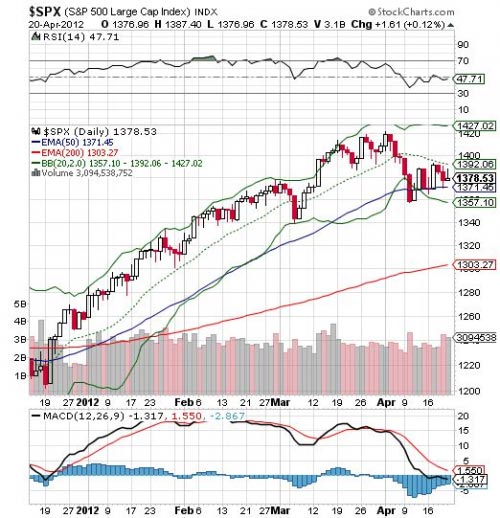
The S & P 500 (SPX) ended last week with a rally. But the index failed to make any headway. It still closed between its 20-day and its 50-day moving averages. It did manage to hold above the 50-day line five times in the past two weeks. That's significant. But it also failed to rise above its 20-day line multiple times. That is also significant. The two events together suggest that short term traders are in charge of the market and that rapid swings in a small trading range were the norm. That suggests high frequency trading. And that's a negative. That means that whatever happens today, or over the next few days, will have greater signficance. The Bollinger Bands (Green bands that travel with the 20-day moving average) are important. The bottom band is starting to move lower. That's a sign that price action could be starting to head that way. That is also important, given the sudden turn for the worse in Europe.
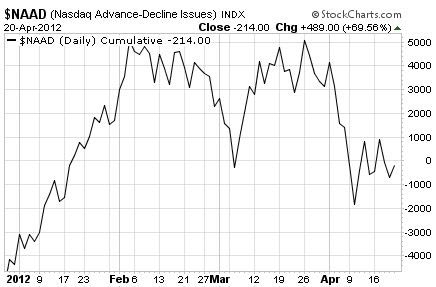
The market's breadth, as measured by the Nasdaq Advance Decline line (NAAD) seemed to be trying to hold up last week. But if there is a bad few days, this line will almost certainly make a new low or more. That means that the market's underpinnings will have eroded further. That's also a negative.
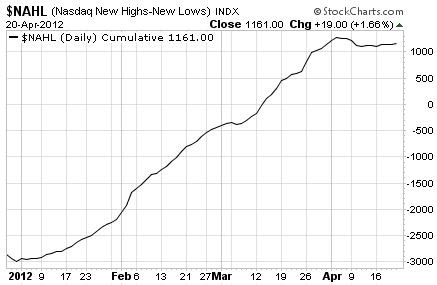
The Nasdaq Hi-Lo line (NAHL) has flattened out over the last couple of weeks. This indicator has been exceptionally useful in the last few months. That it's no longer rising means that, as with the market's breadth, momentum to the up side is now also weaker. ConclusionThe short term seems to be increasingly tilted to the down side. A new political and economic wave of developments seems to be in its early stages. The French election, more signs of trouble with Spain's economy, and now a major corporate bribery scandal involving Wal-Mart, are spooking investors. The 50-day moving average on the S & P 500 remains the key support level. But, even if that holds for now, there is no sign at this point that a major rally is on its way.
Dr. Duarte is is well recognized as a geopolitical and financial market analyst combining a unique set of viewpoints into an original blend of solutions for his audience. He is author of "Trading Futures for Dummies," "Market Timing for Dummies", "Futures and Options for Dummies", "Successful Energy Sector Investing", "Successful Biotech Investing", and co author of "After-Hours Trading Made Easy." He is a board certified anesthesiologist, a former registered investment advisor, and former President of River Willow Capital Management. Dr. Duarte has appeared on CNBC and weekly on the Financial Sense Newshour with Jim Puplava radio show for many years, where he commented on the Energy markets and geopolitics. He has logged appearances on Biz Radio, Wall Street Radio, JagFn, WebFN, KNX radio in Los Angeles, and WOWO radio. One of CNBC's original Market Mavens, Dr. Duarte has been writing about the financial markets since 1990. An expert in health care and biotechnology stocks, the energy sector, as well as financial market sentiment, his daily syndicated stock columns have appeared on leading financial web sites, including Reuter's e-charts, afterhourtrades.com and MarketMavens.com. His articles and commentary have been featured Marketwatch.com. He has appeared in Barron's, U.S.A. Today, Smart Money, Medical Economics, and in Technical Analysis of Stocks and Commodities magazines. Dr. Duarte published the critically acclaimed market timing newsletter 'The Wall Street Detective,' from 1990-1998, when it became an exclusively electronic publication. His daily market commentary 'Joe Knows' appeared on Financialweb.com from 1998-2000. Dr. Duarte served as senior columnist for investorlinks.com from 1998-2001. |
 |
 |


 Joe Duarte M.D.,www.joe-duarte.com, is a widely read analyst and writer. His daily Market IQ column is read by thousands of investors, information seekers, and intelligence aficionados and professionals around the world.