|
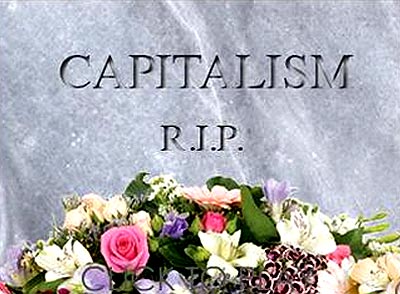
Capitalism Died Decades Ago
The following is an excerpt of James J Puplava's recent interview with Richard Duncan, author of "The New Depression: The Breakdown of the Paper Money Economy" JIM: When the United States stopped backing dollars with gold in 1968, the nature of money changed. All previous constraints on money and credit creation were removed and a new economic paradigm took shape; economic growth was no longer driven by capital accumulation and investment as it had been since the beginning of the Industrial Revolution. Instead, credit creation and consumption became the new drivers of the economy. And over that period of time, the United States debt increased fifty-fold to 50 trillion dollars. In 2008, however, that debt could not be repaid and the new depression began. And that’s the topic of today’s discussion, the title of a new book, The New Depression: The Breakdown of the Paper Money Economy; and its author joins me on the program Richard Duncan. Richard, you argue in your book when the United States went off gold backing from the dollar in 1968, the nature of money changed and the result was a proliferation of credit. As you document in your book, we went from almost 1 trillion dollars to today we’re now over 50 trillion. Let’s talk about that. RICHARD: Right. In the past, up until 1968 it was a law that the Fed had to maintain gold backing for every dollar that it issued. It had to keep 25 percent gold backing for each dollar. After World War II, the US central bank had no difficulty meeting that requirement because the US had so much gold at the end of the war, but in 1968 they came up against that constraint and they would either have to have stop issuing more dollars or somehow acquire more gold. And in the end what they did is they changed the law and they removed that requirement, and afterwards there was no longer any requirement for the Fed to keep gold backing for the dollars it issued. And at that point, I believe that the nature of money changed. We moved from a commodity-based monetary system, a gold-standard system to a paper-money system, a fiat-money system. Before that time if a person took a dollar bill to the Treasury Department, at least in theory, he was meant to receive some gold in exchange for it, but now if you take a dollar bill to the Treasury Department, they will just give you another dollar bill in exchange. So before, there was a very clear distinction between money and credit: Money had gold backing. Well, now that distinction has been blurred. If you take a dollar bill to the Treasury Department and they give you another dollar in exchange. Well, what’s the difference between a dollar bill now and a 10-year Treasury bond? In the sense that they’re both credit instruments, the 10-year Treasury bond pays interest, the dollar bill doesn’t pay interest. So we've moved from a system where there was a clear distinction between money and credit to a system where there is really no distinction at all between money and credit. Money, in a sense, has become credit and that really changed everything. JIM: You know, credit-induced boom and bust cycles aren’t new. The Austrian economists Ludwig von Mises and Rothbard wrote extensively about them, but before we went off gold backing, we had several restraints on credit. One was the legal requirement that the Fed back its monetary base with gold, and the second is banks hold liquid reserves to back their deposits. Richard, explain the changes that were triggered by going off gold backing of the dollar. RICHARD: In 1968, when this requirement for the Fed to hold gold backing ended, afterwards, after 1968, the Fed has issued 20 times as many dollars as it had up until 1968. It issued roughly another 900 billion paper dollars and that 900 billion paper dollars acted as a foundation upon which this 50 trillion dollars of credit was created; that was the most important change. The other change you referred to was over those last four decades the amount of liquidity reserve requirements that banks were required to hold against their deposits has steadily diminished. Now, through the system of fractional reserve banking, banks are able to create money essentially, create deposits. Now, the way that works is that when someone deposits, let’s say $100 into a bank, that bank is required to set aside those liquidity reserve requirements. The liquidity reserve ratio is 10 percent and that first bank sets aside $10 of reserves and lends out $90. The $90 then circulates through the economy and it’s redeposited and Bank B then has to set aside 10 percent and lends out 80 — $81. And this reoccurs again and again until in the end you have more or less 10 times as much deposit and credit as you started out with through this system of fractional reserve banking; in other words, the banks create credit and create money. Now, the thing that has changed is that over time the liquidity reserve requirement that the banks were required to hold came down very sharply from roughly 14 percent — a ratio of 14 percent down to roughly 1 percent. And as the ratio became smaller and smaller, as the liquidity reserve requirement became smaller and smaller, the amount of credit that the banks could create became larger and larger. In fact, it moved toward infinity. And that was the second reason 50 trillion dollars of credit was possible, to create so much credit, was because the liquidity reserve requirement was reduced again and again by the Federal Reserve itself... Now, in the old days when gold was money, there was only a limited amount of money. If the government had a big budget deficit and borrowed a lot of money, that would push up the interest rates and crowd out the private sector. So it was always a good thing if the government spent less money because if it spent less money the interest rates would drop and businesses and individuals could borrow more and probably spend more efficiently. But that’s not the world we live in anymore. In the world we live in, the government already has trillion dollar budget deficits and interest rates are at rock bottom levels already. They’re at rock bottom levels because in our world there’s not a limited amount of money; the government is free to create as much money as it wants and that’s what it’s been doing. So it’s been financing the massive budget deficits by massive paper money creation. So in our world, if the government spends less money now, interest rates are not going to go down; interest rates are already at rock bottom levels. So if the government spends less money, the GDP is going to shrink, not only by the amount the government spends less, but because when the government spends less, fewer will have jobs so that personal consumption will shrink and therefore business investment will also shrink. In other words, the economy will spiral into a severe recession/depression. Now, that’s where we need to begin this national debate. It’s terribly unfortunate we've gotten ourselves into this situation where our economy has been fueled by a $50 trillion expansion of credit denominated in paper money, but it’s created a US and a global credit bubble that has been fueled by credit expansion. Now the credit can’t expand anymore and it’s only the government sector that can take on additional debt; the private sector cannot take on any additional debt because they don’t make enough, their salaries aren’t going up anymore because of globalization so they can’t afford anymore debt. So this means we're dependent on government spending whether we like it or not. This is truly regrettable but this is the truth. So what you asked me is how do I really think it’s going to play out. Well, unfortunately, there’s no indication that anyone recognizes that there’s a tremendous opportunity. I really think that what we have, we have a new economic system. This system is not capitalism anymore. Capitalism was a system that was dominated by the private sector and the growth dynamic of capitalism worked like this: businessmen would invest, some of them would make a profit, they would save that money through capital accumulation and they would invest and profit and capital accumulation, investment, profit, capital accumulation. And that drove the economic dynamic. That’s not the way our system has worked for decades. Our system has been driven by credit creation, followed by consumption, credit creation and consumption; and that’s driven our growth dynamic. And it’s worked wonderfully. It’s created very rapid economic growth all around the world. The problem is this new system is not capitalism. I think “creditism” is a better name for it. Creditism now seems to have hit a standstill in the potential to create any more growth because the private sector can’t bear anymore debt. Now, while it’s not recognized that we have a different economic system, I think everyone generally agrees there are various serious problems with whatever this system is that we have. The faults of this system are completely obvious, but we're overlooking the opportunities inherent in this system. The opportunity is the United States government can now borrow massive amounts of money at 2 percent. If it just borrowed on a very aggressive scale and invested aggressively in 21st Century transformative technologies such as solar energy, nanotechnology, genetic engineering and biotechnology, they could transform the world. They could restructure the US economy, they could create medical miracles, they could generate new industries that would generate new taxes and balance the budget. They could balance the trade deficit. All our problems would be solved if we just grasped the opportunities that are available to us within this new economic system. But are we going to do that? No. We're probably not because we're caught up in a very toxic debate where we're told our government, our elected officials and our democracy are incapable of doing any good. Well, I don’t believe that’s true. I think in a democracy we are responsible for our elected officials and that it’s the responsibility of the people to make sure the right officials and right policies are put into place. Now, if we cut the government spending, we are facing a very dire future. If we radically cut government spending as the Tea Party would have us do, then our economy could fly into depression just like it did in 1930 when we faced a very similar situation in the aftermath of a credit bubble at the point when the debt could no longer be repaid. Now, there is a chapter in my book called Disaster Scenarios, in which I try to be really as frightening as I can be to make it clear to everyone just how bad things could become as things really go badly from this point forward. To imagine how badly things could go, well, I think the best way to imagine that is just to reconsider what happened in the 1930s and the 1940s. In 1930 when the credit bubble of the 1920s and the debt bubble couldn't be repaid, the international banking system collapsed and global trade collapsed and the United States economy shrank by 46 percent relative to 1929 and unemployment ranged from 15 percent to 25 percent for a decade. In Europe, Europe turned fascist. Asia turned fascist. The Japanese took over Asia. The Germans took over Europe. And this depression didn’t end until World War II started. At that time government spending did increase. In fact, it increased 900 percent; not 9 percent, not 90 percent. 900 percent. And that massive expansion of government spending, that ended the depression, but World War II also ended 60 million lives. Now, we have to understand what went wrong in that credit bubble and that credit bust that was followed by depression and war. We have to understand what went wrong and we have to understand how to do better this time. And I think we could — we can do better. We have a tremendous opportunity. We do not have to collapse into the Great Depression, but there is a very real danger that we will. I think people should consider this. You can look at the global economy now, it’s a giant rubber raft. But instead of this rubber raft being inflated with air, it’s inflated with credit. The problem is the raft is defective and the credit is now leaking out of all the sides as credit is being destroyed in the subprime disaster and Europe and the European banks. Credit is leaking out all the sides of this raft. Now, on top of this raft — this global economy of ours — all the asset prices, all the assets are floating: all the stocks, all the bonds, gold and other commodities. And furthermore, seven billion people are on top of this raft. The natural tendency of the raft is to sink because it’s defective and credit is being destroyed is leaking out over all the sides. And as it sinks, that’s why all the asset prices tend to move together now, move down. And this explains the policy response. The policy response is to pump in more credit, so this is the only policy response policymakers know what to do. When the raft starts to sink, they pump in more credit. When they pump in more credit, either through large budget deficits or through QE1 or QE2, through LTRO or some other mechanism, the raft begins to float higher again; all the asset prices move up together again. This is very unusual for all the asset classes to move up and down together, but this is the explanation for why they do. And this is the explanation for the government policy response. They can’t let the raft sink because if the raft sinks, this is going to lead to geopolitical calamity, catastrophe. And so all they know to do is to pump in more credit to keep the raft from sinking. And this is what they are going to continue doing because they have no choice. Luckily, they can continue to do this for the next five years with very little difficulty. The US government debt is roughly 100 percent of GDP only. So that’s quite bad, but in Japan, Japan’s government debt is 240 percent of GDP. The Japanese government has been doing this for 22 years now and so there is no reason the US government couldn't increase its level of debt up to at least 150 percent of GDP, which takes us another five years into the future. So this is what everyone should expect to happen. One way or the other, the governments have no choice, [but] to keep pumping in more credit so that our raft doesn't go down. So if stock prices get too weak, investors should expect the government to respond somehow and pump in some more credit and push them back up again. So as investors, I think we really have nothing to worry about because the government can’t afford to let the raft sink, so they’re going to pump in more credit. Every time the stocks are too weak, the government will do something to push them back up again. Every time the economy gets too weak, there’ll be more stimulus at one time or the other to push it back up again. But the next five years, there’s nothing to worry about. The problem, however, is somewhere five to ten years out. And at that point, the US government then will truly be as bankrupt as Greece. And at that stage, unless we have taken advantage of this five to ten year window of opportunity to restructure the global economy imaginatively, then we’re looking at a very dire longer term future. But between now and then, eat, drink and be merry; we are on government life support. They are pumping in credit and they are not going to stop. JIM: Well, I’ll tell you, Richard, you have written a very thought provoking book. And I’d like to give my compliments to you. It’s probably one of the best books I’ve read on macroeconomic matters since Reinhart and Rogoff’s book This Time Is Different. The name of the book is called The New Depression: The Breakdown of the Paper Money Economy by Richard Duncan, who’s been my guest. Richard, I want to thank you for joining us here on the Financial Sense Newshour and I wish you all the best with this book. RICHARD: Thank you very much, Jim. And it’s been a pleasure talking with you. Richard Duncan is the author of The Dollar Crisis: Causes, Consequences, Cures – the bestseller that accurately predicted the global economic crisis that began in the 2008 and the government’s unorthodox policy response to it. Since beginning his career as an equities analyst in Hong Kong in 1986, Duncan has served as a global head of investment strategy at ABN AMRO Asset Management in London, worked as a financial sector specialist for the World Bank in Washington DC, and headed equity research departments for James Capel Securities and Salomon Brothers in Bangkok. He also worked as a consultant for the IMF in Thailand during the Asian Crisis and is now chief economist at Blackhorse Asset Management. |
 |
 |