Send this article to a friend:
January
19
2026
|
Send this article to a friend: January |
The Myth of a Self-Financed Fed
At this point, extravagant government boondoggles are barely newsworthy. A few people batted their eyelashes last week at Trump’s proposal to expand military funding by half a trillion dollars but everyone has forgotten about it now because it was last week and attention spans are measured in seconds these days. But the Fed’s building renovations are causing more of a stir. Senator Tim Scott questioned Powell about it last June, and now the Department of Justice has issued subpoenas about Powell’s answers. Powell responded with an uncharacteristically blunt message, saying that the DOJ’s actions are a pretext—that this is all a part of a plot, led by Trump, to diminish Fed independence in its monetary policy decisions. Of course, Fed independence is a myth—a joke, really—as Ryan McMaken ably demonstrates:
(See also my take on the event that allegedly established Fed independence, and Joe Salerno’s piece on how to reform the Fed. Murray Rothbard also demolished this myth.) So the Fed is doing some expensive renovations, but why should taxpayers care? The Fed, after all, is “self-financed”! Consider this representative reporting from Fox Business:
The true part of this statement begins with the sixth word, but then ends on a misleading note; the blatantly false part is that the Fed is “self-financing.” The Fed does not rely on congressional appropriations. This is because it relies on conjuring up new dollars to purchase government securities, and then earns the interest on those securities. These interest payments from the Treasury ultimately come from—you guessed it—the taxpayer. In 2024, the interest income from its Treasury securities and other government debt was $153 billion. But the Fox Business article also mentions “fees charged to financial institutions.” In 2024, this was $524 million (included in the Fed’s “Income from services” in its financial statements). That’s 0.34 percent of the Fed’s interest income from government debt—a drop in a bucket. So, including this in a list of how the Fed “self-funds” itself with equal (or, at least, unqualified) importance as its interest income is disingenuous. It gives the impression that the Fed earns a good chunk of its income by providing valuable check clearing services and automated clearing house operations to private financial institutions. Even if this source of funds was significant for the Fed, it’s dubious that this should be considered honest income. The Fed is a government-privileged banking cartel, established by law. It’s not like they are truly competing on the market with private firms. The propagandistic rhetoric surrounding the Fed’s “self-financing” makes it seem like the Fed can just snap its fingers and new building materials and labor appear out of thin air for its building renovations. We should remember the wise words of Frédéric Bastiat:
In other words, when the Fed renovates its building in Washington, DC, the building materials and laborers have an opportunity cost. This opportunity cost is the value of their alternative uses, where and how they would have been used in the private market economy, subject to the profit and loss test of the market (i.e., subject to consumer demands). The Fed is not “self-financed.” It is a legal counterfeiter—a particular kind of counterfeiter that uses new money to lend to the government (through primary dealer middlemen, in a sort of shell game). The new money is used to bid up prices throughout the economy, meaning ordinary citizens pay this “inflation tax” at the gas pump, grocery store, and everywhere else. When the Fed spends its interest income, which came from taxpayers, it bids resources and employment away from where it would have been used to serve consumers. Thus, we should look upon the Fed’s luxurious amenities with contempt, the same way we’d look upon a counterfeiter’s mansion, or a car thief driving off with our car we bought with money we earned honestly. 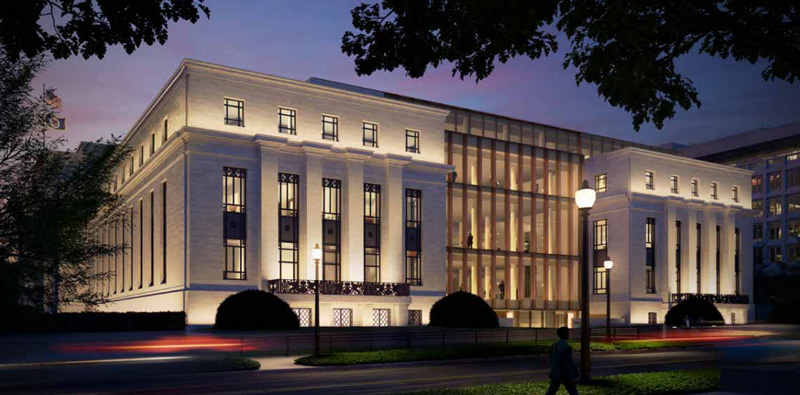
You can look at the 2021 plans for their building renovation yourself. While some of the details may have been eliminated or explained away after the political firestorm, these original plans included:


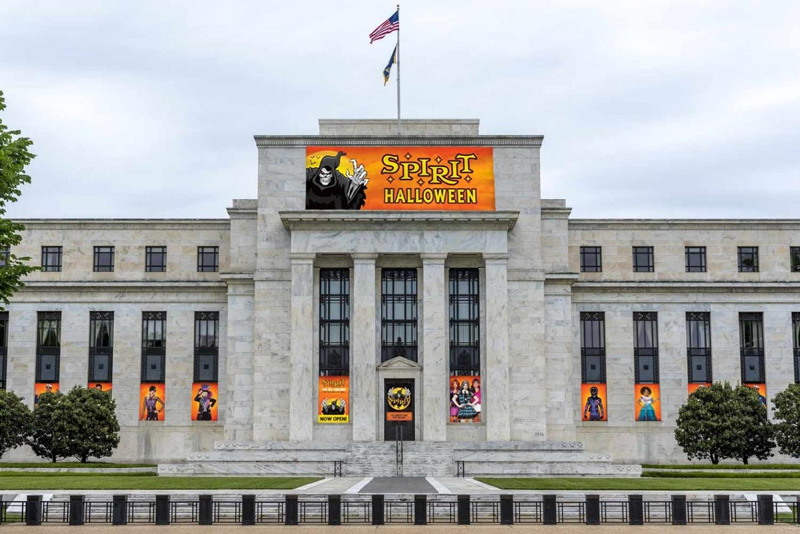
In my opinion, the renovations should look like this:
Dr. Jonathan Newman is a Fellow at the Mises Institute. He earned his PhD at Auburn University while a Research Fellow at the Mises Institute. He was the recipient of the 2021 Gary G. Schlarbaum Award to a Promising Young Scholar for Excellence in Research and Teaching. Previously, he was Associate Professor of Economics and Finance at Bryan College. He has published in the Quarterly Journal of Austrian Economics and in volumes edited by Matthew McCaffrey and Per Bylund. His research focuses on Austrian economics, inflation and business cycles, and the history of economic thought. He has taught courses on Macroeconomics and Quantitative Economics: Uses and Limitations in the Mises Graduate School. He is the author of three children’s books: The Broken Window, Ludwig the Builder, and The Magic Coin. His commentary appears regularly in the Mises Wire and Power & Market.
|
Send this article to a friend:
 |
 |
 |
 The estimated costs of the Fed’s building renovation project have risen from $1.9 billion to $2.5 billion. Hilariously, the Fed