
Send this article to a friend:
January
16
2026
|
Send this article to a friend: January |
World on Fire? Be a Buyer!
You see, the Chicken Little Austrian School forgets to remind its adherents to gather ye rosebuds while ye may. That is, there’s a boom before the bust, and one has to make hay while the getting’s good, no matter how much you disagree with the prevailing fiscal or monetary policy. Yes, the state is a gang of thieves writ large, as Rothbard said. But he neglected to say you had to figure out how to understand the thieves to make out like a bandit. The thieves of the state steal value. The mechanism they use to steal this value is inflation. You need to learn how to beat inflation to win the game. It’s as simple as that. But it’s not always easy. Except in times like these. If there’s one thing Donald Trump doesn’t have, it’s a poker face. Like Larry Bird calling a three-pointer and then draining it over his opponent, The Donald tells you his every move before he does it, on purpose. So let’s try to interpret the news and read the tea leaves together, shall we? Power… Everywhere. Control, Nowhere.War, inflation, and political chaos are back in fashion… again. Venezuela’s currency is preparing for its next rebranding campaign (the Bolívar Reborn, perhaps?), Israel and Iran are exchanging the kind of pointed “regional diplomacy” best measured in drones, and Russia continues to grind away at Ukraine while energy traders grind their teeth. The United States, of course, is busy projecting power everywhere and control nowhere. A sensible investor, observing this dog’s breakfast, might think it’s time to sell everything and move to the countryside, far from the maddening crowd. But the cheerfully irrational creatures known as the global markets see it differently. They smell opportunity. So should you. The Inflationary Spirit Is EternalThe Federal Reserve insists, firmly and yet politely, inflation is under control. Jerome Powell, the outgoing circus ringmaster, promises that price pressures are “broadly consistent” with the 2–3% fairy tale. Yet, behind closed doors, traders are already toasting Kevin Hassett, the probable incoming whipbearer, who is expected to rediscover the alchemy of “accommodative policy.” In central bank jargon, that translates roughly as: “The printing will continue until morale improves!” Ever the optimists, the markets know what that means… Lower rates, re-expanded balance sheets, and, before long, another asset price resurgence. If money is about to become cheaper, the only rational reaction is to pay more for everything that isn’t made of paper. The War DividendFor all their tragedy, conflicts tend to have curious side effects on markets. Mainly when waged by the United States, wars are the Keynesian stimulus packages that dare not speak their name. Missiles create manufacturing jobs, especially for Lockheed and Raytheon. Rebuilding contracts provide recurring revenue streams, as if they were government-backed subscriptions (which they are). Ever so conveniently, defence stocks offer diversification against geopolitical risk. America’s military adventures have long been a reliable source of GDP growth, though it would be impolitic to say so out loud. Since GDP counts spending as output, this makes complete sense. For every drone strike abroad, there’s a congressional earmark at home. The moral arithmetic may be questionable, but the fiscal pork adds up nicely. Gold, Silver, and the Return of Material RealityWhile equity traders celebrate this peculiar synthesis of chaos and optimism, the world’s central banks are quietly hedging their enthusiasm. Russia and China continue to buy gold by the tonne. Even Venezuela, between defaults and currency resets, finds creative ways to acquire more bars. Gold, it seems, has become what diplomats used to call “non-aligned.” It respects no sanction, owes no loyalty, and yields no interest, and yet somehow inspires the most devout faith. Silver, for its part, remains both the greedy and the frugal investor’s rebellion against fiat money—an enduring relic of pre-digital credibility. Both metals thrive on the same principle that drives Bitcoin enthusiasts and gold bugs alike: the conviction that monetary restraint is a fairy tale for children and finance ministers, but I repeat myself. The Rational Response to Irrational TimesFor those who prefer narratives over numbers, it’s tempting to dismiss market buoyancy as delusion. Yet history suggests something subtler. When governments overpromise, central banks capitulate, and fiscal deficits balloon, tangible assets like equities, commodities, and metals quietly price in the coming rescue. The world can burn only so long before policymakers reach for the extinguisher marked liquidity injection. Investors who bought during earlier infernos like Vietnam, Iraq, and the 2020 pandemic panic were rewarded, not punished, for betting on the system’s inability to confront its own excesses. This, then, is the paradox of the moment: The greater the dysfunction, the stronger the case for owning something real. If history repeats as it generally does, first as tragedy and then as quantitative easing, those who maintain their composure while central banks rediscover the joys of “temporary” stimulus will have the last laugh. After all, if the world is determined to set itself on fire, it’s only sensible to own the flameproof assets. So get long and stay long equities and the metals, my friend.
|
Send this article to a friend:
 |
 |
 |
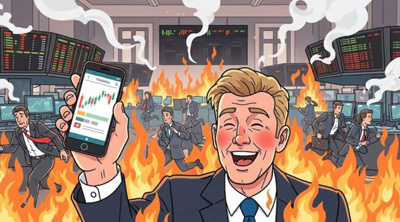 I spent years in the financial wilderness, waiting for the sky to fall.