Battle Royale
Bill Bonner
 Hear that noise? It's not sleigh bells ringing. It's not children singing. No, that's the sound of pumps working night and day. In addition to cutting rates, the Fed and the European Central bank are pushing up and down on their pumps as hard as they can - lending extra money as fast as borrowers will take it. Hear that noise? It's not sleigh bells ringing. It's not children singing. No, that's the sound of pumps working night and day. In addition to cutting rates, the Fed and the European Central bank are pushing up and down on their pumps as hard as they can - lending extra money as fast as borrowers will take it.
The idea is to replace the liquidity that the markets are destroying...and prevent the free market from working. That is, the feds try to artificially increase the supply of cash and credit...so as to avoid correcting mistakes.
As we explained on Friday, it's almost impossible for an economy to correct mistakes when the price of money is going down. Instead, mistakes are typically made worse. A guy who is deeply in debt, for example, finds that the easiest thing to do is to borrow more! Already, the feds have practically sunk the entire economy with too much debt; now they're trying to put more debt into the system.
Economist Gary Dorsch describes the situation:
"The worst is yet to come for the global banking system, which faces potential losses of more than half-trillion dollars from investments in toxic sub-prime US mortgage debt. "The problems in the financial sector remain with us," said Bank of England chief Mervyn King on Nov 19th. "A painful adjustment faces the global banking sector over the next few months as losses are revealed and new capital is raised to repair bank balance sheets," he said.
"To defuse the crisis, the Fed, the European Central Bank, and the Bank of England are pumping enormous sums of money into the banking system, at below market interest rates, to prevent a "credit crunch" from triggering a global stock market meltdown. "Central banks are working together to forestall any sharp tightening in credit conditions that might lead to a downturn around the world," King declared.
On Friday, we saw some effect - the Dow rose 205 points.
But what markets take away, the feds have a hard time replacing. This is the Battle Royale we've been talking about. Inflation vs. Deflation; Markets vs. Market Manipulators.
The markets clearly want to go down...they want to correct the mistakes of the past five years...maybe the past 25 years. And that is what the headlines are telling us. This morning, for example, we find CNN telling us "credit card defaults are alarmingly high." The LA Times adds that "job data" in the Golden State give rise to the "fear of recession."
And Robert Kuttner, writing in the Boston Globe, tells us that a "perfect storm" has hit the U.S. economy. Where do they find people like Kuttner? The man misses the point completely. He thinks laissez faire economics has failed. It is a case of "free market fables thoroughly discredited by events," he says. What to do about it? Give the economy some of that old elixir - central planning! No kidding. He says fixing the situation "will require a repudiation of free-market economics."
Get ready for it, dear reader. When this thing blows up, people like Kuttner are going to look like they have some sense. They're going to prescribe more regulations...more government programs...more central planning and meddling. And the voters - who never seem to have a clue - are going to go for it. They're going to believe that capitalism has failed...that capitalists are greedy...and that we'd be better off having apparatchiks and hacks running the economy.
Of course, you know the real story, don't you, dear reader? It's not the free market that prints up dollar bills and floods the world with them...or creates Sovereign Wealth funds...or sets the Fed's interest rates. But that is a long story...we'll come back to it.
Besides, today is Christmas Eve. Surely we have something better to do than to dig around in the dustbin of the world's monetary system...or bring out some old shopworn relic of Soviet Era economics, like Kuttner, just so we can tell you what a moron he is. And surely, you have something better to do listen to us.
You don't?
Well, then we'll just keep going. But in the holiday spirit, let us say that we love people like Kuttner; he may be a disaster as an economist...but he is a delight to a financial observer with a sense of humor.
Now...back to our story:
The problem with working the pumps is that the pumps don't always work. There, that seems simple enough.
And here we turn to Ambrose Evans-Pritchard, writing in London's Telegraph newspaper, for elaboration:
"Liquidity doesn't do anything in this situation," says Anna Schwartz, the doyenne of U.S. monetarism and life-time student (with Milton Friedman) of the Great Depression.
"It cannot deal with the underlying fear that lots of firms are going bankrupt. The banks and the hedge funds have not fully acknowledged who is in trouble. That is the critical issue," she adds.
"Lenders are hoarding the cash, shunning peers as if all were sub-prime lepers. Spreads on three-month Euribor and Libor - the interbank rates used to price contracts and Club Med mortgages - are stuck at 80 basis points even after the latest blitz. The monetary screw has tightened by default.
"York professor Peter Spencer, chief economist for the ITEM Club, says the global authorities have just weeks to get this right, or trigger disaster.
"The central banks are rapidly losing control. By not cutting interest rates nearly far enough or fast enough, they are allowing the money markets to dictate policy. We are long past worrying about moral hazard," he says.
"They still have another couple of months before this starts imploding. Things are very unstable and can move incredibly fast. I don't think the central banks are going to make a major policy error, but if they do, this could make 1929 look like a walk in the park," he adds."
Ai yi yi. Merry Christmas...
Well, what other thoughts do we have?
We're working on a thought, however.
"God sent His son down from heaven," the priest explained at yesterday's mass here in Buenos Aires, "so he could be among us. So he could be a man. So he could share our fate...our lives. So he could be human. He did that so that we could be closer to God...the good news was that his son - who was just like us - a man too...showed us that we could join God. We could be with God. This is the good news of Christmas."
We were joined at Sunday mass by almost the entire family. Elizabeth and the boys flew in from Paris. Maria came from London. Our oldest son already lives here in Argentina. Only two children - out of six - were missing...one because he missed his plane and had to spend the weekend in Dulles Airport. The other because she is spending Christmas with the family in the United States.
"Well, he could have added that this good news was revolutionary," said Elizabeth, who has recently begun a new career. With the children leaving home, Elizabeth faced a question that many women face. She looked around and wondered what she would do. She is still a young woman. Should she go back to work? Should she start a business? Should she take up horse riding more seriously? No. Elizabeth decided to go back to school. She is studying history at the Sorbonne in Paris.
"In the ancient religions - at least in Greece and Rome - there was a clear separation between men and gods," she explained. "Whenever a man got too close to the gods, he died in some horrible way. Artemis, for example, saw the goddess Diana naked. He was turned into a stag and devoured by his own hounds. And remember that woman that Zeus was sleeping with? He came to her only in the dark of night. She asked him to prove that he really was Zeus. So he showed himself to her...and she burned up. It was impossible for man to walk among the gods and a big mistake to try. In the Greek tragedies, almost always, a man acts as though he thought he was a god...and the gods punish him. That's what hubris is all about...pretending that you have the power of the gods. And I know you like to point that out too. That as soon as the Federal Reserve...or economists...or politicians...think they can look into the future and improve it before it happens, they are acting as though they thought they were gods. 'It is not given to man to know his fate,' is the old expression. And if you pretend to know it, you're going to be punished. You're going to reach too far...you're going to be a victim of your own pride and conceits. That's what the ancient lessons are all about."
"One of the really revolutionary things about Christianity is that it allows men to join the gods. We have the idea of saints. And the idea that you can be a saint. And we even think that you can pray to a saint - not only to God himself - and that the saint will intercede with God on our behalf. Christianity tells us that we can join the whole company of saints...and join God himself...in heaven. We won't be punished for trying to be godlike. Just the opposite, we will be rewarded. That is revolutionary. And that is what we are celebrating on Tuesday."
Merry Christmas,
Bill Bonner
The Daily Reckoning
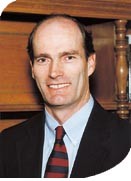 Bill Bonner is the
founder and president of Agora Publishing, one of the world's most successful
consumer newsletter publishing companies,
and the author of the free daily e-mail The Daily
Reckoning. Bill's passion
for international travel and big ideas are reflected in the company he's
successfully built. In 1979, he began publishing International
Living and
Hulbert's Financial Digest. Since then, Agora has grown to include dozens
of newsletters focusing on finance, health and travel. Since the early '90s
Bill has vigorously expanded from Agora's home base in Baltimore, opening
offices in London, Paris, Bonn, Waterford, Ireland and Johannesburg, South
Africa. Bill Bonner is the
founder and president of Agora Publishing, one of the world's most successful
consumer newsletter publishing companies,
and the author of the free daily e-mail The Daily
Reckoning. Bill's passion
for international travel and big ideas are reflected in the company he's
successfully built. In 1979, he began publishing International
Living and
Hulbert's Financial Digest. Since then, Agora has grown to include dozens
of newsletters focusing on finance, health and travel. Since the early '90s
Bill has vigorously expanded from Agora's home base in Baltimore, opening
offices in London, Paris, Bonn, Waterford, Ireland and Johannesburg, South
Africa.
***
|