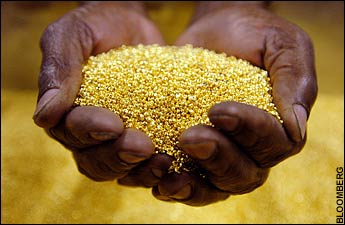
Gold is now more precious than ever
Demand still outstrips supply, but with the era of easy exploration gone, investors switch focus to mergers and acquisitions Roman Abramovich's investment in Highland Gold Mining underlines that the precious metal is becoming more precious by the month. Gold is increasingly hard to find, but the demand for gold companies is strong.
These two are related, of course. Last week, James Mavor, vice-president of the world's largest gold miner, Canada-based Barrick, said production of the metal was falling faster than expected, and would drop, perhaps, 10pc over the next five years. "The industry has not been acquiring new mines," Mr Mavor told a mining conference. "What would normally take three to five years to commercialise now takes about seven to 10." Increased labour and equipment costs make some mines more expensive to exploit. The number of mines with only gold is falling, so companies turn to deposits mixed with copper or silver - with their separation costs. As with oil, the days of "easy gold" are over, and increasingly the answer is to spend more money on mergers and acquisitions rather than exploration. Mr Abramovich's decision, through his Millhouse investment vehicle, to buy a £200m stake in Highland, follows the acquisition last month of another gold producer operating in Russia, Celtic Resources, by Alexei Mordashov, billionaire owner of Severstal. Barrick has large stakes in both UK companies and supported the Severstal takeover and yesterday's investment by Millhouse. Several of Russia's richest men own major gold assets. Oleg Deripaska, a close associate of Barrick's founder Peter Munk, has gold companies in Mongolia. Viktor Vekselberg controls Zoloto, and Vladimir Potanin owns a large slice of Polyus. Mikhail Fridman established a gold company earlier this year. In Russia, much investment is still needed to explore potentially high-quality fields. Many smaller firms need the backing of rich individuals or companies. Russia is not always an easy place to do business and it helps to have on side a backer or owner who understands the system. John Meyer, head of resources at investment bank Fairfax, says further takeovers inside and outside Russia are more than likely. European Goldfields is an attractive takeover target, he believes, as is Peter Hambro Mining. "There has been quite a lot of consolidation in the industry already and there will be a lot more of it going on over the next five or 10 years," he said. Russia's gold output has fallen by more than 15 tons in three years as investors who buy mining licences don't always have the means or intention to develop projects, said Viktor Ivanov, of the Gold Producers Union. "We hope the arrival of more prominent and active investors will stimulate production." The industry lobby group expects Russia to mine 144 tons of gold this year. Gold prices had been trading close to 27-year highs of $850, a level not seen since the 1980s, but have fallen back in recent weeks. Some analysts think the price has peaked. But Henry Horne, managing director of Highland, believes the dip in price is just a "cyclical thing". Despite the recent fall, gold prices have risen 26pc this year. Mr Horne said yesterday: "I'm very bullish on gold. There is a huge upside because demand will continue to outstrip supply." Barrick's chief executive, Gregory Wilkins, says the price "could easily move to $900, $1,000 or beyond. It could happen very quickly." Speaking at an RBC Capital Markets conference in London last month, Mr Wilkins said: "There is a great disparity between the money spent on exploration and success. It's hard to say where the price of gold is going because we're in uncharted waters." ***
|
 |
 |