
Oops, they're on to you
Eventually De Niro gets another cop (David Caruso) to beat up the loser boyfriend, and save the neighbor from further torment. Incredibly, Caruso does the job without a single CSI Miami-style close-up. The Uma Problem, however, takes the rest of the movie to work out. Last Thursday, Fed Chairman Bernanke testified to Congress that economic growth should slow in the fourth quarter and that the number crunchers at the FOMC expect GDP growth to remain on the weak side early next year. But the Fed expects this housing thing to be behind us in no time, and the economy should pick up thereafter. The chairman also testified that while inflation has been kicking up some dust lately, the bottom line is that overall and core inflation should be "consistent with price stability next year." It's too bad regular Americans don't get the chance to testify before Congress. If they did, many might say something like this: "Mr. Bernanke, we're on to you!" Here's why: On Sunday, syndicated columnist Bob Herbert opined that if Mr. Bernanke would just "open his eyes" he would see what so many Americans are already see, and that is tough sledding. And what does the columnist Herbert see? "Flimflammery." That he calls the government's statistics on a variety of topics. In other words, even a New York Times political columnist, a man less consumed with Federal Reserve policy than Hanna Montana, understands that the official stats don't mesh with the real world. As Herbert sees it, the real world is the opposite of the statistical world which tells us: "job growth good, inflation low." The management of Sara Lee and Black & Decker probably see things with Herbert's eyes, at least when looking at recent financial statements. Both the maker of frozen cakes and the purveyor of must-have power tools complained that rising inputs have crimped profit margins. And as Barry Ritholz explains, the biggest factor behind positive October same store sales for many retailers wasn't a productivity miracle, or an unstoppable consumer, it was food inflation. Herbert is onto Bernanke, but he's not alone. Thousands of people who aren't New York Times columnists don't buy that we aren't already in a recession. What other conclusion can a reasonable human draw from the hoards of people willing to pay good money to hear a man tell them what they already know: "Spend less, save more." That's what radio host and anti-debt guru David Ramsey preaches to the masses as he tours the allegedly recession-free USA. Five thousand would-be and converted savers recently attended an Atlanta area event, including one disciple who paid off $24,000 in credit cards in less than a year while learning to live on $1,100 a month. The Atlanta devotees are an unlikely bunch to hold hands and buy an SUV as one Fed president famously suggested. Same goes for the thousands planning to attend upcoming Ramsey lectures in Indianapolis, Grand Rapids, Dallas, Lexington and San Antonio. At long last, is "frugality" the new "new kitchen"? Could be judging from Paul Kasriel's chart of Mortgage Equity Withdrawal. That's chart #9 way down the page of his latest Economic Outlook. The chart shows the huge amounts of money that have been sucked out of home equity over the past few years. Recent withdrawals total twice the levels of 2000. But today, thanks to tighter credit, the home ATM is missing the "fast cash" option. That means that this source of funding (or any source?) will be smaller over the next seven years. As an indication of tighter mortgage credit generally, Countrywide reported that its October mortgage loan fundings fell by almost half year-over-year, with subprime lending insignificant. To paraphrase NASA, "More spending is not an option." Consumers are already spending a record amount of what they are earning. Kasriel's chart 5 tracks the ratio of real personal consumption expenditures to real disposable personal income. By this measure, we are spending like the war is already over. World War II, that is, back personal when balance sheets were sound and kitchen counters were devoid of espreso machines. David Ramsey might sum up this disjointed column this way: Tighten the belt. Pay off debt. Aggressively save. Watch out for inflation. But if enough people take his advice, it will take a lot more flimflammery to avoid a recession. |
 |
 |
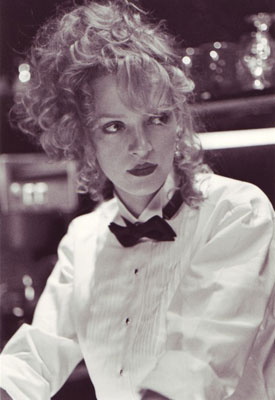 In the 1993 movie Mad Dog and Glory, Robert De Niro plays a police photographer who saves the life of a small time organized crime figure. The crime boss (Bill Murray) tries to return the favor by loaning DeNiro the character played by Uma Therman. While loaning out Ms. Therman is a grand gesture, De Niro is understandably uncomfortable with the arrangement. In a minor subplot, De Niro realizes that his kind-hearted neighbor is being abused by another member of the police force, but is afraid to confront the guy. One night De Niro checks on a disturbance only to have the boyfriend slam the door in his face. Feeling helpless about the whole thing, De Niro, shouts through the door, "I'm on to you!"