|
|
The Rush for Gold: Sales of Bars Double
Dominant social theme: When people are nervous, they put money in gold. It's just nerves! Free-market analysis: Funny how investors turn to gold as an "effective hedge" and a "safe haven in times of financial turbulence" - as if gold is a metaphorical barometer of investor timidity. Instead of "sucking it up" and realizing that the value of money rises and falls in a "real man's" economy, investors - cowards that they are - try to find ways to avoid stagflation and devaluation. Thus it is that statements about gold and the ownership of gold sometimes seem to verge on a kind of propaganda war. Who's responsible? Well, a good guess as to who is behind this covert (so far anyway) war on precious metals would be those who have a stake in the system as is, particularly those working in the financial industry and in central banking. Of course the war doesn't have to remain covert. Those of us with longer memories will recall that in 1933 under Franklin Delano Roosevelt, gold holdings were made illegal and people lined up to turn in gold lest they be labeled as "hoarders" and worse. Could it happen today? There is always that possibility. In America and elsewhere in the West, certain laws allow the confiscation of gold, and silver too. Even where such activities are frowned upon, it is always possible that they could happen anyway. Gold and silver are certainly a threat to those in power and to pretend otherwise is to refuse to acknowledge the lessons of monetary history. There is simply no gainsaying that the middle class predilection to holding gold and silver undercuts the power of central banking. After all, it's hard to control the money supply when the people who are supposed to use your money insist on keeping something else at home as a store of ultimate value. It is probably not too strong to say that holding gold and silver provides a window for people to withdraw emotionally and practically from the fiat money system. It is a threat to central banking, particularly, because if things get bad, people can begin to barter using gold and then the whole private money system begins to activate again. Conclusion: If one finds the current monetary system at all funny, versus sad and even desperate, then the bias shown against gold and silver has taken on some of the proportions of a running joke. Central banks and their allies have done everything possible to trivialize and discredit the ownership of gold and silver. In no special order, they've manipulated the market to keep prices low via hedging and shorting, used mainstream media to criticize high "commodity" prices and positioned gold as a harbinger of "doom and gloom." This last is especially clever because seen this way the ownership of gold and silver becomes a statement as to whether or not one believes in the viability of the system. Thus, within the vast Western middle class, anyway, ownership of even modest amounts of gold and silver was gradually conflated with a kind of over-emotionalism and lack of rationality. Central banks have done other things to restrain gold and silver prices from moving up. They've artificially restrained the supply of gold and its availability and they've sold gold or threatened to sell gold in serial formulations, first one then another and another. This happened, especially in the 1990s. And what has been the result of all this? Central banks have divested themselves of billions of dollar's worth of gold while the price has quadrupled in the past five or six years. Mainstream media and pliant economists have expended tons of newsprint decrying gold as a kind of 'barbaric relic' (as socialist economist John Maynard Keynes put it) and still, in the end, as the economy collapses, the middle class turns to ... gold. One can almost hear the hairs on central bankers' collective heads being pulled out by the roots. When will people get it? Gold is yesterday's news! But when fiat economies go sour, people buy gold. The price doesn't seem to matter (gold is neither screamingly high nor terribly low) and neither do years, even decades, of anathematization. It's almost as if people have a genetic instinct toward holding money metals during times when things aren't so good. It's well known that people harbor certain feelings about, say, fire that are universal and cut across gender, conditioning and upbringing. Why not gold and silver as well? Chances are after thousands or even hundreds of thousands of years, natural selection (if that's what it is) has encouraged the holding of honest money as a survival trait. If that's the case, then central banks have a lot more work to do and are up against something far more powerful and primordial than they perhaps expected. That won't stop them of course. Look for more concerted attacks on gold, especially, if prices continue to rise. It's just nerves after all, isn't it? |
 |
 |

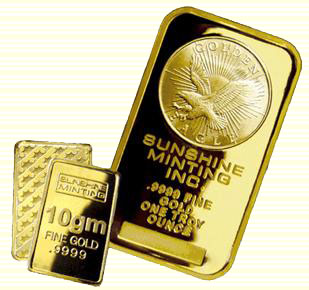 Britons who still have any wealth to invest are turning their backs on the property portfolios, stocks and shares, and sports cars that have long constituted conventional investments, and pumping their savings into old-fashioned gold bullion and coins. Leading gold bullion suppliers BullionVault, ATS Bullion and Baird & Co have all revealed record levels of investment in gold bars, and the World Gold Council (WGC) has reported a big increase in the number of gold coins being bought. Last year saw an 81 per cent increase in UK investment in gold coins, taking the amount bought to 4.5 tons. Traditionally, in Indian and Asian markets, gold jewelry and coins have often been traded, while in France and Italy the trade in ingots - small pieces of gold - has previously been much stronger than in the UK. But this is changing. "We have seen a rising level of interest in gold as an investment in the UK," said Matthew Graydon of the WGC. "Retail investors have realized that gold offers an effective hedge against currency movements, is an effective inflation hedge, and is a proven safe haven in times of financial turbulence." - Guardian