
Send this article to a friend:
December
26
2013

|
Send this article to a friend: December |
|
Facing the Future – Mitigating a Liquidity Crunch 
Despite the media talking up optimism and recovery, people are not seeing the supposed good news playing out in their own lives. As we have discussed here many times before, the squeeze continues on Main Street, while QE has generated asset bubbles at the top of the financial food chain. Complacency reigns, but this is the endgame. Increasingly delusional collective optimism, based on illusory wealth for the few, has ben the driving force for 2013, even as the smart money has been selling everything not nailed down for most of the year – cheerfully handing the empty bag to a public that demands it. It’s been a five year long party, where, demonstrably, no lessons were learned from the excesses preceding the previous peak, and the consequences that followed from it. Now, as a result of throwing caution to the wind again (mostly with other people’s money of course), we face another set of consequences, but this time the hangover will be worse. Timely warnings are rarely credible, as they contradict the prevailing wisdom of the time, but it is exactly at this time that warnings are most needed – when we are collectively irrationally exuberant on a grand scale. We need to understand the situation we are facing, in order to see why this period of global excess will resolve itself as a global credit implosion, what this means for ourselves and our societies, and what we can hope to do about it, both in terms of preparing in advance and mitigating the impact once we are confronted with a new, sobering, reality. We are facing an acute liquidity crunch, not the warning shot across the bow that was the financial crisis of 2008/2009, but a full-blown implosion of the house of cards that is the global credit pyramid. Not that it’s likely to disappear all at once, but over the next few years, credit will undergo a relentless contraction, punctuated by periods of both rapid collapse and sharp counter-trend rallies, in a period of exceptionally high volatility. The primary impact will stem from the collapse of the money supply, the vast majority of which is credit – a mountain of IOUs constituting the virtual wealth of the world. This has happened before, albeit not on this scale. Since humanity reached civilizational scale we have lived through cycles of expansion and contraction. We tend to associate these with the rise and fall of empire, but they typically have a monetary component and often involve a credit boom. Bust follows boom as the credit ponzi scheme collapses. Mark Twain commented on one such episode in 1873:
Few recognized at the time that the ensuing financial panic of 1873, at the culmination of a period of speculative excess, was going to lead to a long and grinding depression. The signs were there, as they are today, but few connected the dots in advance and understood what was about to unfold and why. Few ever do at comparable points in time. Unfortunately, humans are not good at remembering, let alone learning from, and applying, the lessons of history. The information is available for those who care to look – far more information than people had access to at previous junctures – but not in the mainstream media. The media’s role is to reflect and amplify the mood of the time, spinning events in accordance with it in a self-reinforcing feedback loop. Real information – the kind we need if we are to face a future more challenging than anything most of us have ever experienced – is found elsewhere, with independent voices contradicting received wisdom when it most needs to be contradicted. That has been our task at The Automatic Earth for the last six years. We cover the events of the day, placing them in the context of the bigger picture we have developed since January 2008. We aim to make complexity comprehensible, so that people can identify the most immediate and most significant threats and prepare themselves to face them. At the present time, the threat people most need to appreciate is a liquidity crunch, hence this is a major focus of our most recent Video Download release – Facing the Future. It is well underway in some parts of the world already and many more countries will find themselves affected in the not too distant future. Essentially, a liquidity crunch creates a situation of artificial scarcity. People hold on to what money they have when they are unsure when they might earn any more of it, as makes perfect sense from an individual perspective. However, when a large number of people do so, the amount of money in circulation falls sharply, leaving an insufficient supply to sustain anything like the same amount of economic activity. Not just actual unemployment, but the fear of future unemployment can be enough to cause spending to plummet, drastically reducing money in circulation. When money is not available to change hands in exchange for goods and services, those goods and services are not exchanged. In the Great Depression of the 1930s, observers noted that “they had everything but money”. The people and resources were still there, but were not able to connect. As an artificial construct, one might think that a loss of money would have little impact if other factors remained, but this is not the case. As we have explained before, finance is the global operating system, and crashing the operating system has severe consequences in terms of disrupting supply chains – with cascading effect – at both local and global levels. Since this is the major risk we face, and the consequences are likely to be severe, we need to take steps to prepare ourselves and our communities. The more cohesive and close-knit a community, the better it is likely to be able to withstand external shocks, so all manner of community-building initiatives can be extremely valuable. In our new Facing the Future Video Download series, Laurence Boomert describes a wide range of demonstrably effective possibilities in considerable detail, explaining how and why they work. Such efforts address a liquidity crunch indirectly, through increased resilience.

However, there are also means to address the scarcity of money directly, and these are likely to have a very important role to play. Alternative currencies can go some distance towards filling the void left by a lack of money in circulation, albeit at a local level. These have been used in many places faced with an economic seizure at the national level, notably Austria, during the Great Depression of the 1930s, Argentina, following the financial crisis of 2001, and Greece today. They are very likely to arise spontaneously in times of crisis, but have the potential to be more effective more quickly if established in advance. A range of them is covered in our new Facing the Future Video Download material.

Nicole Foss and Laurence Boomert with Peak Moment TV’s Janaia Donaldson (center) in Vancouver, Canada
The best known, and arguably most effective, example of local currency in action is the Austrian town of Wörgl in the early 1930s. In the depths of the depression, with over 30% unemployment, the mayor, Michael Unterguggenberger, did not have the funds to cover projects he wanted to build to put his constituents back to work. Rather than use his reserves of 40,000 schillings, he deposited these in the bank and in 1932 issued local stamp scrip backed by his reserves. The scrip required a stamp each month, at a cost of 1% of its face value (a feature called demurrage), hence there was an incentive to spend the money rather than to hoard it. Although the incentive was small, the psychological effect was disproportionately large, keeping the money in circulation at a substantial rate. Although only a small quantity of scrip was issued, it circulated quickly enough to support a great deal of economic activity in a town previously caught in the grip of an economic seizure:
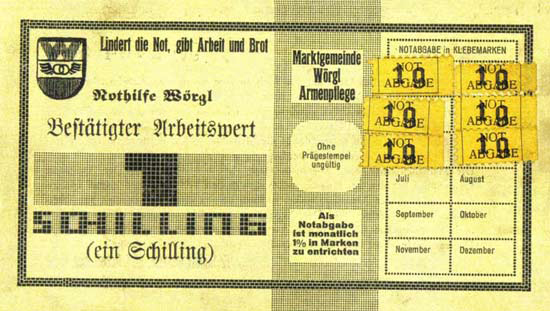
The use of scrip enabled approximately 100,000 schillings worth of local government spending to occur on projects without the need to deplete reserves of national currency at all. In addition, a multiple of this amount in private spending occurred, even though only some 8000 schillings worth of scrip was ever in circulation. Altogether, it has been estimated that some 2.5 million schillings worth of economic activity was financed in one year. As the stamp scrip was a creation of local government, people were allowed to pay their taxes using it. As there were substantial tax arrears, this was an effective tool for encouraging the acceptance of the currency. People were, in fact, paying their taxes early in order to avoid the 1% monthly loss due to the stamp fee:
Mayor Unterguggenberger understood the nature of the crisis he was addressing and how is stamp scrip acted to mitigate it. Each Wörgl note was printed with the following justification:
It was not necessary for the stamp scrip to replace the national currency, only to supplement it. Local currency in Wörgl was always exchangeable for Austrian schillings, at a cost of 2%, but the scrip was so well accepted that few sought to covert it. One observer, Claude Bourdet, master engineer from the Zürich Polytechnic, reported on the success of the stamp scrip at the time:
Local goods and services could be purchased with scrip, allowing scarce national currency to be used for non-local essentials and national taxes. If spread widely enough, this model could potentially have protected both local and national supply chains, at least to some extent. However, the central bank decided to assert its money monopoly, shutting down the Wörgl experiment in late 1933 after 13 months. The town then sank back into economic depression. The deprivation across the country set the stage for an unfortunate choice of ‘solutions’:
The power inherent in a money monopoly is tremendous. As far back as the late eighteenth century, the patriarch of the Rothschild banking family, Mayer Amschel Rothschild, acknowledged the extent of power over money in saying ,”Permit me to issue and control the money of a nation, and I care not who makes its laws!” This was acknowledged in the early days of the United states, when debt enslavement was recognized as the power to conquer. Thomas Jefferson wrote of his concern in 1816:
We have had the inflation, in the form of a money supply expansion, largely based on credit creation, that has proceeded virtually uninterrupted for decades. Now we stand of the verge of the deflation that follows all credit expansions as night follows day. Given its significance, it is no surprise to find the power of money monopoly defended. The ability to do so depends, however, on being able to project power at a distance through strong central control. As this in turn depends on the extent of chaos, the state of supply lines and the availability of sufficient energy, defence will not always be possible, and a money monopoly is not likely to stand the test of time. We will need to develop alternative trading arrangements, both for the present and for the future, as we will be faced with rebooting our financial operating system.
Given the potential for local currencies to mitigate the coming liquidity crunch, it is very much worth the effort to create one. They exist in many locations already, some with a history measured in decades. Emergency currencies have also been recently created in order to address the liquidity crisis already hitting the European periphery. For instance, the Greek town of Volos holds a market where all goods and serviced are denominated in TEM (Τοπικ? Εναλλακτικ? Μον?δα, meaning Alternative Monetary Unit):
Such networks clearly have significant social value in bringing people together to face hard times. Much can be gained through mitigating the psychological effects of deprivation in isolation, and the resulting relationships of trust can be enduring. Providing the ability to purchase goods and services, including essential staples, without the requirement for scarce euros, is also critical for those without any other means of support:
The Greek government approves of this limited form of monetary creativity and has passed legislation encouraging "entrepreneurship and local development” as a substitute for the welfare state it is no longer able to provide. So far nothing more ambitious that might challenge the money monopoly has been attempted. The TEM system of electronic barter only goes so far, as it does not involve local government and cannot be used as a means to meet tax obligations. Local government has only been able to offer moral support:
It is probably only a matter of time before a more ambitious form of alternative currency, along the lines of the Wörgl experiment, is tried in some of the regions of the European periphery where suffering is particularly acute. This may occur before or after these countries give up their doomed attempt to stay in the eurozone, but would probably be more successful if tried during a transition away for the euro, as this would amount to less of a direct challenge to the global money monopoly. Experiences gained in such an experiment would be valuable if communicated to other locations, many of which will be facing similar difficulties in their turn. An alternative currency interchangeable with the national currency and usable for local tax obligations, as in Wörgl, is not necessarily a panacea, nor even a permanent solution, but it can make a significant difference mitigating the effects of a liquidity crunch in the short to medium term. Had the Wörgl experiment been allowed to continue, it is possible it would have run its natural course before the local economy could have become self-sustaining:
Nevertheless, the monetary experiment allowed for many municipal projects to be completed and for local economic activity to be supported for a period of time. This was clearly beneficial. As with the TEM currency in Greece, part of the effect of local initiatives like this is psychological – alleviating a prevailing sense of isolated deprivation and brining a community together. This has value in its own right, independent of the monetary effect. Such a course of action should be tried again, and permitted to run for longer, but it is not clear that this will happen once we find ourselves facing widespread economic depression again. The money monopoly is even more powerful today than it was in the 1930s, and even more likely to defend its powerbase, at least while it remains capable of doing so. Alternative currency can mitigate a situation of artificial scarcity caused by a liquidity crunch, but there are other limits that are not artificial. We were not facing resource limits, or a skills shortage, in the 1930s, but we are today. For a time, money will be the limiting factor, and local currencies may come into their own if allowed to do so, but beyond that financial crunch we will have to face physical curbs to growth. Energy will probably be the next hurdle we have to address. The future will be challenging and we must face it fully informed.
For those who are interested, I will be teaching, along with Albert Bates, Marisha Auerbach and Christopher Nesbitt, on a Permaculture Design Certificate course in Belize in 2014. The course will be the 9th annual event held at Maya Mountain Research Farm between Feb 10-22nd. Click here for details and registration.
This article addresses just one of the many issues discussed in Nicole Foss’ new video presentation, Facing the Future, co-presented with Laurence Boomert and available from the Automatic Store. Get your copy now, be much better prepared for 2014, and support The AutomaticEarth in the process!
|
|---|
Send this article to a friend:
 |
 |
 |