
Send this article to a friend:
November
29
2013

|
Send this article to a friend: November |
|
How Fed Spreads Price Inflation via Taper 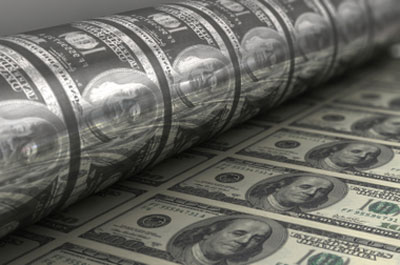
How does the Federal Reserve Bank (Fed) taper quantitative easing (QE), to aid the "take away?" How does the Fed raise rates, and regain control over the short interest rates heading subzero, while better focusing credit on prices planners prefer manipulated. In turn, manipulating expectations, and in turn, human action? How does the Fed continue QE indefinitely, while varying pace to meet their needs? We have seen "many" officials at the Fed want to formally allow an unlimited amount of deposits to earn a rate fixed by the Fed (likely starting near 0.16%), in turn the market gains Fed-owned Treasuries or mortgage backed securities, causing two of 4 formerly clogged conduits of credit to soon flow: 1. As Fed's Treasuries rise, they can be sent back into the market to displacing demand in reuse, where multiple cash loans can be made against the collateral (increasing propensity to lengthen collateral chains, or create new ones as Fed collateral becomes a known quantity (and thus why it is wanted by some for money market mutual funds (MMMF) deposits to be subjugated)). 2. Banks incentivized, and given legal balance sheet space to "begin lending," as liabilities to non-banks fall (moved to the Fed), rather than just reserves used as collateral inflating financial markets. Enacting the above also regains control over short rates, as the Fed can fix the price they will pay for deposits held in Fed accounts. In this way non-banks formerly with Fed reserves (unable to earn 0.25% interest, as only banks can earn 0.25% in reserves accounts at the Fed (and not on just the 'excess')) lending them out inter-bank, pushing rates further lower to a now average 0.09%, can now gain in part as banks do--from the Fed--further adding cash (3 of 4). This also allows the Fed to raise interest rates without the price of collateralized lending moving away lower, from uncollateralized rates. Or how the ECB could wrongly take bank account deposit rates negative--imposing the ultimate incentive to spend faster, so long as bank note withdrawal was further limited. How to cycle the rate of balance sheet accumulation by the Fed, or taper, and untaper is aided by this tool as the illusion of the end, or health is importantly portrayed (4 of 4), when the case is such that the faucet head is triplicating at a time when base currency is hyperinflated, and will remain so spare the Fed's accounting treatment of repo we will be treated to, thanks to FASB (105). Let's put this stuff not on a Dodd-Frank mandated, Fed-backed, central counterparty where scarce assets are centralized and losses borne by the populace, but rather let banks keep it. And rather than funneling cash back to the government via bank fines, let banks passing through existing legal resolution process without hilarious FASB changes (marking the first day, Feb 5 of the stock market remarking from lows) by 3 members of the 5-person Financial Accounting Standards Board (FASB) who voted in favor of these additional proposals:
The proper process of receivership, causing the good assets to be taken over by the prudent (i.e. Lehman) is the legal way to "redistribute" rather than suspending free market capitalism. Results of the above process for the dollar value versus real goods, services and money? Wwow Lastly, we just can't stress enough the charade that is "this coming Spring" as a US congressional supermajority is now required to restrain the Federal creation of debt, including Duke University's Campbell Harvey maligned and Treasury (and banker) approved, floating rate note, where by if rates go up, interest payments from taxpayers go up immediately, not just when debt is rolled. In an interview with Bloomberg he comments on the timing: "If the Treasury had converted half its outstanding debt in 1993 into floating-rate notes or bonds, the interest expense savings would have amounted to about $2 trillion given the fall in rates." Obviously, today the situation is different, and now that rates are pegged as close as possible to zero, Harvey has changed his tune on issuing floating rate anything: "In an environment with historically low interest rates, the Treasury should avoid floating-rate debt as it introduces risk… If interest rates go up, it puts the government at risk because they will need to come up with a lot of extra revenue to pay the interest bill." So the question remains, why do it? And who wins? Kyle Bass, Hayman Capital LP told us, the public. What happens is... Dollar inflation, broader price inflation in dollar terms ahead. h/t ZH, Peter Stella, former International Monetary Fund (IMF), Head of the Central Banking and Monetary and Foreign Exchange Operations Divisions Addendum for those who care about consuming (and forming valuations using) true methodology, a thank you to Henry Hazlitt for unpacking so many common misunderstandings in the Failure of the 'New Economics' (Audio)
|
|---|
Send this article to a friend:
 |
 |
 |