
Send this article to a friend:
November
26
2013

|
Send this article to a friend: November |
|
Who's Really King Of The World Today 
Well, if you thought you’d seen all the madness and absurdity that could possibly come out of the financial system by now, you are definitely being caught on the wrong flat foot as we speak. And there can be no doubt that much more of this will be revealed as we go along. Jamie Dimon renting Buckingham Palace to celebrate his $13 billion settlement with US regulators is just the beginning, though it’s a pretty clear statement of just how untouchable too big to fail policies have made Wall Street and the City feel. And they don’t feel that way for nothing, in every sense of the word, count on it. A Labour spokesman said this about the party at the Palace, which included appearances by the Royal Philharmonic and the English National Ballet: “"There is also the fact that this should be a special place. This is the home of the Queen. Where is it all going to end?" Well, sir, maybe it’s time to wake up, because the new kings and queens of the world have taken over. And they intend to be loud and proud about it, like any group of conquerors throughout history ever did. Fine dining for Dimon at the Palace raises concerns of commercialisation
That’s one sign that there’s been a takeover and a change of guards. The story coming out over the weekend about Royal Bank of Scotland – RBS – is another. And the “Royal” label in its name starts to sound mighty cynical. RBS is now being accused of pushing healthy client businesses into bankruptcy, so it could take over their assets for pennies on the pound. There’s one little detail that should make this even more preposterous: RBS is 81% government owned. RBS accused of pushing small businesses to the edge to boost profits
How do you like them apples, right? Still, if I were a betting man, I’d put my money on these stories sounding so hard to believe, and on people being so unwilling to believe them, that they’ll be filed under ‘too far out of left field’, and we all go about our days as if nothing ever happened. This thing about the Fed paying interest on reserves that banks have with it, is another example of this. We’ve all seen to which extent those reserves originate as directly as possible from the Fed’s own QE policies. They hand that $85 billion a month to Wall Street, much of it in exchange for MBS, so the mortgage debt risk no longer rests with the banks, and then pay interest on what it’s just handed to the banks. And whatever explanations and excuses may emanate from the banks themselves and the financial press that serves them, in essence it’s just another piece of too big to fail folly. Once it’s become acceptable to complain about the interest the Fed pays you on the reserves it’s just handed you, it’s like that Labour guy said about Buckingham Palace: “What’s next”? US banks warn Fed interest cut could force them to charge depositors
I suggested the other day that since the $85 billion a month QE that Janet Yellen intends to keep going is such an unmitigated failure – that is, from the point of view of the real economy -, why not try and give it to the American people instead of the banks? There’s no doubt that would do a lot more to revive the economy. Come to think of it: there’d be another advantage: the people wouldn’t insist on being paid interest on it, and whine and threaten and throw tantrums when they didn’t get it. Yves Smith posted a nice piece by economics professor Rajiv Sethi on Saturday, who also looks at alternatives to the QE disaster: Why Should Banks be the Only Ones with Accounts at the Fed?
Don’t worry, I know how hard it is to make people realize to what extent QE is so bad for the US economy. Because they are being told to look at the stock markets, and the records they set, and interpret those records as evidence that QE is a big success. The problem with that interpretation is that it’s evidence of the exact opposite. Stock market records in a time of global high unemployment, austerity and budget cuts are a sign of how, and to what extent, the financial industry has taken over our societies. Just like Jamie Dimon in Buckingham Palace, like RBS intentionally bankrupting its own healthy clients, and like Wall Street complaining about interest paid on free hand-outs. And for those who care to look, there are more sign of this finance coup d’état we’re in the middle of. You have to look no further than that same $13 billion JPMorgan settlement. I’ve seen all sorts of interpretations of this, but I get back to the same point all the time: only $2 billion of it looks to be certain to be non-deductible. All of the remaining $11 billion is at the very least open to interpretation. And with US banks having paid $100 billion (!) already in legal costs, vs $77 billion for their European counterparts, who would dare doubt that deals such as this have been very carefully constructed to favor the banks? I mean, once you note that these legal costs, $177 billion, are much higher than the actual penalties and fines and settlements, estimated at $125 billion and largely tax-deductible to boot, doesn’t that tell you the whole story? JPMorgan can deduct big chunk of $13 billion deal
And the guys and dolls on Capitol Hill of course put in a token appearance, but in (sad) reality they have no more power left than the Queen of England does. Congressman Peter Welch (D-VT) sent a letter to Jamie Dimon:
What, that’s supposed to make Dimon see the errors of his ways? Bring him to tears? Report to the nearest police station? No, this is simply Welch illustrating the demise of the American democracy in two simple sentences. The JPMorgan settlement, and the shenanigans that surround it, is not an isolated case. It perfectly fits an established pattern. Remember Libor? Here’s the Wall Street Journal’s interpretation of events, with some great graphs. And before we go any further, why not ask yourself how it’s possible that this long term and at times hefty manipulation of an instrument to which according to the WSJ, $800 trillion in securities and loans are linked, results in total fines of just $5 billion or so. But that’s not even what I would like to point out here, that’s a story for another day.
The WSJ added a number of graphs, which I’ll post in order, with the question if you can spot a common feature in all of them:
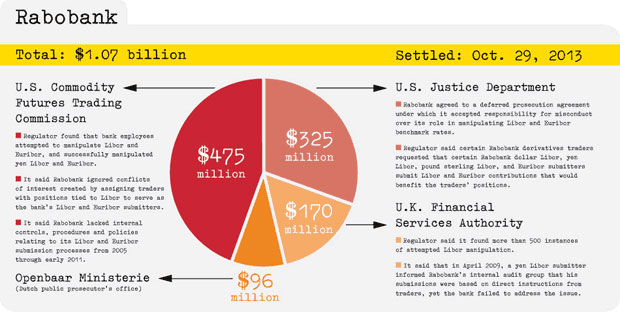
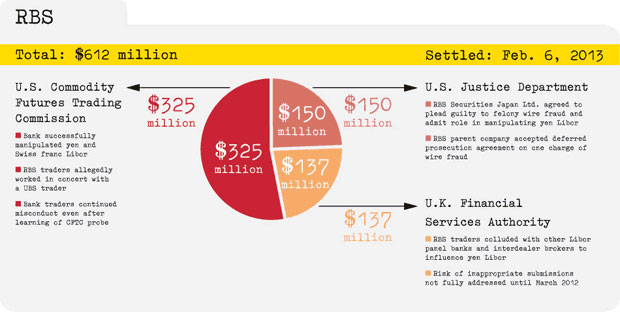
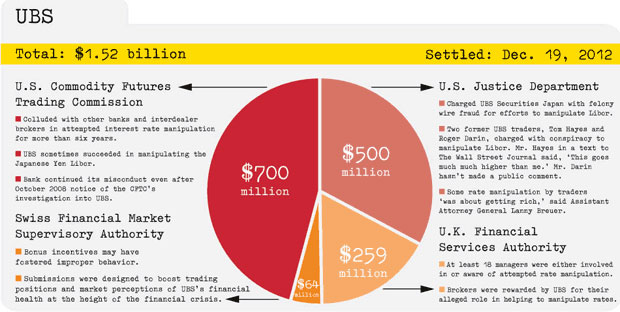
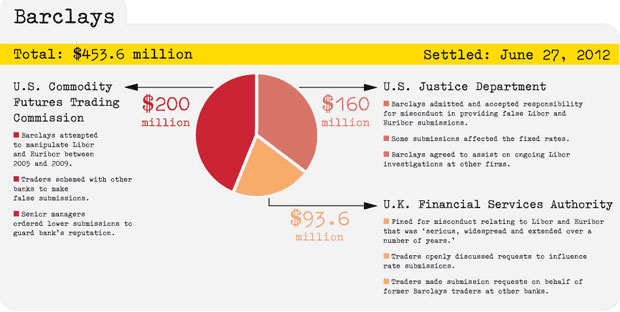
If you didn’t see that common feature, that’s alright, it wasn’t the first thing that I thought of either. But it’s there: all these banks pay far more in fines to foreign regulators than to their own. In particular, these European banks pay by far the biggest chunk of their fines to US regulators. But why? Dutch newspaper NRC asked that same question a few weeks ago, and, focusing on domestic Rabobank, concluded that A) the Dutch central bank (the regulator), which got zero, doesn’t have the legal power to fine more than €60,000 no matter what, while the Dutch justice department, having never fined a bank anything near €96 million, was even sort of embarrassed to do so. A source at the justice department is quoted as saying the “fines culture” in the US is much more developed than in Holland. Also, that Holland doesn’t want to copy/paste the US: “you don’t want two cops”(?!). And finally, that the US simply started its investigation sooner. Now, I’m not an expert in international banking law, but I do find it curious that a company pays far more in fines to foreign authorities than it does domestically, for having engaged in fraudulent behavior globally. For instance, does this mean Rabobank and RBS can expect fines from all 200-something countries on the planet? I doubt it. The EU is preparing its own settlements with banks over various Libor and Euribor frauds, but it has already announced Rabobank won’t be fined over a yen Libor case it’s working on. I love the – partial – explanation for that: a large part of Rabobank’s involvement in yen Libor fraud consisted of internal communications between it own traders and benchmark submitters, and that means a charge of conspiracy to commit fraud is not applicable, because under antitrust law you can’t conspire with yourself. So why do the Dutch let their own bank pay over $1 billion to foreign regulators, while they get less than 10% of that? I tell you, when I finally figured it out, I felt really stupid for not having thought of it before. It’s so simple: what Rabobank pays in fines abroad is tax deductible!! Of course! Now it all makes sense! And I don’t know what exactly the situation is for RBS and Barclays and UBS, but I do have a hunch. You, the taxpayer, get to pay the fines. The EU will fine US banks a billion here and there in return, just for good measure, and use it to build a swanky office or two in Brussels, and bob’s your now poorer uncle. There’s a lot more symbolism hidden in JPMorgan’s temporary takeover of Buckingham Palace that you might want to concede. But it getting ever harder to ignore, and you really shouldn’t. Just to be clear on one thing: for people like Jamie Dimon, it’s all a big game. No matter what his bank is fined, he’s not paying it from his own pocket, the bank pays. It’s merely a matter of sport to try and lower the fine for the bank as much as possible, using billions in bank assets to pay lawyer’s fees. But even more than that, it’s a way – while everybody else remains blissfully unaware, thinking this can’t possibly be true – to show kings and queens and regulators and justice departments and parliaments and presidents alike who’s really king of the world today.
|
|---|
Send this article to a friend:
 |
 |
 |