Send this article to a friend:
November
22
2013

|
Send this article to a friend: November |
|
The Kennedy Assassination (November 22, 1963) 50 Years Later 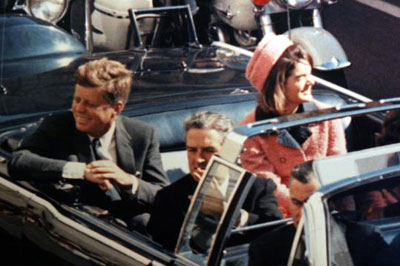
November 22, 2013, is the 50th anniversary of the assassination of President John F. Kennedy. The true story of JFK's murder has never been officially admitted, although the conclusion that JFK was murdered by a plot involving the Secret Service, the CIA, and the Joint Chiefs of Staff has been well established by years of research, such as that provided by James W. Douglass in his book, JFK And The Unspeakable, published by Simon & Schuster in 2008. Ignore Douglass' interest in the Trappist monk Thomas Merton and Merton's prediction and focus on the heavily documented research that Douglass provides. Or just turn to the contemporary films, taken by tourists watching JFK's motorcade that are available on YouTube, which show clearly the Secret Service pulled from President Kennedy's limo just prior to his assassination, and the Zapruder film that shows the killing shot to have come from President Kennedy's right front, blowing off the back of his head, not from the rear as postulated in the Warren Commission Report, which would have pushed his head forward, not rearward. I am not going to write about the assassination to the extent that the massive information permits. Those who want to know already know. Those who cannot face the music will never be able to confront the facts regardless of what I or anyone else writes or reveals. To briefly review, the facts are conclusive that JFK was on terrible terms with the CIA and the Joint Chiefs. He had refused to support the CIA organized Bay of Pigs invasion of Cuba. He had rejected the Joint Chiefs' "Operation Northwoods," a plan to commit real and faked acts of violence against Americans, blame Castro and use the false flag events to bring regime change to Cuba. He had rejected the Joint Chiefs case that the Soviet Union should be attacked while the US held the advantage and before the Soviets could develop delivery systems for nuclear weapons. He had indicated that after his reelection he was going to pull US troops out of Vietnam and that he was going to break the CIA into a thousand pieces. He had aroused suspicion by working behind the scenes with Khrushchev to defuse the Cuban Missile Crisis, leading to claims that he was "soft on communism." The CIA and Joint Chiefs' belief that JFK was an unreliable ally in the war against communism spread into the Secret Service. It has been established that the original autopsy of JFK's fatal head wound was discarded and a faked one substituted in order to support the official story that Oswald shot JFK from behind. FBI director J. Edgar Hoover and President Johnson knew that Oswald was the CIA's patsy, but they also understood, as did members of the Warren Commission, that to let the true story out would cause Americans to lose confidence in their own government at the height of the Cold War. Robert Kennedy knew what had happened. He was on his way to being elected president and to holding the plotters accountable for the murder of his brother when the CIA assassinated him. A distinguished journalist, who was standing behind Robert Kennedy at the time of his assassination, told me that the killing shots came from behind past his ear. He submitted his report to the FBI and was never contacted. Acoustic experts have conclusively demonstrated that more shots were fired than can be accounted for by Sirhan Sirhan's pistol and that the sounds indicate two different calibers of firearms. I never cease to be amazed by the gullibility of Americans, who know nothing about either event, but who confidently dismiss the factual evidence provided by experts and historians on the basis of their naive belief that "the government wouldn't lie about such important events" or "someone would have talked." What good would it do if someone talked when the gullible won't believe hard evidence? Secret Service pulled from JFK's limo http://www.lewrockwell.com/2013/11/james-huang/must-watch-video/ Zapruder film http://www.youtube.com/watch?v=ufvmHYqfdbU James W. Douglass, JFK and the Unspeakable, Simon & Schuster, 2008 Operation Northwoods: http://en.wikipedia.org/wiki/Operation_Northwoods
He was Distinguished Fellow at the Cato Institute from 1993 to 1996. From 1982 through 1993, he held the William E. Simon Chair in Political Economy at the Center for Strategic and International Studies. During 1981-82 he served as Assistant Secretary of the Treasury for Economic Policy. President Reagan and Treasury Secretary Regan credited him with a major role in the Economic Recovery Tax Act of 1981, and he was awarded the Treasury Department's Meritorious Service Award for "his outstanding contributions to the formulation of United States economic policy." From 1975 to 1978, Dr. Roberts served on the congressional staff where he drafted the Kemp-Roth bill and played a leading role in developing bipartisan support for a supply-side economic policy. In 1987 the French government recognized him as "the artisan of a renewal in economic science and policy after half a century of state interventionism" and inducted him into the Legion of Honor. Dr. Roberts' latest books are The Tyranny of Good Intentions, co-authored with IPE Fellow Lawrence Stratton, and published by Prima Publishing in May 2000, and Chile: Two Visions - The Allende-Pinochet Era, co-authored with IPE Fellow Karen Araujo, and published in Spanish by Universidad Nacional Andres Bello in Santiago, Chile, in November 2000. The Capitalist Revolution in Latin America, co-authored with IPE Fellow Karen LaFollette Araujo, was published by Oxford University Press in 1997. A Spanish language edition was published by Oxford in 1999. The New Colorline: How Quotas and Privilege Destroy Democracy, co-authored with Lawrence Stratton, was published by Regnery in 1995. A paperback edition was published in 1997. Meltdown: Inside the Soviet Economy, co-authored with Karen LaFollette, was published by the Cato Institute in 1990. Harvard University Press published his book, The Supply-Side Revolution, in 1984. Widely reviewed and favorably received, the book was praised by Forbes as "a timely masterpiece that will have real impact on economic thinking in the years ahead." Dr. Roberts is the author of Alienation and the Soviet Economy, published in 1971 and republished in 1990. He is the author of Marx's Theory of Exchange, Alienation and Crisis, published in 1973 and republished in 1983. A Spanish language edition was published in 1974. Dr. Roberts has held numerous academic appointments. He has contributed chapters to numerous books and has published many articles in journals of scholarship, including the Journal of Political Economy, Oxford Economic Papers, Journal of Law and Economics, Studies in Banking and Finance, Journal of Monetary Economics, Public Finance Quarterly, Public Choice, Classica et Mediaevalia, Ethics, Slavic Review, Soviet Studies, Rivista de Political Economica, and Zeitschrift fur Wirtschafspolitik. He has entries in the McGraw-Hill Encyclopedia of Economics and the New Palgrave Dictionary of Money and Finance. He has contributed to Commentary, The Public Interest, The National Interest, Harper's, the New York Times, The Washington Post, The Los Angeles Times, Fortune, London Times, The Financial Times, TLS, The Spectator, Il Sole 24 Ore, Le Figaro, Liberation, and the Nihon Keizai Shimbun. He has testified before committees of Congress on 30 occasions. Dr. Roberts was educated at the Georgia Institute of Technology (B.S.), the University of Virginia (Ph.D.), the University of California at Berkeley and Oxford University where he was a member of Merton College. He is listed in Who's Who in America, Who's Who in the World, The Dictionary of International Biography, Outstanding People of the Twentieth Century, and 1000 Leaders of World Influence. His latest book, HOW THE ECONOMY WAS LOST, has just been published by CounterPunch/AK Press. He can be reached at: PaulCraigRoberts@yahoo.com |
|---|
Send this article to a friend:
 |
 |
 |