
Send this article to a friend:
November
20
2013

|
Send this article to a friend: November |
|
The Biggest Money Printing Of All Time 
Martin D. Weiss: The U.S. economy is now so addicted to the Fed's monthly $85 billion injection of monetary stimulus ... that just the thought of withdrawal is enough to cause violent market convulsions. Consider, for example, the absurdity of this recent chain of events:
All in response to supposedly good news about the economy! All because investors would rather see the economy sink than see the Fed cut back on its monthly megadose of money shot up their veins. Or consider the long sequence of excuses Fed Chairman Bernanke has offered for smashing the 100-year Fed prohibition against running the money printing presses 24/7 ... First, he said they had no choice because of the great debt crisis of 2008.
Second, as soon as the worst of the debt crisis was apparently behind us, they promptly came up with a brand new rationale: Trillion-dollar federal budget deficits year after year.
Next in the long line-up of excuses came the European debt crisis, the Fiscal Cliff and, most recently, the government shutdown. Each time, the Fed kept the pedal to the metal on its giant money presses. And each time, there was a new crisis to justify their reckless DUI. Yellen takes the cake ... In the Forked Tongue category, wannabe Fed chief Janet Yellen has now eclipsed Fed Chairman Bernanke for the first prize. In her testimony before Congress this week, she says little or nothing about the 2008 debt crisis, federal deficits, European debacles, fiscal cliffs or any others which were among her predecessor's favorite excuses for the unprecedented money printing she vows to pursue. Nor does she talk much about a weak economy. Instead, her new rationale is that, although the economy has improved, it hasn't quite improved "enough." As Mike Larson eloquently notes, it seems the "not-improved-enough" argument is all that's needed to justify continue running the Fed's printing presses — and doing so at the same speed as Bernanke did in the immediate aftermath of the Lehman Brothers collapse. The end result is vividly illustrated in this chart: 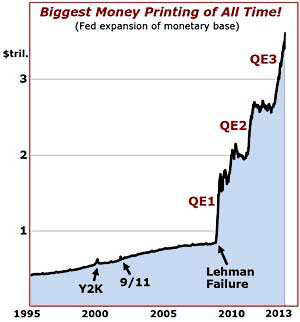
It tracks the U.S. monetary base, a direct measure of how much money the Fed has been printing — and injecting into the banking system. It depicts how the sheer magnitude of the Fed's monstrous expansion is mind-boggling in the extreme. To better comprehend this monster, start by looking at the relatively gradual slope of growth in the 1990s and 2000s — before the Lehman Brothers failure. And bear in mind that even that "slower" pace was considered irresponsibly rapid by many experts. Next, look at the sudden explosion that began immediately after the Lehman Brothers failure! That's when the Fed threw all its old rule books into the East River. And that's when the Fed flew off on a new, high-risk trajectory into the outer space of monetary policy. Then, see how the Fed's immediate response to post-Lehman crisis (QE1) was replicated not just once, but twice — with QE2 and QE3. Last, consider these outrageous facts:
The most alarming fact of all is this... While the Fed has used crisis after crisis to justify its monetary madness, it has not yet begun to resolve the underlying diseases that gave rise to those crises. It has merely papered over their symptoms.
|
|---|
Send this article to a friend:
 |
 |
 |
 Money and Markets is a free daily investment newsletter published by Weiss Research, Inc. This publication does not provide individual, customized investment or trading advice. All information is based upon data whose accuracy is deemed reliable, but not guaranteed. Performance returns cited are derived from our best estimates, but hypothetical as we do not track actual prices of customer purchases and sales. We cannot guarantee the accuracy of third party advertisements or sponsors, and these ads do not necessarily express the viewpoints of Money and Markets or its editors.