|
|
The Corrupt Origins of Central Banking in America
The main objective of the Nationalists, who were also known as Federalists, was essentially to establish an American version of the British mercantilist system, the very system that the Revolution had been fought against. Indeed, it was this system that the ancestors of the Revolutionaries had fled from when they came to America. As Rothbard explained, their aim was
Despite these monopolistic privileges, a lack of public confidence in the Bank's inflated notes led to their depreciation and the Bank was privatized by the end of 1783. But Morris did not give up on his scheme. He recruited a young Alexander Hamilton to serve more or less as his political puppet within the Washington administration. (Rothbard called Hamilton "Morris's youthful disciple.") In fact, the reason why Hamilton became Treasury secretary, despite having no reputation at all in the field of finance, was the recommendation by Morris to George Washington. (During the Revolutionary War, when he was an aide to Washington, Hamilton took the time to write Morris a 30-page letter proclaiming that he agreed with every one of his ideas about protectionist tariffs, corporate subsidies, and a government-run bank to finance them.) Morris and his fellow Nationalists wanted a king-like chief executive who would rule over a mercantilist empire, just as the king of England ruled over his mercantilist empire. They, of course, would be the ones to advise and instruct the "king" and benefit financially from such an empire. So their young protégé Hamilton commenced his seven-year crusade to overthrow the first US constitution - the Articles of Confederation - by calling for a new constitutional convention to supposedly "revise" the Articles of Confederation. At the convention, Hamilton laid out his (really Morris's) plan: a permanent president who would appoint all the governors and who would have veto power over all state legislation. Under such a plan, state sovereignty would have been destroyed, and there would have been no escape from the central government's high taxes, protectionist tariffs, heavy debt, and foreign-policy imperialism - the agenda of the Nationalists. The Hamilton/Morris plan was defeated, of course, as was the proposal made at the convention to include a central bank among the delegated powers to the federal government. But the government was more highly centralized, as "the Nationalist forces pushed through a new Constitution" and "were on their way to re-establishing the mercantilist and statist British model..." (p. 193). They begrudgingly acquiesced in a Bill of Rights in return for the anti-Federalists' support for the new Constitution. And most importantly, writes Rothbard,
The First Bank of the United States "promptly fulfilled its inflationary potential," Rothbard writes in his History of Money and Banking in the United States (p. 69). It issued millions of dollars in paper money and demand deposits "pyramiding on top of $2 million in specie." The Bank invested heavily in the US government, and "The result of the outpouring of credit and paper money by the new Bank of the United States was ... an increase [in prices] of 72 percent" from 1791–1796. Northern merchants provided the main political support for Hamilton's Bank, whereas southern politicians like Jefferson supplied most of the opposition to it, seeing it as nothing more than a vehicle for financing an American version of the corrupt British mercantilist system, which would be destructive of liberty and prosperity. They were right, of course, and remain right to this day.
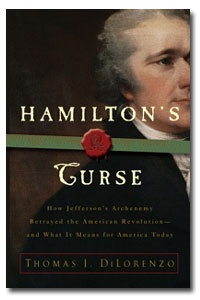
Thomas DiLorenzo is professor of economics at Loyola College in Maryland and a member of the senior faculty of the Mises Institute. He is the author of The Real Lincoln, Lincoln Unmasked, How Capitalism Saved America, and, more recently, Hamilton's Curse. Comment on the blog. |
 |
 |

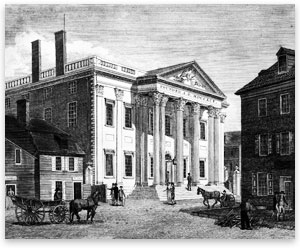 Central banking has been a corrupt, mercantilist scheme and an engine of corporate welfare from its very beginning in the late 18th century. The first central bank, the Bank of North America, was "driven through the Continental Congress by [congressman and financier] Robert Morris in the Spring of 1781," wrote Murray Rothbard in