Send this article to a friend:
October
29
2014

|
Send this article to a friend: October |
|
Oil Residue The Size Of Rhode Island Covers Gulf Of Mexico Seafloor In Macondo Well Disaster Aftermath
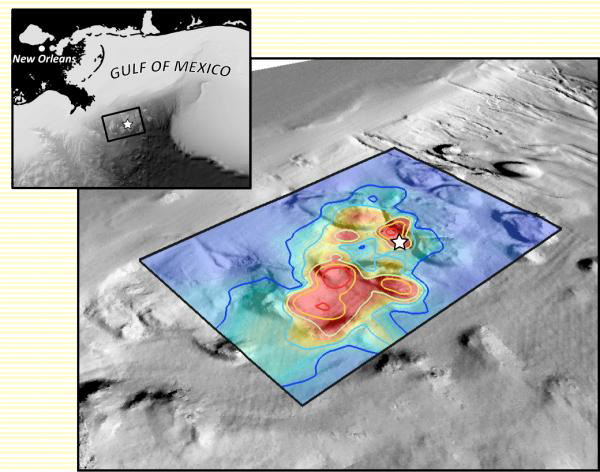
The researchers found an area of 1,250 square miles (3,237 square km), mostly southwest of the Macondo well, where a thin sheen of oil rests in patches on the top half-inch of the seafloor, according to the NSF. The reason why the massive spill was never visible on the ocean surface? "Based on the evidence, our findings suggest that these deposits are from Macondo oil that was first suspended in the deep ocean, then settled to the seafloor without ever reaching the ocean surface," Valentine said in the statement. "This analysis provides us with, for the first time, some closure on the question, 'Where did the oil go, and how did it get there?'" Don Rice, the program director of the National Science Foundation's Division of Ocean Sciences, told Live Science in a statement. More from Live Science:
Unfortunately, there is more: a major portion of the spill has still not be accounted for and much of the deep ocean oil is still missing. The portion Valentine and his colleagues traced represents only 4 to 31 percent of the oil thought to be trapped in the depths of the ocean (up to 16 percent of the total oil spilled). AP adds that according to Valentine the spill from the Macondo well left other splotches containing even more oil. He said it is obvious where the oil is from, even though there were no chemical signature tests because over time the oil has degraded.
Needless to say, BP is not enthused and hardly wants this walk down memory lane recreated which is why the oil giant questioned the conclusions of the study. In an email, spokesman Jason Ryan said, "the authors failed to identify the source of the oil, leading them to grossly overstate the amount of residual Macondo oil on the sea floor and the geographic area in which it is found." It's impossible at this point to do such chemical analysis, said Valentine and study co-author Christopher Reddy, a marine chemist at Woods Hole Oceanographic Institute, but all other evidence, including the depth of the oil, the way it laid out, the distance from the well, directly point to the BP rig. And, of course, there is the logical question: who else had a massive oil spill in the GOM in recent years? And while some of the oil has been found, the question where the rest is remains, as does the far more important question: what was the spill's impact on sealife and sea-currents in the Gulf? At least several more years will have to pass before that particular answer is unveiled. Source: Fallout plume of submerged oil from Deepwater Horizon |
|---|
Send this article to a friend:
 |
 |
 |