Send this article to a friend:
October
20
2014

|
Send this article to a friend: October |
|
Saudi King Fires First Shot In New Oil War
Saudi actions are already cascading across oil markets. We'll likely see effects in the short-, medium- and long-terms. What will it mean to our energy investments? Let's think it through… Stealthy Saudis The Saudi move was stealthy; so stealthy that you might have missed it, even if you follow the energy sector. Unlike much else that happens in the Middle East, the Saudi move didn't involve anything blowing up — well not "blowing up" for real, with blast, heat and dead bodies flying. What happened, specifically?
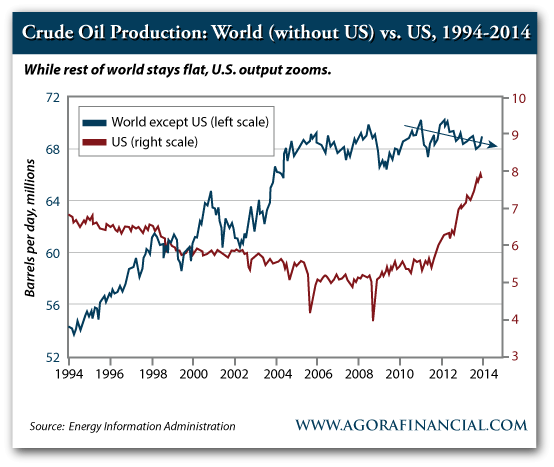
Got that? Lower prices, versus cut supply. Remember, this is Saudi Arabia, the so-called global "swing" producer. That is, Saudi Arabia has plenty of oil wells, ready to go; already drilled and hooked up to pipes. The Saudis can raise or lower oil output literally by turning valves. Thus, instead of turning valves to the right ("lefty-loosey, righty-tighty," as an old Army engine maintenance manual explained), Saudi is maintaining output while lowering prices. Here's a succinct summary of what's going on, according to Bloomberg News: "State-owned Saudi Arabian Oil Co. cut prices for all grades and to all regions for November shipments, reducing those for Asia to the lowest level since 2008." Get that? Cut prices. All grades. All regions. The lowest level since 2008! Whoa! Didn't oil markets — and every other kind of market — sort of… umm… crash back in 2008? Yes, I seem to recall seeing something about that… As you might imagine, a Saudi spokesman puts a purely innocent spin on things. Price cuts are intended to "boost margins for refinery clients." The pricing move is definitely "not the start of a price war," he says. No. Of course not. Why would anyone think that? Isn't Saudi Arabia well known for helping refiners boost margins, at its expense? Oh, wait… Implications Oil traders at Germany's Commerzbank AG, as well as traders at Citigroup, have a different take on the Saudi price cuts. The downward pricing moves "could be the opening shots in a price war." Gee, do ya think? Not to be outdone by Saudi Arabia, this week Iran announced that it, too, will sell oil to Asia in November, and at the largest discount since 2008 — there's that date again. That is, State-run National Iranian Oil Co. will match the Saudi price cuts. Per Commerzbank, "The timing of Iran's price cuts makes the price war more and more probable." It's notable that both Saudi Arabia and Iran are lowering prices for customers in Asia. The fact is that Middle East oil producers have recently begun to face strong price competition for oil sales in Asia, their largest market in recent years. Lower prices for West Texas Intermediate (WTI) and Brent-quoted crude, however, mean that tanker traffic has shifted. More oil cargoes are moving to Asia from Russia, Latin America and the U.S. Indeed, a million-barrel tanker recently sailed from Valdez, Alaska to South Korea; the first major U.S. crude oil export to anywhere in over ten years. (The Saudis' price cut announcement came a few days later. Coincidence?) Saudi Salvaging Market Share What's driving the shift in oil trades and the trend to lower prices? U.S-Canadian fracking, as long-time OI readers doubtless know. It's changing the world. Energy-wise, we're living not in a "once per generation" time; it's a "once per three or four generation" transformation. As oil scholars know, global crude oil output has been relatively flat for several years, across pretty much the entire world, except for the U.S. — another story entirely. Think of the Middle East, where political strife and war has stymied large output increases. Plus, in the rest of the world, things simply have not unfolded in the oil patch as fast or easily (or within budget!) as people hoped; think of offshore Brazil, or production issues in Angola, East Africa, Australia or any of many other locales. Or another example; right now (today), per Bloomberg News, Nigeria has not yet contracted to sell half of the oil it plans to load into tankers in November. Why? Well… not enough buyers! So should we expect dramatic price discounts from Nigeria? Don't be surprised.
As the chart shows, U.S. fracking has added well over three million barrels per day to global oil supplies within the past six years or so. North America's oil patch is Ground Zero for a global upheaval in energy pricing and trade patterns — long story. However, for all the fracking success, the Saudis will not concede market share caused by tight pricing from new U.S. oil output; that is, Saudi Arabia is cutting prices. Along those lines, my immediate sense of Saudi price-cutting is that it's an in-your-face effort to maintain Saudi Arabia's market share. Saudi Arabia is deeply concerned about losing markets for its oil over the long haul. (It would make sort of the same problem as Nigeria has — see above.) Recent price cuts are sort of a "buy in" with refinery customers to keep them happy; and this may work for the time being. So the Saudis will sell the "same" amount of oil, but for less money. My next immediate sense of Saudi price-cutting is that it's a grave mistake for the overall world oil industry. Now everyone will sell the "same" amount of oil, but for less money. Everyone in the energy industry can get squeezed, so that the Saudis can attempt to maintain their market share — versus turn their valves righty-tighty, and lower output. That's what price wars do. What is the Target? Who or what is the Saudi target in this price war? Well, per the Wall Street Journal, "A Saudi official late last month said that if oil prices went below $90 a barrel, oil companies would decrease output and prices would rebound toward $100." Oh really? And which "oil companies" might that be? Again, per a headline in the Wall Street Journal, "Price Drop Tests Oil Drillers." That is, apparently the Saudis believe that U.S. majors, independents, drilling companies and service companies will feel the economic heat, and — presumably — throttle back on drilling and fracking. Of course, none of this will play out fast or easily. First, I don't subscribe to the Saudi estimate of a $90 floor for profitable oil from fracking. In the U.S., there are nearly 1.5 million drillable "tight oil" sites, according to a recent estimate I saw at a private conference in Houston. (More on that in another article.) In other words, the U.S. has plenty of players with sites to drill and a business model to drill 'em; and a good many can afford to conduct business all the way down to $50 per barrel and lower. That "fracking floor," so to speak, could be much lower than Saudi estimates. This price war could get ugly. Then we have the drilling rig fleet, onshore and offshore. A drilling slowdown would probably hurt shares in, say, Nabors Industries (NBR: NYSE); and offshore plays like Transocean (RIG: NYSE). I mean, it could hurt them more than we've suffered during the summer-early fall swoon. This is not to say that the companies have structural problems; it's just that they'll have a rough spell in the market. If you're holding for the long term, prepare for a wild ride. Same thing with the service guys, Halliburton (HAL), Baker Hughes (BHI: NYSE) and Schlumberger (SLB: NYSE). They've sold down in recent months, but that was a reflection of oil prices dropping $20 or so, from (Brent) $110 to $90. What if there's another $20 or $30 to go, on the down-side? Look out. Again, it's not to say that the companies have structural problems. We'll experience a rough spell, though. Get set for the same wild ride. Here in the U.S., any significant diminution in energy industry drilling and operations will impact economies all across the nation. Imagine less drilling, completion and energy-related construction activity from Alaska to Pennsylvania to the Gulf of Mexico, and many places in between. That's a lot of money that won't get spent. If things pull back far enough, we might live through a new version of the classical old "oil bust," in which contracts get cancelled, people get laid off, leases expire and tax collectors go away empty-handed. In short, say farewell to one of the critical pillars of that (over-rated) U.S. "economic recovery" that political hacks like to brag about. Then again, another oil bust will give investors a chance to buy into great companies, fixed for the long haul, but selling a bargain prices. This Saudi oil price cut is just beginning to show effects. It'll get worse before it gets better. I'll have more to say next week. That's all for now. Have a good weekend. Best wishes… Byron W. King
|
|---|
Send this article to a friend:
 |
 |
 |