Send this article to a friend:
October
18
2014

|
Send this article to a friend: October |
|
Gasp! Lockheed Skunk Works Says It Has A Nuclear Fusion Reactor
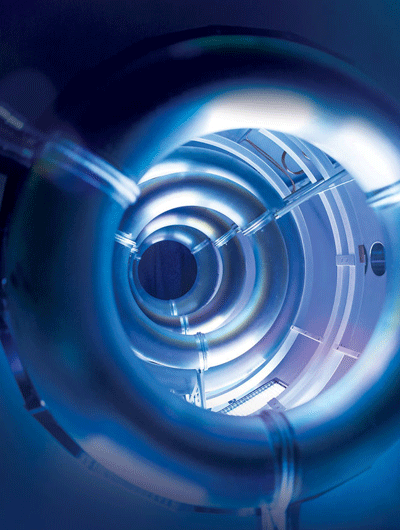
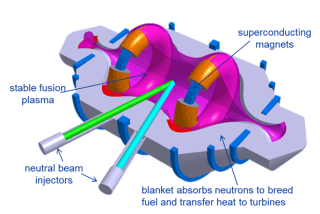
Lockheed's 'bleeding edge' aircraft design and boutique technology development arm, the Skunk Works, has officially announced that they have what they think is a very workable and incredibly small fusion reactor design. If it does indeed work as projected it could change the the world as we know for the better, not just for powering homes and offices all over the world, but for powering ships and even spacecraft and aircraft, the cumulative effect of which would be akin to a restart on the atomic age all over again. Early production examples of the Compact Fusion Reactor would fit into a shipping container and produce 100MW of power. This output would be enough to power well over a whopping 80,000 homes in the US and is equivalent to one of the Navy's large A4W fission reactors found on Nimitz Class aircraft carriers.
What is most exciting is that the Compact Fusion Reactor would be able to do this without the tons of radioactive material and waste that are currently produced by nuclear fission reactors scattered around the globe. Aviation Week was given exclusive access to the program, and in their expose on this potential energy revolution (which I highly recommend you read) they addressed what the CFR would need to operate and what radioactive material it would leave behind in doing so:
When it comes to potential meltdowns and the resulting release of deadly radioactive particles associated with them, Lockheed states:
Beyond the possibility of incredibly plentiful energy and clean water for billions, the implications of a CFR on the transportation world could me massive, as large ships that currently use swimming pools of fossil fuels on a weekly basis could be powered by a propulsion unit that is just a fraction of the size of their massive engines, and runs without the need to carry many thousands of pounds of fuel. The same can be said for air travel, as airliners could be built that would not need fueling during their entire service life. Additionally, high-flying drones could take the place of satellites, or even cell phone towers, for some communications relay work, staying aloft for months or years at a time without the need for fueling. One of the most exciting potential uses for this new technology is for space travel. The power that a small fusion reactor can potentially generate, and the efficiency of its power generation, could provide a spacecraft with the thrust and energy it needs to make it to Mars and back in a fraction of the time that is currently within the realm possibility. This all sounds so fantastic. If the Skunk Works' prophesies come true it could change the political and socioeconomic balance of the world forever, and let's face it, boy could the world use some good news. Yet we must keep in mind the fact that we have heard fusion reactor claims many times before, and other research and development tanks are working on other fusion systems as this is being written, but the abundant resources and historic track record of Lockheed's Skunk Works does give the program serious cache. There is also the fact that Lockheed has allowed such a deep look into the program, and their stated time line for making an active prototype (within five years, a production example with ten) is ambitious to the point that it would do the company no good making such claims if they did not think they were truly onto something. In the end, it will be a wait and see affair to see if this technology turns into a stable, virtually globe saving form of near free energy. The Skunk Work has done some amazing things in the past, and many more things we still are not allowed to know about, but the creation of stable and efficient nuclear fusion concept would be quite the stripe on the Skunk's back. pictures via Lockheed Martin Tyler Rogoway is a defense journalist and photographer who maintains the website Foxtrot Alpha for Jalopnik.com You can reach Tyler with story ideas or direct comments regarding this or any other defense topic via the email address Tyler@Jalopnik.com
|
|---|
Send this article to a friend:
 |
 |
 |