|
A Levitating Wirelessly Powered Lightbulb (Editor Note: Of all the great inventions and discoveries of Nikola Tesla, nothing stood out with greater potential benefit to the whole of humanity than his discovery of wireless power transfer in 1889. Funding for his research had come from J.P. Morgan who stopped the funding when he realized there was nowhere to put a meter. By 1931, Tesla had perfected a receiver for Dark Energy which he defined as "a mysterious radiation, which comes out of the aether". Supported by the Pierce-Arrow Co. and Westinghouse, he took the gasoline engine from a new Pierce-Arrow and replaced it with an 80-horsepower alternating-current electric motor with no external power source. Tesla's "Dark Energy" receiver powered the car for five days, driving at speed of up to ninety miles per hour. George Westinghouse reacted the same as had J.P. Morgan. If he couldn't sell the power, he didn't want the technology "to see the light of day". With the wireless transmission of power, as is evidenced below, humanity might finally begin to benefit from Nikola Tesla's genius with technology developed over 117 years ago. - JSB)
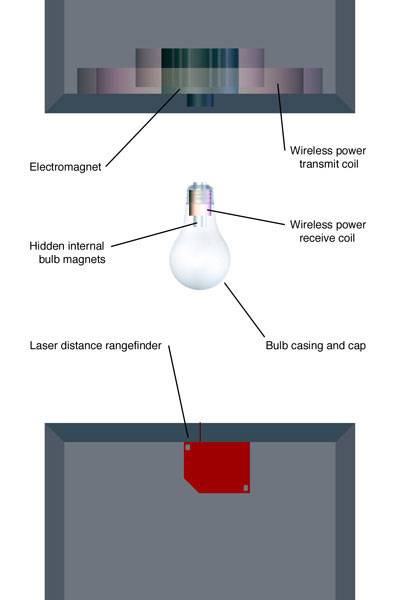
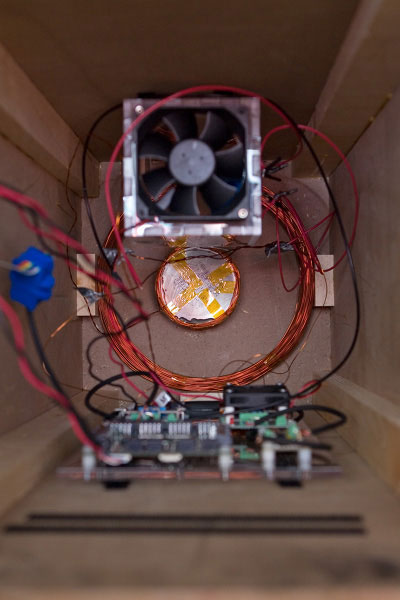
This is not a trick or a photoshop manipulation. The bulb and the casing contain hidden circuitry [shown in figures] that uses electromagnetic feedback to levitate the bulb roughly 2.5" from the nearest object, and uses coupled resonant wireless power transfer to beam power from the housing into the bulb itself. Tesla invented wireless power transfer in the late 1880's. However this effect is still largely underutilized. I wanted to explore this effect coupled with feedback stabilization of a naturally unstable object. Details in the figures highlight the embedded circuitry and techniques used to levitate and power the bulb. For more technical details on the background of this work, please click here. Details of the previous prototype are available here. For press images, please email me.
Movie: click on light bulb (small, 3om)
|
 |
 |

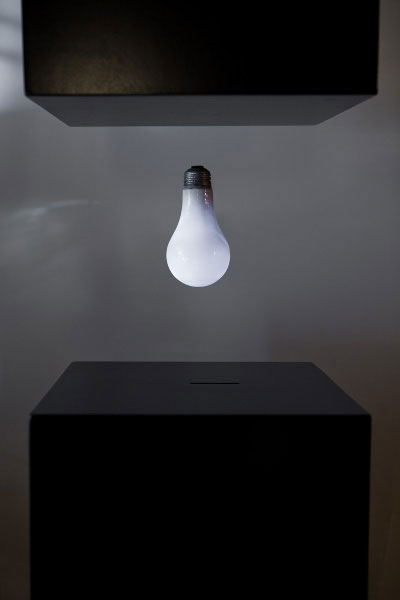 The lightbulb is levitating yet powered. It will float stably in midair and remain on for years without any physical contact, charging, or batteries. Ironically, with the levitation and wireless power circuitry both on, this entire package still consumes less than half the power of an incandescent bulb.