|
Local inventor developing fuel-less generator 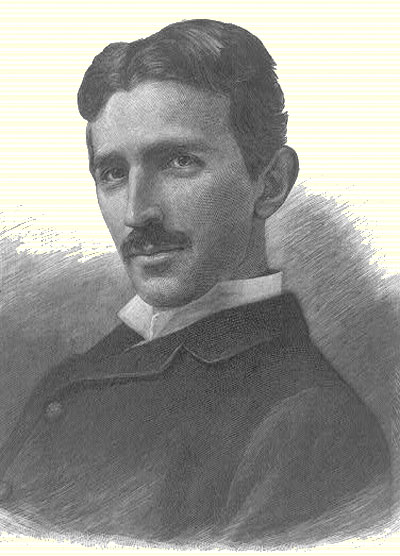
(Editor's Note: Nikola Tesla figured out "over unity; ambient electricty generation over 100 years ago. Radiant Energy can perform the same wonders as ordinary electricity, at less than 1% of the cost. It does not behave exactly like electricity, however, which has contributed to the scientific community's misunderstanding of it. In 1931, under the financing of Pierce-Arrow and George Westinghouse, a 1931 Pierce-Arrow was selected to be tested at the factory grounds in Buffalo, N. Y. The standard internal combustion engine was removed and an 80-H.P. 1800 r.p.m electric motor installed to the clutch and transmission. The AC motor measured 40 inches long and 30 inches in diameter and the power leads were left standing in the air - no external power source and no recharging of any batteries was necessary. At the appointed time, Nikola Tesla arrived from New York City and inspected the Pierce-Arrow automobile. He then went to a local radio store and purchased a handful of tubes (12), wires and assorted resistors. A box measuring 24 inches long, 12 inches wide and 6 inches high was assembled housing the circuit. The box was placed on the front seat and had its wires connected to the air-cooled, brushless motor. Two rods 1/4" in diameter stuck out of the box about 3" in length. Mr. Tesla got into the driver's seat, pushed the two rods in and stated, "We now have power". He put the car into gear and it moved forward! This vehicle, powered by an AC motor, was driven to speeds of 90 m.p.h. and performed better than any internal combustion engine of its day! One week was spent testing the vehicle. Several newspapers in Buffalo reported this test. When asked where the power came from, Tesla replied, "From the ether all around us". Upon the conclusion of the test, Mr. Westinghouse asked Tesla "Where can I put the meter?" Tesla replied, You cannot meter ambient electricity. It's free." Upon hearing that, Westinghouse took the car, put it in a warehouse, and no one ever heard anything about it again. -JSB)
That, in essence, is Filipino inventor Ismael Aviso's "baby", the Motionless Electronic Generator (MEG). "I started working on it in December 2009, but the technology has been with me since 2007," said Aviso of his invention, which, while still under the early stages of development, has been stirring enthusiasm within free energy circles. The "motionless" in MEG's name denotes that it is a solid-state device, meaning it has no moving parts, explained Aviso, 54, a microwave engineering expert and entrepreneur residing in an impoverished Navotas City town. The MEG module itself resembles four to five computer central processing unit (CPU) boxes, side-by-side. But how can a generator run without any fuel? "(Through) ambient energy," the spectacled inventor answered. By "ambient energy", Aviso is referring to the unseen, free-moving energy in the surroundings that is just waiting to be harnessed. He said signals emitted by cellular phone sites are a form of this energy. Aviso said he is able to attract this type of energy with MEG through a process of "imitating back electromotive force", or back EMF. One of Aviso's followers, Sternling Allan of Pure Energy Systems (PES) Network, Inc., with the help of a colleague has termed the process "mimicking an inductive collapse." Allan likened the Filipino's solid-state free energy generator to "a high-power solar panel that is always on… which gives you as much electricity as you need, when you need it, regardless of whether the sun is shining." In principle, the MEG is very similar to another Aviso invention - his fuel-less, self-charging electric car. The car, whose radical engine has been outfitted with a free-energy absorbing antenna, was tested by Department of Energy (DoE) specialists last February 24 in University of the Philippines (UP), Diliman. "It's like having fish for dinner," Aviso said, determined to explain his generator's free energy properties in a non-technical way. Philippine DOE Verifies Aviso's Self-Charging EV
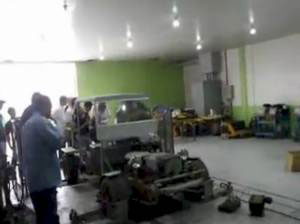
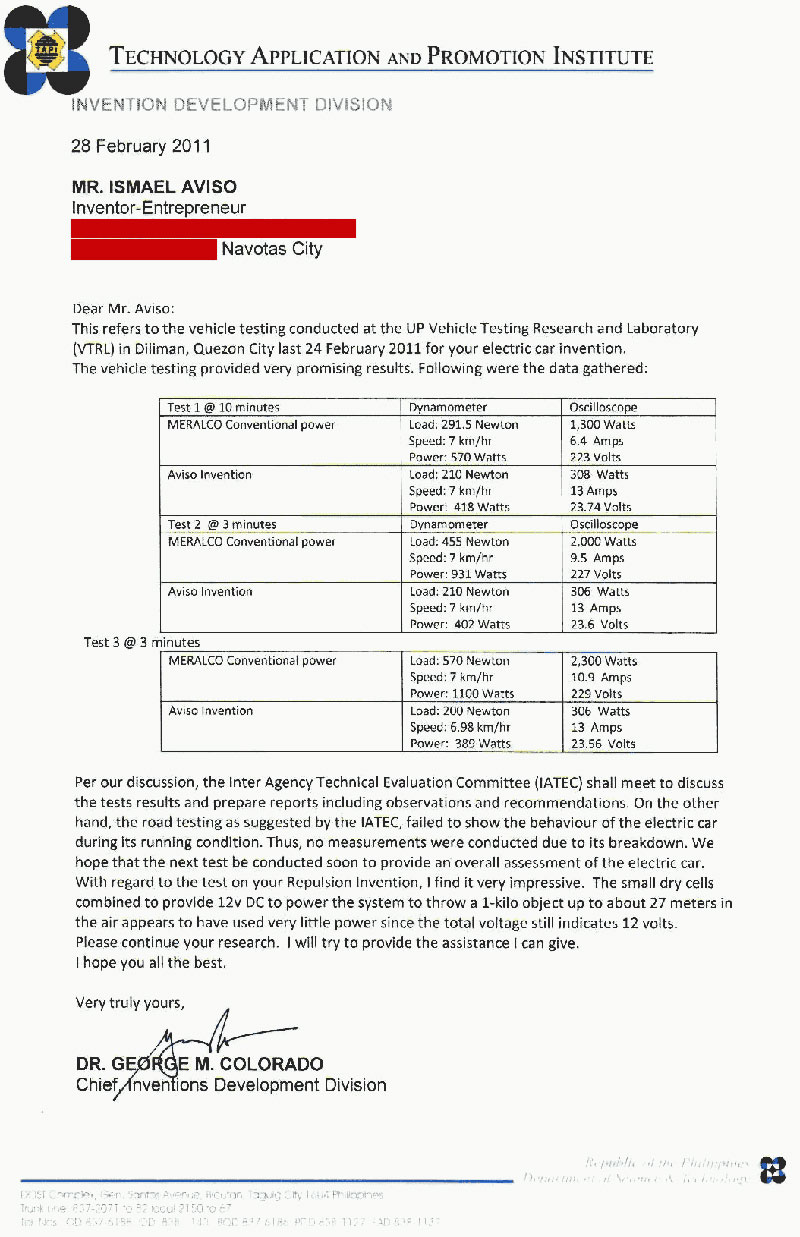
Sterling D. Allan Today, the Philippine Department of Energy tested Ismael Aviso's electric car, showing that running off wall power, the 11 kW DC motor ran at 45% efficiency, but with Aviso's on-board generator which harvests ambient energy from the surroundings, the motor ran at 133% efficiency (overunity).
Major, breaking news here. Today in the Philippines, the Department of
Energy (DOE) validated a free energy technology we've been reporting on
recently. This is the first instance that I know of in which a national
DOE has validated overunity of any kind outside of the conventional free energy
technologies of solar, wind, geothermal, tide, biomass, where the source of
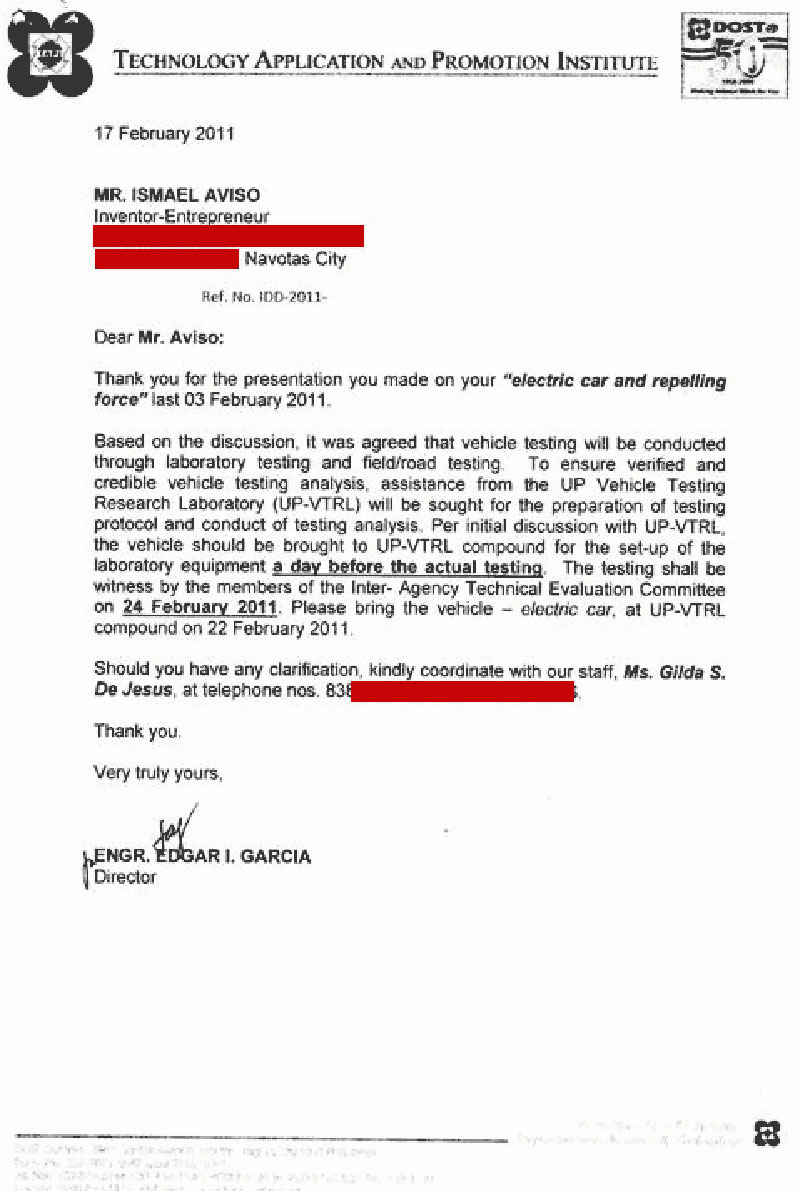
energy is always obvious. Here's a letter that the department sent Aviso on February 14 to schedule today's test. It says that the testing would be witnessed by members of the Inter-Agency Technical Evaluation Committee at the UP-VTRL compound of the Technology Application and Promotion Institute, a division of the Department of Energy.
As mentioned in our last story about this technology, Aviso was featured Monday morning on Channel 7, the largest TV network in the Philippines. They accompanied him to the meeting with the Department of Energy on February 17, in which the proposed testing procedure was discussed. Here's the video of their coverage that they posted today on their site. Test Data On February 24, 2011 7:38 PM Aviso provided the following:
|
 |
 |

 MANILA, Philippines - Imagine having a fuel-less generator at home that never needs to be recharged.