September
14
2013
14
2013
|
September 14 2013 |
Beating Indexes, Chasing Unicorns
However, these changes highlight a much bigger issue to investors. I recently wrote an a article entitled "Why You Can't Beat The Index," which covered the variety of flaws of how benchmark indexes are calculated and the effect on portfolios.
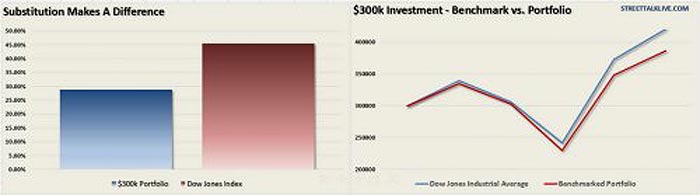
Specifically I covered the impact of the "substitution effect" on the index and the inherent "replacement effect" on your portfolio. The upcoming changes to the Dow Jones Industrial Average highlights the importance of these effects on portfolios that are benchmarked to an index. In order to demonstrate this particular issue we have to make some assumptions. Most investors don't generally build a "price weighted" portfolio, which is a major flaw of the Dow Jones Industrial Average, but rather build portfolios by either buying round lots or investing rounded dollar amounts. For our example we will assume that an individual invests a total of $300,000 dollars equally into each of the 30 stocks that comprised the Dow Jones Industrial Average as of November 1, 2005. Furthermore, the portfolio will be managed exactly like the index and will only be changed when changes to the index are made. (For purposes of this example only capital appreciation will be utilized.) Here is where the problems begin. On February 19, 2008, just prior to onset of the financial crisis, the good folks at S&P Dow Jones indices, swapped out Honeywell and Altria for Bank of America and Chevron. In hindsight, I am quite sure that the decision to swap out Honeywell for Bank of America was regretted considering what happened next. However, the important point is that when the two issues were swapped out there was no change to the underlying value of the index due to the way it is calculated. However, the portfolio experienced a significant negative impact. In order to adjust the portfolio the shares of Honeywell and Altria had to be sold and then new shares of Bank of America and Chevron had to be purchased. The original $10,000 investment into Honeywell had grown to $13,367 but the same investment in Altria had fallen to just $2,275. Therefore, since there was a net loss of $4,358 between the two positions, only $15,642 was able to be reinvested in the two new companies. In September of 2008 it was American International Group's turn to be swapped out for Kraft Foods. While this swap again didn't change the value of the index it resulted in a 95% loss in the sale of AIG in the portfolio. Then, as the financial crisis ended and the markets began to recover, Citigroup and General Motors, were swapped out for Cisco Systems and Travelers in June of 2009. These two swaps resulted in net losses for the portfolio of roughly 93% and 85% respectively. The next change came in September of 2012 as Kraft Foods was swapped out for United Healthcare. Once again there was no change to the value of the index but the impact to the portfolio was at least positive this time showing a 20% gain. Since the most recent changes do not actually occur until September 20, 2013 we will assume that the upcoming changes occurred as of the close on September 11th. Therefore, the substitutions of Nike, Goldman Sachs and Visa resulted in portfolio losses of roughly 69% in Alcoa, 66% on Bank of America and 17% for Hewlett-Packard. The following two charts show you the difference in returns from $300,000 invested in the index versus a portfolio benchmarked to the index.
This is the impact of the "substitution and replacement" effects. During the period of the analysis the drags created by the loss of capital in the portfolio resulted in a net return difference of 28.85% versus 45.54% for the Dow Jones index. This effect is magnified over longer periods of time. While Wall Street wants you to compare your portfolio to the "index" so that you will continue to keep money in motion, which creates fees for Wall Street, the reality is that you can NEVER beat a "benchmark index" over a long period. This is due to the following reasons:
In order to win the long term investing game your portfolio should be built around the things that matter most to you.
The index is a mythical creature, like the Unicorn, and chasing it takes your focus off of what is most important - your money and your specific goals. Investing is not a competition and, as history shows, there are horrid consequences for treating it as such. So, do yourself a favor and forget about what the benchmark index does from one day to the next. Focus instead on matching your portfolio to your own personal goals, objectives, and time frames. In the long run you may not beat the index but you are likely to achieve your own personal goals which is why you invest in the first place.
|
|---|
Send this article to a friend:
 |
 |
 |