September
02
2013
02
2013
|
September 02 2013 |
The magic ends...a snapshots of dying currencies
The penny is, of course, no longer a gift from Hell--at least not in Canada. They have been eliminated. Even so, over the years, they changed from real money (when they were copper), to a reflection of real money (when they were zinc), and since 2000, they had been nothing but tokens, created at will (coated steel). I remember when I discovered that Canadian pennies were no longer copper. A friend of mine showed me a neat trick with a zinc penny and a blowtorch. You can roast the copper penny as long as you wanted under the blowtorch, and apart from glowing red hot, and temporarily losing its oxidized coating, nothing happened. The zinc penny, by contrast, lasted a few seconds before erupting into brilliant flame, the deformed outer copper sheath collapsing onto nothing. I actually thought it was a plastic token before looking up its content on the internet. The above quote didn't actually refer to pennies--the exact word was sen, a Japanese copper coin, worth 1/100 of a yen. Nowadays, it doesn't have much value, but in the story from which the quote was taken, it was valuable enough to buy the silence of an accessory to a crime. What happened to its value? Did the copper become worthless? The answer is that too many yen were printed. My wife's grandmother left us a collection of dirty coins, which she had kept hidden through the years of the Japanese occupation of Singapore. A piastre de commerce of French Indochina, dated 1908. A few Straits Settlements 5c pieces ranging from 1890 to 1935. A gorgeous Straits Settlement dollar from 1908. There was a US quarter and a half-dollar, a Chinese coin from Kiang Nan province, which can be ascribed to 1904 from the chop marks (but which wikipedia tells me was restruck several times in the 1920s). A couple of franc coins from 1899 and 1915. A couple of Thai (then Siam) coins, of uncertain age and value. Silver, all of them, but in total, not much. I assume there were rather more of them when the occupation started. 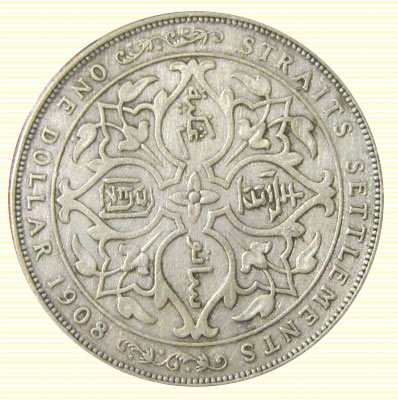 During the occupation, as occupiers typically do, the Japanese issued their own currency--one which (like the occupiers in America) the denizens of Singapore were forced to accept. The power to make money without limit is its own temptation, and the subsequent inflation combined with the disappearance of capital goods and food was the consequence. After their defeat, the banana currency became worthless. Unfortunately, the British were a few days late in delivering the new currency intended to replace it, so for several days there was no legal money in Singapore. Only those who managed to keep US dollars, British pounds, or gold or silver hidden through the war years could go to the market and exchange them for a bit of rice. It's during these sorts of times that the value of those gold necklaces Indian women are so partial to really comes to the fore. It's so easy to pinch off a link or two. Silver coins for Malaya (now Malaysia and Singapore) were minted by the British Mint during the war (dates of 1943 and 1945 are common). However, they weren't delivered until after the end of the war, and I have been given to understand that the first thing the local population did upon their delivery was hoard them. Many of these coins never circulated, and a good number of them in all denominations were left to us as well. 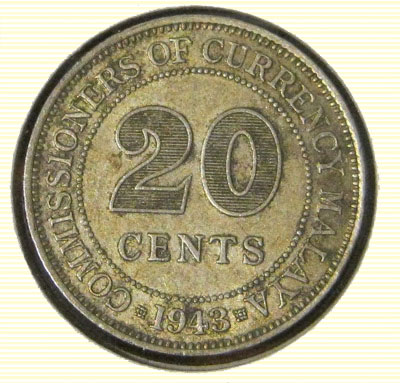 In the Japanese movie "For Those We Love", which depicts the lives of kamikaze pilots near the end of the war in Japan, there is a scene in which the local noodle-shop owner wants to cook noodles with egg for one of the pilots about to head off on his final mission. She has no eggs, so she sends one of her assistants to buy some from a local farmer. "But he doesn't take money any more," she protests, so the elder women has to dig up a family heirloom to trade for eggs. Destruction of the value of currency has recurred through history, with famous examples in Germany, throughout much of Europe, most African countries (Zimbabwe most famously, but even stalwarts like Ghana have had problems). What was the magic? The magic was the magnificent illusion that money printing increased wealth. It certainly looked that way, despite all the common-sense interpretation that would have you believe that it doesn't. But that's the beauty of a wonderfully performed magic trick. Something impossible seems to happen. You know it can't happen, but it looks like it did, and what's the harm in letting yourself believe? The latest round of the great trick really began in the late 1950s. Spending by the US government increased the demand for labour by the millions, which allowed women to enter the workforce in large numbers. 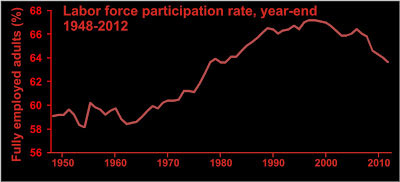 Data source: Bureau of Labor Statistics (BLS)
The main uptick in the labour force participation rate began in the early '60s, but the real bottom (on this graph) was in the mid '50s. One obvious source of stimulus in the 1960s would have been the Vietnam War, on which the US gov't spent the equivalent of $738 billion, in 2011 dollars (pdf). That kind of money created a lot of jobs--mainly in the military industries, but also for lobbyists. At the same time, the "Great Society" was in full swing. Lots of public works projects. The same thing happened up here in Canada, with a huge increase in universities, highways, and transit systems. All this spending created a lot of jobs. Nobody asked whether these jobs were really necessary. Would the public works projects pay off? Certainly they appeared to make society more prosperous. But was it real prosperity or just a magic trick? Was it an illusion, or something more sinister . . . A thief and a magician enter a convenience store. The thief says to the magician, "Watch this", and promptly places three chocolate bars into his pocket so smoothly that nobody else notices. He is just about to leave when the magician calls him back and says, "I've got a better trick." The magician approaches the shopkeeper, and asks if he'd like to see a trick. "I can make three chocolate bars disappear and reappear." He unwraps three chocolate bars and eats them. When the shopkeeper asks to see them reappear, the magician points to the thief and says, "They are in my friend's pocket."In the earliest part of my education I recall, we were fed the belief that it was right for women to enter the workforce, and it followed that once women wanted to work, all these jobs opened up for them. Millions of them. Why can't it happen now? Look at the unemployed--the real unemployed. Their numbers are reflected in a massive increase in duration of unemployment not to mention the increase in the reported unemployment rate. 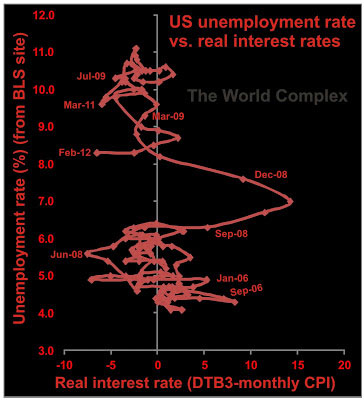 I thought the unemployment rate was supposed to drop when interest
rates were low. Data from BLS.
Don't the unemployed want jobs? Why don't jobs magically appear for them like they did in the 60s? 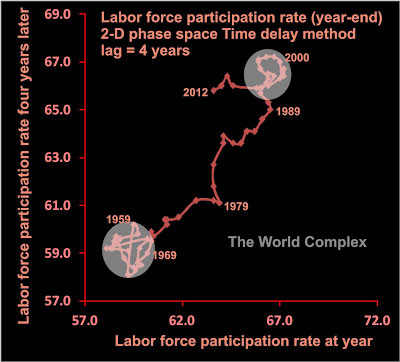 Impressive job creation from the 1960s until about 2000.
It stalled briefly during the Volcker high-interest-rate period
of the early 80s. Data from BLS.
The trouble is similar to what our magician friend in the story above might face if the shopkeeper suddenly demanded a repeat performance, this time with meat pies. The magician can only perform a trick like that so many times. Perhaps he becomes too engorged with chocolate bars and meat pies. Perhaps there aren't any that can "appear" in his friend's pocket. Or maybe the shopkeeper simply won't be fooled any more. 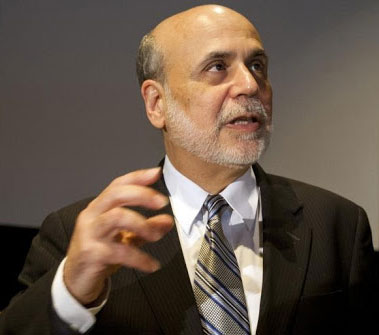 That's funny. All that money of yours that disappeared was
supposed to reappear in my hand. Errrm, sorry? At least is isn't as bad as Siegfried and Roy's last trick with the tiger. What does the rest of the world think? 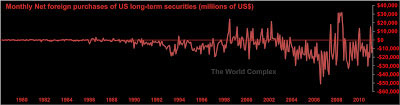 Too lazy to update this. Sorry. To mid 2011. But I doubt it's gotten better.
It looks like the rest of the world started to lose faith in the US dollar in the '90s. Remember the Strong Dollar Policy under Clinton? Looks like somebody thought it was a selling opportunity. But the problems with the money-creating approach became apparent by 1970. Nixon kept the system going a bit longer with his trick of taking the dollar off the gold standard, so the US would not have to exhaust its stored gold redeeming green coupons. The system ran out of gas again at the end of the 70s, but Volcker's trick of raising interest rates gave the US 20+ years of slowly falling interest rates, which allowed the audience to keep believing the illusion. But even then, it should have been clear that something was up. GDP as it was defined at the time was climbing, but some of its ancillaries were not keeping up. 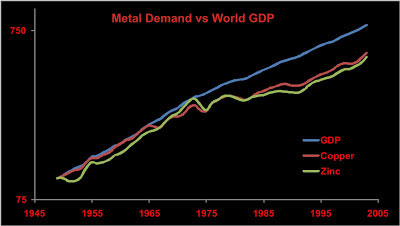 Data from Handselbanken Capital Markets.
It is difficult to imagine just how the economy grows without similar increases in the use of copper and zinc, both of which are tough to replace. One comment wondered if we replaced copper and zinc with plastics. Some piping maybe. But not much wiring. As I proposed earlier, what really happened in the late 1970s was a contraction in the economy, which was hidden by fudging reported GDP. If real GDP is tied to demand for copper and zinc, then I would say that (from the above chart) world GDP was overstated by approximately 80% as of 2005. It's hard to imagine that that number has gotten smaller subsequently. Either that, or the "value" of lawyers bills, lobby groups, US medical expenses, overspending on military wonder weapons, financial charges and skimming, and other less than productive enterprises now constitutes just under 50% of the world "economy". I hope it makes you feel rich. With lower demand came lower exploration expenditures--at least for base metals. 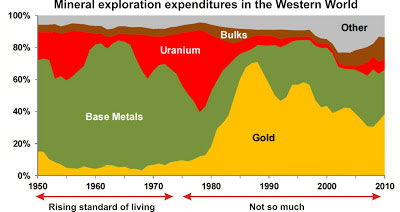 Source here (pdf)
I think this graph shows the change in mindset from the past to the present. Don't mine base metals; mine money (gold). And this established the precedent for today's industrial ideal: don't make products, make money. And so the business model changed: from producing real products, which improved lives and increased the wealth of everyone; to making money through methods including outsourcing and speculation, which improved the lives and wealth of only a few. Back to jobs.
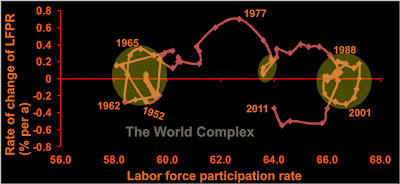 After the little scare in 1980, we had 20 years of lower interest rates, during which the US labour force participation rate increased to its highest level in history. After the internet bubble popped, the US Fed shoved interest rates down, igniting a nice housing bubble, which created a lot of construction, real estate, and retail jobs. Unfortunately, these only matched the losses of manufacturing jobs--until about 2007. More recently, the number of full-time jobs is falling. The magician has pulled all the rabbits there are out of the hat. If money printing can't create jobs anymore, the pain that is to come will dwarf the pain already felt. The labour force participation rate will fall to the level of the 1950s unless there is another rabbit in there somewhere. |
|---|
Send this article to a friend:
 |
 |
 |