
September
06
2013
06
2013
|
September 06 2013 |
How Fed Policy Has Devastated Three Generations of Retirees
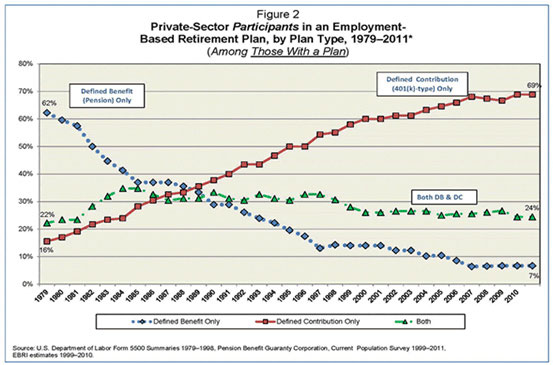
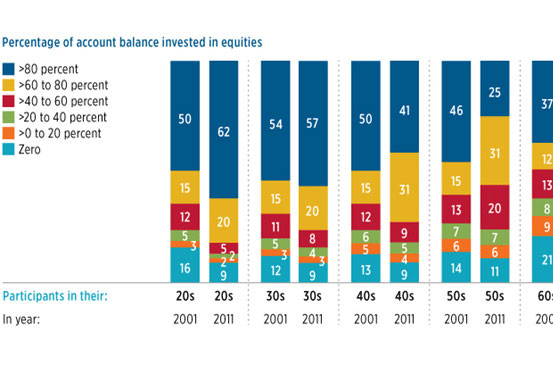
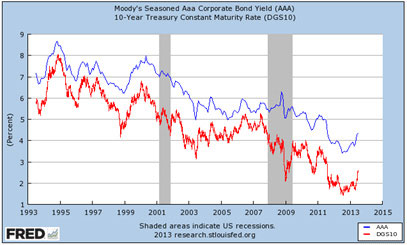
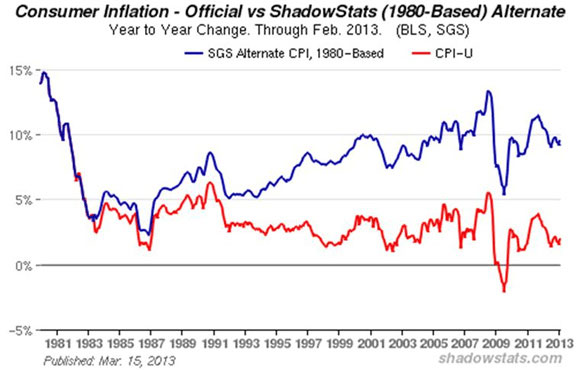
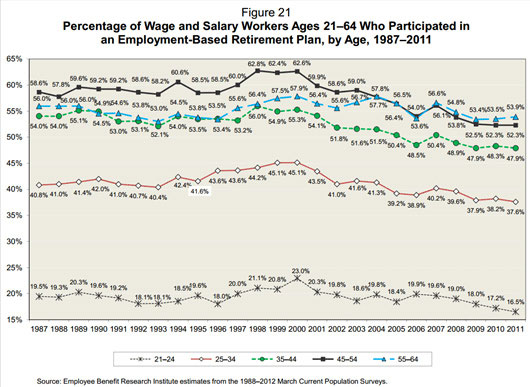
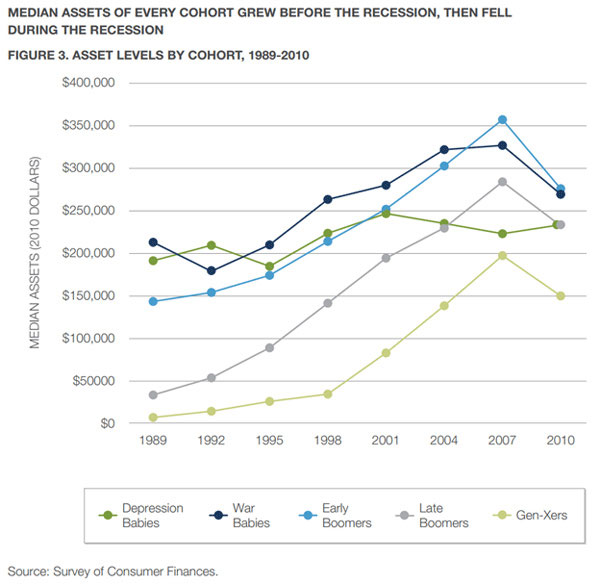
Over the past few years, the Federal Reserve has moved from simple interest rate manipulation to wholesale market interference with the goal of maintaining bank solvency and equity prices. This steamroller-style interference in the markets has had massive consequences. And not just for the Baby Boomers who are now hitting retirement age, but also for their children and children's children—three American generations whose retirement hopes have been left to swing in the wind on a string of broken promises. Baby Boomers Get Their Risk OnThe Baby Boomer generation (born 1946 – 1964) is quite used to adjusting to ever-changing conditions when it comes to retirement. For decades, receiving a pension was what one looked forward to for their old age. But as you can see in the chart below, at least in the private sector that idea has become as extinct as a T-rex. Its replacement became the 401(k) and the IRA—tax-deferred vehicles that let savers take control of their own retirement, for better or worse. Granted, Americans have built up a sizable nest egg in these defined-contribution retirement accounts—more than $5.4 trillion in IRAs alone—but the cumulative savings fail to tell the larger story. The dire truth is that Baby Boomers are caught in a trap, simultaneously trying to preserve capital and generate yield through wild market swings like 2000's massive crash, 2008's 30% correction, and 2010's flash crash. The market's frequent large "corrections" have had a sobering effect on Boomers' investment behavior. In an attempt to avoid the swings while still making money to live off, Boomers have flooded the bond market with money and significantly reduced their stock market exposure. As you can see in the right-most bars on the graph above, Boomers who are in their sixties today have significantly reduced the weighting of equities in their portfolios over the last decade—much more so than their peers of just 10 years earlier. It's true that since the bursting of the housing bubble in 2007, major indexes have recovered to a point where anyone who stayed put after the crash should have been made whole again. Yet the actual market participation by the Boomers has been considerably lower—thrice bitten, twice shy—meaning many missed out on the equity market's recovery. Instead, hundreds of billions of dollars flowed into the bond markets over the past five years, as evidenced by the $50 billion upswing in bond ETF assets in 2012, and the $125 billion in bond-based mutual fund net inflows over the same period. Following a protective instinct, conservative investors shifted their money from stocks to bonds… at exactly the time interest rates were rapidly falling for most classes of income investments. Boomers have suffered more losses and settled for lower income than ever before. The double whammy took a serious toll on the retirement dreams of many. But that was OK, because there was always Social Security as a backstop. It's become increasingly obvious, though, that Social Security is not keeping up with the times. By tying its payouts to the Consumer Price Index (CPI)—a measure as flawed at predicting actual consumer prices as a groundhog at predicting the weather (a consumer price that doesn't include fuel or food?)—as a net effect, the real value of Social Security payouts has shrunk dramatically. Here's a chart of official consumer inflation vs. the real numbers calculated by economist John Williams of ShadowStats (he uses the US government's unadulterated accounting methods of the 1980s). While the official number is 2%, real inflation is in the 9% range. Washington has been cutting Social Security payments for years, just in a way that wasn't obvious to most newscasters and taxpayers—at least not until it was time to collect, as increasing numbers of Boomers now are. Between the downfall of the pension, Boomers' eschewing of the stock market, and the government's zero interest rate policy, for many Americans retiring in their sixties has become little more than wishful thinking—and a financially comfortable retirement now requires taking significantly more risk than most are willing or able to handle. Generation X Strikes OutTraditionally, the 45-55 age group has been the most fervent retirement savers, but that has changed drastically in the last 25 years. As you can see in this chart, the most rapid declines in participation rate for the black line (age 45-54) coincide with major dips in the market, such as in 2001 and 2007. To make matters worse, Gen-Xers (born 1965 – 1980) are also the most debt-ridden generation of the past century. According to the Pew Research Center, Gen-Xers and Baby Boomers alike have much lower asset-to-debt ratios than older groups. Whereas War and Depression babies got rid of debt over the past 20 years, Boomers and Gen-Xers were adding to their load:
That situation deteriorated further in the last six years; while all groups lost money in the Great Recession, the Gen-Xers were the hardest-hit. As Early and Late Boomers struggled with asset depreciation of 28% and 25%, respectively, Gen-Xers lost almost half (45%) of their already smaller wealth. They also lost 27% of home equity during the crisis, the largest percentage loss of the groups studied by Pew. Millennials: Down a Well and Refusing the RopeThe effects of a prolonged period of low interest rates on current and near-term retirees are obvious. But the long-term effects on those now in their early years of working and saving may be much greater. We've all been taught about the power of compound interest. Put away $10,000 today, compounding at 7%, and in 20 years you have about $40,000 and in 30 years nearly $80,000. As powerful a tool as long-term compounding is, though, nothing can cut the legs out from under it more than saving less early on or earning less in the first few years. Any small change to the input has a drastic effect on what comes out the far end. The Millennials—those born between 1981 and 2000—are suffering from both right now. It's no secret that interest rates are low, and there is little that their generation, whose oldest members are now in their early thirties, can do about it. Shrinking interest rates are wreaking real havoc on the Boomers' children, extending the time to retirement for that generation by nearly a decade. Why would any politician pass legislation to change Social Security eligibility, a measure that usually doesn't bode well for reelection, if they can simply rely on fiscal policy to accomplish the same net effect? To make matters worse, the years of financial turmoil, a tough post-college job market, high levels of student loans, and numerous other factors have kept most Millennials out of the stock markets. Millennials are far less likely to open a retirement savings account than previous generations. According to a recent Wells Fargo survey, "In companies that do not automatically enroll eligible employees, just 13.4% of Millennials participate in the plan." This is worse even than the number EBRI collected in the graph presented earlier, which still pegged retirement plan participation rates at all-time lows for the 20-something set. Only a small percentage of Millennials are taking even the most basic step toward taking charge of their own retirement. With their parents and grandparents showing them the failure of the pension system and Social Security first-hand, one would think the opposite might be true. But the numbers clearly show that Millennials are less interested in saving for their future retirement than their parents were. Having seen it happen to their own grandparents, maybe they are just resigned to the idea that they'll have to work well into their golden years anyway. And who could blame their generation for not trusting the stock markets with their capital after seeing what happened to their parents’ nest eggs so many times during their own childhoods? The youngest working generation is eschewing investment, at what might be a great cost down the road. Adapt to SurviveMultiple years of shrinking interest rates, thanks to heavy bond buying by the Federal Reserve in its Quantitative Easing program, have taken an immense toll on generations of savers. The increased risk that current and future retirees have to take on to meet their income needs has left many shaken and financially insecure. As a result, many are now looking to new strategies to make up for the shortfall the Fed's zero interest rate policy has created—shifting their focus from bonds to dividend-paying stocks and adapting as they go along. The tremendous challenges American savers and income investors are facing—and the best investment strategies to ensure a comfortable retirement—will be discussed in America's Broken Promise, a must-watch online event hosted by Casey Research. Join FOX Business News host John Stossel, former US Comptroller General David M. Walker, and investment experts Jeff White, Dennis Miller, and David Galland in this crucial and timely discussion. Registration is free—click here to save your seat.
An active international lecturer for 40 years, Dennis wrote several books on sales and sales management. He was a contributor to the American Management Association and is a former US Marine and a member of the Mensa Society. Early in his career, he was an adjunct professor at Northwestern University. In 1995, Dennis undertook a serious study of investing, devoting many hours a day to reading and speaking with investment managers, authors, analysts, and anyone who could broaden his knowledge of investing. Sixteen years later, in a conversation with Casey Research's managing partner David Galland, he suggested that Casey Research was not filling an important role in speaking to baby boomers and retirees about planning and funding retirement. David agreed. Soon after that conversation, Dennis' new book Retirement Reboot was born, as well as his monthly newsletter, Money Forever, and his free journal, Miller's Money Weekly.Working with Casey Research analysts, Dennis advises subscribers on how to prepare a bulletproof retirement portfolio and ensure having their own money forever.
|
|---|
Send this article to a friend:
 |
 |
 |
 Over the course of his career, Dennis Miller has consulted with many Fortune 500 companies, training hundreds of executives to effectively communicate the value of their company's products to their customers. Among his many multinational clients are: GE, Mobil, Shell, Schlumberger, HP, IBM, Corning Glass, Eastman Kodak, AC Nielsen, and Johns-Manville.