What Distinguishes the Rich from the Poor Today, Part I
Gonzalo Lira
In Part II of this series, I'll be covering education. In Part III, I'll be covering something I call "structural pliancy". - GL
One of my brothers-in-law, C., is moving from Chile to America to take over a fairly large corporation. He is a highly educated, highly successful guy in his late-thirties - a big strapping guy of about 6'3", a former rugby player, big on golf, with four small kids and a tall willowy wife who looks like a model.
Though he's been to the United States many times, for business and pleasure, he's never actually lived there. So over a Sunday lunch, we talked about his first impressions about daily life in America - and what struck him was the food:
"It has no taste," C. told me. "Or rather, supermarket food has no taste: Beef, fish, chicken - it all tastes bland and watery."
He told me how vegetables too tasted oddly bland, and on top of that, he and his wife were worried about what is actually in the food.
 |
Yeah, it has two heads - but it was
raised organically. So it's safer
than your lunchtime Chicken McNugget. |
The reason they're worried about American food is because of the size of American children in his kids' new schools:
"Our kids were among the tallest in their class in Chile - but they're among the smaller kids in their U.S. classroom. On top of that, the girls in my older daughter's class are starting to menstruate - and they are nine years-old! That's not normal."
C.'s conclusion: "It's the industrially processed foods - God knows what they're sticking in it. But we've got four children - and we want them to be healthy. So that's why we started buying all our food at organic markets. The food bill is triple what it would be, but I don't care, I can afford it: I want my family healthy."
That - in a nutshell - is what will begin to distinguish rich people from poor people in the XXI century, as it has for millenia before: Diet.
But what kind of diet is the issue.
If in ages past, the diets of the wealthy had more calories, in this century and the future, the diets of the wealthy will have less chemicals and hormones.
And as in the past, we will see the difference in their children.
In the nineteenth century and before, the mark of the wealthy was fat: Plump women, plump men, and their plump children. They were all fat because they had the wherewithal to buy more food. More food meant more calories, which of course meant plumpness. It's no surprise that early portrait photography almost uniformly depicted fat people: Photographs were expensive, and the people with the money to get their portraits done had the money to eat well.
The poor, of course, were skinny and frail-looking. They were short of stature - because they hadn't received enough protein as they were growing up. Look at any nineteenth century picture of a crowd, say soldiers on a Civil War battlefield, and everyone looks as skinny and slight as a professional jockey - not an ounce of excess fat on anyone, and no one over 5'6".
Today, in the XXI century - where presumably everyone has access to enough food - we can easily spot the poor as well:
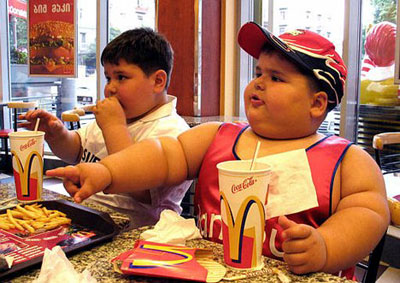
They are fat. They sport massive bellies falling over their belts - or more often, hidden under tent-like t-shirts (both men and women) - and the flesh of their faces runs smoothly into their shoulders: They have no necks.
Their obesity comes from the cheap processed foods that they eat: Fried meats and starches, not to mention sugary soft-drinks drunk by the gallon.
The poor today are also big: Not merely fatter but taller, larger. This is because of all the hormones that they are ingesting, hormones injected into the cheap processed foods that they eat by the corporations trying to bulk up the poultry and beef they are selling.
The food processing companies are trying to maximize their profits by hurrying the growth process of the meats and poultry that they sell. To hurry this growth, they inject antibiotics - to prevent sickness, which makes the animals lose weight - and they inject growth hormones, which make the animals fatter, and therefore more profitable in less time.
Click here to continue reading "What Distinguishes the Rich from the Poor Today?"
 Gonzalo Lira (born February 29, 1968) is an American novelist and filmmaker born in Burbank, California. He is the son of Gonzalo Lira Valdés and María Isabel López Hess; he is a descendant of José Miguel Carrera. He grew up in the San Fernando Valley, New York City, and Miami, as well as Guayaquil, Ecuador. He completed high school at St. George's College in Santiago, Chile, in 1985. He attended Dartmouth College in 1991, graduating with honors in 1995, with a degree in history and philosophy. Gonzalo Lira (born February 29, 1968) is an American novelist and filmmaker born in Burbank, California. He is the son of Gonzalo Lira Valdés and María Isabel López Hess; he is a descendant of José Miguel Carrera. He grew up in the San Fernando Valley, New York City, and Miami, as well as Guayaquil, Ecuador. He completed high school at St. George's College in Santiago, Chile, in 1985. He attended Dartmouth College in 1991, graduating with honors in 1995, with a degree in history and philosophy.
His first novel was Counterparts, a commercial thriller published in 1997. His first Spanish language novel was Tomáh Errázurih, a highly experimental coming-of-age story published in 1998. Starting in 2010, Lira began contributing economic analysis to Zero Hedge, naked capitalism, Seeking Alpha and Business Insider.
gonzalolira.blogspot.com
|