Send this article to a friend:
July
15
2014

|
Send this article to a friend: July |
|
Natural Gas Discoveries Fueling Gaza Crisis?
This morning, he said:
But in 2007, a year before Operation Cast Lead, Ya'alon's concerns focused on the 1.4 trillion cubic feet of natural gas discovered in 2000 off the Gaza coast, valued at $4 billion. Ya'alon dismissed the notion that "Gaza gas can be a key driver of an economically more viable Palestinian state" as "misguided." The problem, he said, is that:
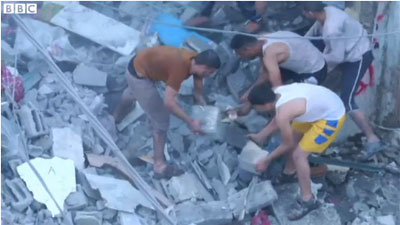
Operation Cast Lead did not succeed in uprooting Hamas, but the conflict did take the lives of 1,387 Palestinians (773 of whom were civilians) and 9 Israelis (3 of whom were civilians). Since the discovery of oil and gas in the Occupied Territories, resource competition has increasingly been at the heart of the conflict, motivated largely by Israel's increasing domestic energy woes. Mark Turner, founder of the Research Journalism Initiative, reported that the siege of Gaza and ensuing military pressure was designed to "eliminate" Hamas as "a viable political entity in Gaza" to generate a "political climate" conducive to a gas deal. This involved rehabilitating the defeated Fatah as the dominant political player in the West Bank, and "leveraging political tensions between the two parties, arming forces loyal to Abbas and the selective resumption of financial aid." Ya'alon's comments in 2007 illustrate that the Israeli cabinet is not just concerned about Hamas – but concerned that if Palestinians develop their own gas resources, the resulting economic transformation could in turn fundamentally increase Palestinian clout. Meanwhile, Israel has made successive major discoveries in recent years - such as the Leviathan field estimated to hold 18 trillion cubic feet of natural gas – which could transform the country from energy importer into aspiring energy exporter with ambitions to supply Europe, Jordan and Egypt. A potential obstacle is that much of the 122 trillion cubic feet of gas and 1.6 billion barrels of oil in the Levant Basin Province lies in territorial waters where borders are hotly disputed between Israel, Syria, Lebanon, Gaza and Cyprus. Amidst this regional jockeying for gas, though, Israel faces its own little-understood energy challenges. It could, for instance, take until 2020 for much of these domestic resources to be properly mobilised. But this is the tip of the iceberg. A 2012 letter by two Israeli government chief scientists – which the Israeli government chose not to disclose – warned the government that Israel still had insufficient gas resources to sustain exports despite all the stupendous discoveries. The letter, according to Ha'aretz, stated that Israel's domestic resources were 50% less than needed to support meaningful exports, and could be depleted in decades:
As Dr Gary Luft - an advisor to the US Energy Security Council - wrote in the Journal of Energy Security, "with the depletion of Israel's domestic gas supplies accelerating, and without an imminent rise in Egyptian gas imports, Israel could face a power crisis in the next few years… If Israel is to continue to pursue its natural gas plans it must diversify its supply sources." Israel's new domestic discoveries do not, as yet, offer an immediate solution as electricity prices reach record levels, heightening the imperative to diversify supply. This appears to be behind Prime Minister Netanyahu's announcement in February 2011 that it was now time to seal the Gaza gas deal. But even after a new round of negotiations was kick-started between the Fatah-led Palestinian Authority and Israel in September 2012, Hamas was excluded from these talks, and thus rejected the legitimacy of any deal. Earlier this year, Hamas condemned a PA deal to purchase $1.2 billion worth of gas from Israel Leviathan field over a 20 year period once the field starts producing. Simultaneously, the PA has held several meetings with the British Gas Group to develop the Gaza gas field, albeit with a view to exclude Hamas – and thus Gazans – from access to the proceeds. That plan had been the brainchild of Quartet Middle East envoy Tony Blair. But the PA was also courting Russia's Gazprom to develop the Gaza marine gas field, and talks have been going on between Russia, Israel and Cyprus, though so far it is unclear what the outcome of these have been. Also missing was any clarification on how the PA would exert control over Gaza, which is governed by Hamas. According to Anais Antreasyan in the University of California's Journal of Palestine Studies, the most respected English language journal devoted to the Arab-Israeli conflict, Israel's stranglehold over Gaza has been designed to make "Palestinian access to the Marine-1 and Marine-2 gas wells impossible." Israel's long-term goal "besides preventing the Palestinians from exploiting their own resources, is to integrate the gas fields off Gaza into the adjacent Israeli offshore installations." This is part of a wider strategy of:
For the Israeli government, Hamas continues to be the main obstacle to the finalisation of the gas deal. In the incumbent defence minister's words: "Israel's experience during the Oslo years indicates Palestinian gas profits would likely end up funding terrorism against Israel. The threat is not limited to Hamas… It is impossible to prevent at least some of the gas proceeds from reaching Palestinian terror groups." The only option, therefore, is yet another "military operation to uproot Hamas." Unfortunately, for the IDF uprooting Hamas means destroying the group's perceived civilian support base – which is why Palestinian civilian casualties massively outweigh that of Israelis. Both are obviously reprehensible, but Israel's capacity to inflict destruction is simply far greater. In the wake of Operation Cast Lead, the Jerusalem-based Public Committee Against Torture in Israel (Pcati) found that the IDF had adopted a more aggressive combat doctrine based on two principles – "zero casualties" for IDF soldiers at the cost of deploying increasingly indiscriminate firepower in densely populated areas, and the "dahiya doctrine" promoting targeting of civilian infrastructure to create widespread suffering amongst the population with a view to foment opposition to Israel's opponents. This was confirmed in practice by the UN fact-finding mission in Gaza which concluded that the IDF had pursued a "deliberate policy of disproportionate force," aimed at the "supporting infrastructure" of the enemy - "this appears to have meant the civilian population," said the UN report. The Israel-Palestine conflict is clearly not all about resources. But in an age of expensive energy, competition to dominate regional fossil fuels are increasingly influencing the critical decisions that can inflame war.
|
|---|
Send this article to a friend:
 |
 |
 |