Send this article to a friend:
June
19
2014

|
Send this article to a friend: June |
|
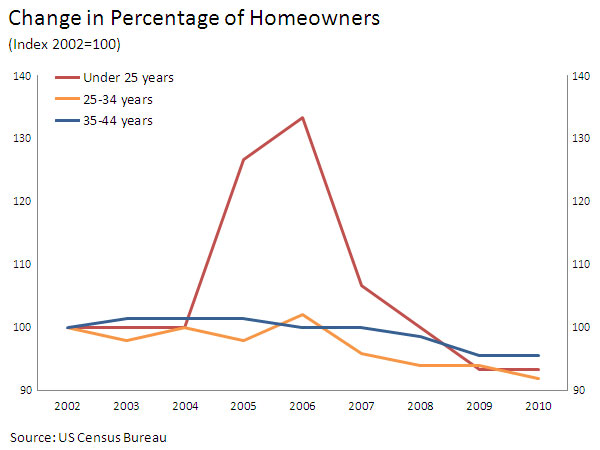
Generation R – Millennials are largely living at home or opting to rent. There is a big challenge when someone comes of age during an economic crisis. Millennials, the children of baby boomers born between 1982 and 2000 have largely grown into an economy that was fully in shambles. This is a generation that grew up with parents talking about the middle class as if it were a foregone conclusion. Their parent's went to school when it was affordable, came of age when jobs were plentiful, and housing costs were reasonable relative to incomes. Those days are largely gone. While some in the real estate industry scratch their heads as to why homeownership for younger Americans is so low, they should spend some time analyzing the cross-currents that are hitting this cohort. The older Millennials are well into their first home buying years yet their homeownership rates are far below those of previous generations. It was thought that once the Great Recession ended in 2009 that somehow these people would be back at it and buying homes. Yet growing up during a time of massive uncertainty leaves a psychological impact on how you view your future goals. Many are opting not to buy homes and many others simply cannot afford to leave home. The apt title for this cohort is Generation R, as in a new generation of renters. Does the American Dream carry the same weight for Millennials? When we look at homeownership data broken out by age groups, we find that many younger Americans bought during the apex of the housing bubble. Many went into massive debt to purchase a home when they were already carrying high levels of student debt. As the housing bubble burst, many who were junior in their careers, were at times the first to be let go. Also, since they bought at the peak, they were severely underwater and many were unable to carry their mortgage payments. There is a growing amount of data suggesting that homeownership will be very different for future cohorts of Americans, particularly the young:
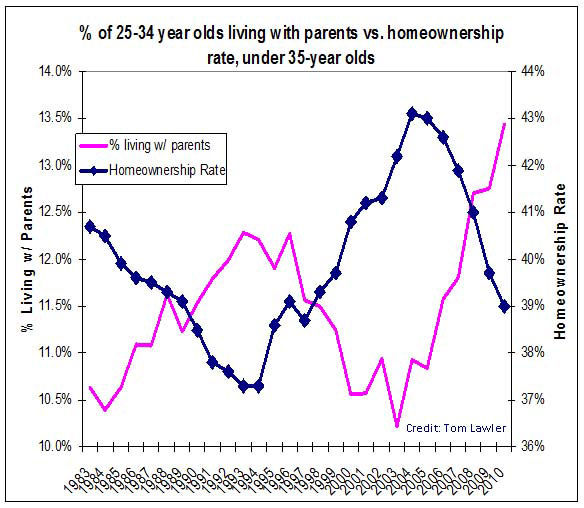
This is incredibly important information. The middle class was largely developed around the mythology of owning a home. Most Americans contain all of their net worth in the equity of their home. Yet today, home prices are largely out of the reach of younger Americans with lower salaries. Take a look at the above chart. You can see that homeownership for younger Americans peaked during the height of the housing bubble. Since then, it has fully retreated. That is one source of information. The impact of the housing bubble popping on Millennials can be seen even more dramatically when we look at those now living at home with parents:
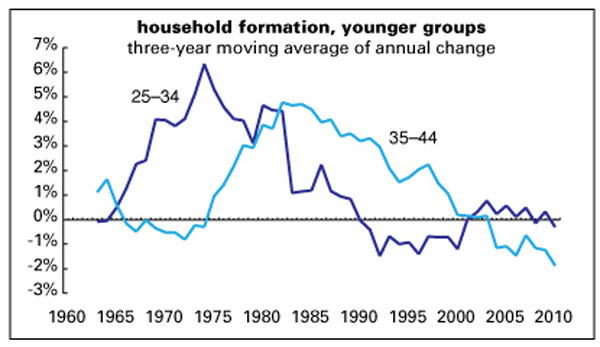
There is a near perfect correlation here. As the bubble burst many younger Americans were forced to move in with their parents or many simply never left the nest. This is largely driven by financial forces versus any sudden shift in wanting to live with mom and dad. The problem is that mom and dad are also struggling with their retirement planning. Since the Great Recession ended the large buying in the housing industry has come from investors. The growth in renting households has been dramatic. You can see the problem for the housing industry with household formation:
This weak growth in household formation is largely due to younger households living at home or simply linking up with roommates under one roof. It also helps to explain why construction and home building continues to be weak. Investors in many cases are buying up existing inventory simply to rent out to households. It will be interesting to see whether motivations for home buying shift for Millennials. I would argue that we would first need to see a shift in wages and jobs before seeing a surge in home buying. Generation R is the new trend here and many are redefining the definition of the American Dream when it comes to homeownership. |
|---|
Send this article to a friend:
 |
 |
 |