
Send this article to a friend:
June
19
2014

|
Send this article to a friend: June |
|
A Horror-Show Called "Fed-Gate" May Be Coming To Your Bond Fund Soon
And so the shoes begin to fall. Owing to the Fed's brutal financial repression since December 2008 (i.e. zero yield on short-term funds), there has been massive scramble for yield that has driven trillions into corporate and high yield bond funds. What this means is that liquid funds which would have normally been parked in bank deposits or money market funds have been artificially displaced. That is, they have been chased by the dictates of the monetary politburo into far more illiquid and risky investment vehicles owing to zero yields in their preferred financial venues. But now it is dawning on at least some of the more market savvy occupants of the Eccles Building that they have created a monumental financial log-jam waiting to happen. In their jargon, the migration of trillions into bond funds since the financial crisis has resulted in a sweeping "maturity transformation". As former governor Jeremy Stein succinctly put it,
What Stein means is that the traditional money markets existed for a reason—even if returns were inferior to what could be obtained in longer duration fixed income securities or investments with equity-like features such as junk bonds. Corporations and individuals who invested in money market instruments, including bank CDs, were willing to absorb the yield penalty in return for the assurance of absolute daily liquidity that the funds in question required. But zero return is not a market driven liquidity penalty; it is an arbitrary prohibition imposed on the market by the monetary politburo. So now we have a giant anomaly. Trillions of daily liquidity demanding investments are potentially stuck in bond funds which could not provide it during a crisis. In effect, any attempt by bond funds managers to meet a surge of redemptions calls would make the crisis surrounding the Reserve Prime Fund's "breaking the buck" in September 2008 seem like a Sunday School picnic. The reason is that the Fed created a massively artificial demand for bond fund investments during the 6-year stretch of ZIRP. Accordingly, in the event that liquidity-seeking investors call their funds, which they are entitled to do by bond mutual funds, there would be a massive imbalance in the market. This is especially true because traditional Wall Street market makers have significantly shrunk their balance sheet positions and available capital owing to Dodd-Frank. So drastically imbalanced markets under crisis conditions would gap down and potentially go even bidless for many higher risk, less liquid corporate issues. As mark-to market losses mounted, of course, investor demands for liquidity would sky-rocket, begetting even more fire sale dumping of corporates and junk bonds and even deeper discounts and losses. In short, in its mindless drive to manipulate financial markets and generate artificial demand for credit, the Fed has created the potential for a massive run on bond funds should a new financial crisis be triggered by one black swan or another. And once again it is evident that the market's natural process of "price discovery" has been destroyed in favor of ham-handed "price administration" by our monetary central planners. Yet the monster they have already created—-a massive log-jam at the bond fund exit gates—-would pale compared to the deformations and anomalies that would result from the imposition of a government dictated exist fee on unsuspecting investors. Even the announcement of a rule-making would potentially trigger the very kind of sell-off that it would be designed to prevent. And if corporate bond prices took a tumble, it would not take long for equity markets to recognize that the massive flow of new debt capital which has been used to fund record stock buybacks could suddenly dry up. Not surprisingly, the big bond houses are lining up in favor of government imposed exits fees and gates. They would like nothing better than to keep investors captive, collect the fees and blame Washington for the inconvenience to investors. The next round of crony capitalism is already underway.
At the podium, Stockman's expertise and experience cannot be matched, and he has a reputation for zesty financial straight talk. Defying right- and left-wing boxes, his latest book catalogues both the corrupters and defenders of sound money, fiscal rectitude, and free markets. Stockman discusses the forces that have left the public sector teetering on the edge of political dysfunction and fiscal collapse Stockman's career in Washington began in 1970, when he served as a special assistant to U.S. Representative, John Anderson of Illinois. From 1972 to 1975, he was executive director of the U.S. House of Representatives Republican Conference. Stockman was elected as a Michigan Congressman in 1976 and held the position until his resignation in January 1981. He then became Director of the Office of Management and Budget under President Ronald Reagan, serving from 1981 until August 1985. Stockman was the youngest cabinet member in the 20th century. After resigning from his position as Director of the OMB, Stockman wrote a best-selling book, The Triumph of Politics: Why the Reagan Revolution Failed (1986). The book was Stockman's frontline report of the miscalculations, manipulations, and political intrigues that led to the failure of the Reagan Revolution. A major publishing event and New York Times bestseller in its day, The Triumph of Politics is still startlingly relevant to the conduct of Washington politics today. After leaving government, Stockman joined Wall Street investment bank Salomon Bros. He later became one of the original partners at New York-based private equity firm, The Blackstone Group. Stockman left Blackstone in 1999 to start his own private equity fund based in Greenwich, Connecticut. In his newest New York Times best-seller, The Great Deformation: The Corruption of Capitalism in America (2013), Stockman lays out how the U.S. has devolved from a free market economy into one fatally deformed by Washington's endless fiscal largesse, K-street lobbies and Fed sponsored bailouts and printing press money. Stockman was born in Ft. Hood, Texas. He received his B.A. from Michigan State University and pursued graduate studies at Harvard Divinity School. He lives in Greenwich, Connecticut, with his wife Jennifer Blei Stockman. They have two daughters, Rachel and Victoria. |
|---|
Send this article to a friend:
 |
 |
 |
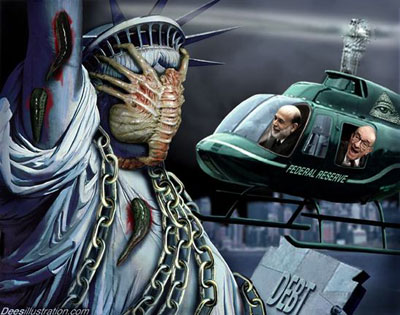 The Financial Times is not exactly a rumor mill—-so its recent headline amounts to a thunderbolt:
 David Stockman is the ultimate Washington insider turned iconoclast. He began his career in Washington as a young man and quickly rose through the ranks of the Republican Party to become the Director of the Office of Management and Budget under President Ronald Reagan. After leaving the White House, Stockman had a 20-year career on Wall Street.