
Send this article to a friend:
June
30
2014

|
Send this article to a friend: June |
|
Cronyism in the 21st Century
Ghandi was once asked, "What do you think about Western Civilization?" to which he famously replied "I think it's a good idea." He may as well have been talking about free market capitalism. Capital in the 21st Century has hit the world like a new teen idol sensation. Everybody is drinking the Kool-Aid and it's being held up as the most important book ever written on the subject of how runaway capitalism leads to wealth inequality. Paul Krugman of course, loves it. As does every head of state and political hack in the (formerly) free world. A text-book sized brick that can be condensed down to a couple bullet points:
What's not to love? There are many other refutations of Capital circulating, most of which address the numerous factual errors and flawed research methodologies in the book, and countering the income equality assertions with observations around how the standard of living generally increases across the board during periods of free(er) market capitalism (such as England during the industrial revolution under the classical gold standard or wider Europe during the High Middle Ages). The age we live in today is not an example of this. I submit that the modern run of standard of living increases, say from end of WWII to present is not an example of "free markets given room to run", but rather a crack-up boom fuelled by credit expansion (cheap money) and cheap energy. This era is now drawing to a close, as the cost of energy inexorably rises and the global debt super-cycle finally hits a wall. After decades of government targeted inflation, after the better part of a decade of ZIRP, after increased regulations in every aspect of our lives, after civil liberties being for the most part abolished (after all, the government is allowed to assassinate any one of us and we are all under continuous pervasive surveillance) what is difficult to fathom is that political economists can still make hay in the world by blaming its problems on capitalism gone wild and runaway free markets. Put simply, true capitalism requires free markets, free markets require a free society and we do not live in a free society. So let's do something different here and accept a core premise of Capital, and say that wealth inequality is increasing, and that it's a bad thing. Where the point is completely missed is in what causes it (ostensibly "free market capitalism") and what to do about it (increase government control, induce more inflation and raise taxes). The point of this essay is to assert that it is not unchecked capital or runaway free markets that cause increasing wealth inequality, but rather that the underlying monetary system itself is hard-coded by an inner temple of ruling elites in a way which creates that inequality. We'll see that wealth doesn't "run away" in a logarithmic fashion (perhaps hinted at by Pareto and captured in various "1% memes") but rather can be best visualized as a vortex, like a tornado, or more accurately, a black hole, a centre swirling around a political/monetary/cronyist nexus that sucks wealth into it from the periphery (the rest of society). Society itself is hard-wired to facilitate this in such an entrenched and subtle fashion that we have arrived in a zeitgeist in which the key facets of this system (the nature of money itself) is out-of-scope. It's not even part of the debate because almost everybody in society is oblivious to it's machinations. (This is the reason why in my writings I do not refer to underclass or overclass but rather, the "outer-class" and the inner elites.)
This is what it tells us: if smart, scholarly people happen to believe that government fiat money is both feasible and beneficial to society, and they put serious thought into devising such a system, what they will not come up with is one run by private central banks issuing debt-based money. They just won't. Any critical analysis would grasp that such an architecture would become a parasitic cancer on the entire society. When you realize this, it's hard not to posit a far-reaching conspiracy to institutionalize inequality. While I am a big believer in the maxim "never ascribe to conspiracy what can be explained by stupidy" it to me falls short in this case. When we look at the structure of the entire monetary system and realize that it's the worst way possible to design a such a system if you have the best interests of the wider society in mind then you can't help but ask in whose interests was it designed and implemented? As such, the system within which we find ourselves seems to be one that isn't designed to be in the best-interest of most of us reading this (and would remain true even if you were inexplicably reading this on Huffington Post, Slate or Business Insider). If we want to understand where wealth inequality comes from, "The Lost Science of Money" is a good place to start for two reasons: 1) his book is an exhaustive history of money, even if one disputes some of his takeaways from it) and 2) like many libertarians and an-caps, he understands the pernicious, malignant effect of private central banking. His ideal solutions may not fly (government controlled fiat, because governments will always inflate and debase) but his exposure of the fraud is convincing. Zarlenga's main thesis can be put briefly that the primary arena of human struggle throughout history has been mainly over the monetary control over societies. If Zarlenga had to put it in one sentence, which he did, it would be this one: "It is by misdefining the nature of money, special interests have often been able to assume control of society's monetary system, and in turn, the society itself". (emphasis added, and you'll see why soon). He broke his book (almost as big as Capital) down into sections, examining that:
All of which is correct and explains why a book like Capital is on the New York Times Best Seller List. The premise that wealth inequality is caused by unchecked capital formation (a.k.a runaway free markets or capitalism gone wild) derives from the biggest misinterpretation of them all. It's not only monetary data that is misinterpreted, it's the entire framework around monetary policy itself which leads to these increasing imbalances. In other words, it is the structure of our monetary system itself which institutionalizes accelerating wealth inequality. Thus, taxation, intentional inflation, credit expansion, money supply injections and central planning all exacerbate income inequality, they do not alleviate it. Pikkety is a political economist (as is Krugman) and Zarlenga calls political economists the "Priesthood of the Bankers." Among the Priesthood I'll again list off Zarlenga's bullet points but this time I'll inject my own interpolation of their meaning in today's climate:
Here we mean academic political economists with no real world financial, market or business experience devise elegant theories which look good on a blackboard, will earn them Nobel Prizes and become ensconced into the prevailing orthodoxy of conventional economic thought. Governments can then utilize these theories (or self-serving adaptations of them) to justify monetary polices that enable them to live beyond their means or otherwise further their own interests and those of their cronies. These policies are utterly backwards in that they posit what economic forces should do according to some model, instead of trying to understand what they actually do based on observed results. When you do unleash Nobel laureates with their theoretical constructs on the real world, you don't get "green shoots", you get LTCM. Economists as propagandists.
Economics degenerates from the scholastics Even the untouchable pillar of Keynesianism is a bastardized caricature of what Keynes actually said, which was that governments could smooth out the business cycle by deficit spending during bust years by running surpluses during the boom years. In it's most basic form this just means saving for a rainy day. But governments don't do that, because (as people like Krugman opine) "the government doesn't have to pay it's bills". Thus, it's all deficit spending, all the time. The last US president to actually run a surplus and pay down debt was Eisenhower (the so-called Clinton era surpluses were a sleight-of-hand fiction). The last president to pay off the debt was Andrew Jackson.
You can look at almost any financial panic, especially over the last hundred years, and you'll see the same thing play out repeatedly. For example, if you go back and look at the S&L crisis and the policy response to it, one is stricken with the similarities between then and now, how nothing was actually resolved in the policy response to S&L, in fact just the contrary, how bad behaviour and incompetence were rewarded instead of allowed to be punished via free enterprise rules of engagement. The pattern is as follows:
The cycle repeats each time ensuing bubble and subsequent meltdown increasing by an order of magnitude. Which brings us to Vincent LoCascio, probably the most under appreciated commentators on our monetary system of this era. If ever there was a pair of "must" read books about what really causes wealth inequality in our society it is his Special Privilege: How the Monetary Elite Benefit… At Your Expense, and The Monetary Elite vs Gold's Honest Discipline. In Special Privilege, a chapter entitled "The Recurring Nightmare" enumerates the serial financial panics of the 19th and early 20th centuries (to wit: The Panic of 1819, The Panic of 1837, The Panic of 1857, The Panic of 1873, The Panic of 1893, and the Panic of 1907, whose policy response led in a straight line to The Federal Reserve Act of 1913). LoCascio poses the question "Isn't There A Lesson Here?"
He went on to observe,
LoCascio published Special Privilege in 2001 (he died in 2006), but large swaths of his work could easily be cut and pasted into the aftermath of the Global Financial Crisis and no doubt, will be highly germane during the forthcoming, next crisis. The only difference being that after the next, inevitable (possibly imminent) wave of financial panic, it may be impossible to kick the can down the road yet another time. We may have finally, collectively come to the end of the line on "the great fiat monetization of everything" and be barreling toward the brick wall of unsustainability at the end of the runway.
This is what is so maddening about the irony of a book like Capital, chalk full of fallacious data and erroneous conclusions makes Pikkety hotter than Justin Bieber, while brilliant historians such as LoCascio die in obscurity. The fact is that financial panic, followed by institutional wealth transfer (and confiscation) is systemically ingrained into what is called "conventional economic thought" The big question around wealth inequality is this: why does wealth inequality increase as the distance from the nexus of political power increases? Why does wealth concentrate toward the centre? When asked this plainly, the answer becomes just as obvious: because the system is rigged that way. Because that is wealth inequality in action. When looked at from this angle you are able to see the underlying flawed assumptions that are otherwise considered "out of scope." Whether you don't believe in a classical gold standard (Zarlenga) or you do (LoCascio), whether you think bitcoin is viable or lunacy, where all these schools of thought intersect is at the point that finds private, fractional central banking a blight on civilization that leads to cronyism oligarchy between banksters, career politicians and corporate/kleptrocrat elites and this is the point that is most vociferously relegated out-of-scope in any kind of dialog around today's central, pressing issues of the time. As LoCascio predicts,
What Pikkety has succeeded in is proving that we are not there yet. The propensity of the masses to rally behind this shows that confidence in the system is still long and strong. But what we are seeing are fissures in the logic - not only in books like Capital in the 21st Century but in entirely new and nonsensical economic schools of thought seemingly conjured out of thin air for the sole purpose of justifying and explaining away the otherwise unavoidable distortions and non-sequiturs of our economy (such as Modern Monetary Theory and Modern Monetary Realism - more on those in another post ). People are still very willing to believe in Unicorn Economics, the emergence of crypto-currencies such as bitcoin point to a widening rejection of that, but it will likely not achieve critical mass until the wheels come off the current system altogether. Postscript: As I completed writing this essay, the ECB announced negative interest rates, in other words NIRP. This is sold to the public as a mechanism to spur bank lending to - again - stimulate the economy. What nobody asks is how the financial system can be so distorted, so perverted that policymakers can simultaneously implement negative interest rates while holding on to claims of legitimacy around their ability to "regulate" or "manage" the economy, or that the wider society is actually benefiting from these policies. If you think - and I know some otherwise highly intelligent people who do - that this is just some highly abstract financial smoke and mirrors that doesn't really mean much in the real world, remember where you read this first: when NIRP fails to stimulate lending, the next Big Idea in Unicorn Economics will be to target money velocity and put expiry dates on cash. It's the next logical step once you've entered the Twilight Zone as we have, and that's also what you get when a global monetary system based on perpetually expanding debt approaches the end of the runway. (Or as as Fiat Paper Money author Ralph T Foster put it, "Reading history is a harmless pastime, reliving it is another matter.")
"Mark Jeftovic is the CEO of easyDNS Technologies Inc. the Toronto-based domain registrar and DNS provider who lives by the credo "Power & Freedom™". In his copious spare time he blogs about anarcho-capitalism, bitcoin and tectonic shifts at Wealth.net and is the guitarist/singer for indie-rock sensations The Parkdale Hookers."
|
|---|
Send this article to a friend:
 |
 |
 |
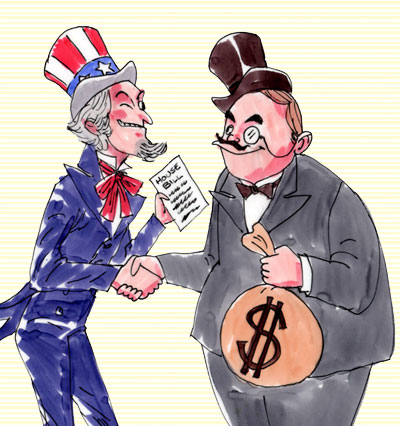
 Because the nature of money itself has been so, for lack of a better word, "esotericized", I need to include Stephen Zarlenga's seminal work "The Lost Science of Money" in our expose. While Zarlenga blesses us with an exhaustive study of money and banking practices throughout history, and does a superb job deconstructing the perniciousness of central banking and debt based money systems, he erroneously arrives at conclusions favouring direct government creation of fiat money (he even came out in favour of that whole "Trillion Dollar Coin" idea because to him it signalled a tacit admission that the government doesn't really need the Federal Reserve). However even his arrival at this seemingly (to us) off-base solution tells us something vital about the system within which we are all immersed.
.jpg)