Send this article to a friend:
June
17
2014

|
Send this article to a friend: June |
|
Deflation: The Big Risk of Big Banks' Risk-Free Gains
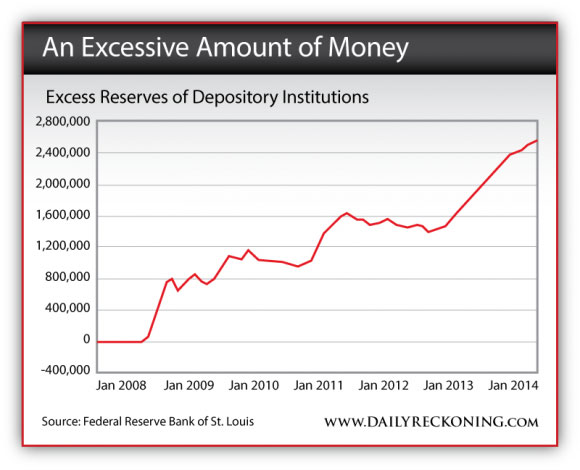
This is the problem for central banks today. The central banks created so much space that depository institutions are putting a bunch of stuff into central bank storage. What is this stuff to which I refer? Money! Depository institutions are required to keep a certain percentage of their deposits in storage with the Federal Reserve (Fed). After the financial crisis, the amount kept on deposit with the Fed understandably increased. Banks also kept an "excess" amount with the Fed, over and above their legal requirements. These are called excess reserves. You might ask why a bank would want to keep excess reserves with the Fed when they could simply create new loans with those funds. In 2006, Congress passed legislation allowing the Fed to pay interest on reserves held for banks. This game changer for banks allowed them to earn virtually risk free returns by simply parking money at the Fed. Some of this parked money had to be there by law but as you will soon find out, the great majority did not. Pre-crisis in 2007, banks stored $43 billion in required reserves and only about $2 billion excess reserves at the Fed. As the figure below illustrates, the current ratio of excess reserves to required reserves is staggering. Required reserves are a little south of $140 billion. Excess reserves are $2.6 trillion.
The European Central Bank (ECB) adopted the same approach by creating a bunch of storage space too. European banks are loaded with extra Euros stuffed in ECB coffers. Similar to the Fed, the ECB paid banks interest on excess deposits. This creates risk free return for the Euro region bankers as well. You could just as easily raise the question about why European banks would rather park their cash in central banks rather than loaning it and making a profit that way. The overstuffed ECB might not be a concern except for the one thing (well maybe more than one) that keeps central bankers up at night – deflation.
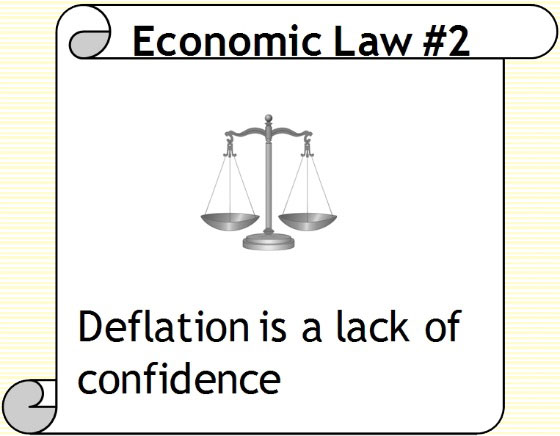
The "D" word is not something you will hear many talk about openly. It is a little understood topic since most alive have not experienced it. Deflation is the reduction of money and credit outstanding. Storing money in central bank coffers, and piling greater and greater cash in that storage is a component of deflation. Deflation has two components. One is monetary and the other is psychological. In the case of the U.S. and European overstuffed central banks, the money appears to be there for loans, but banks want to store their excess funds where they are paid a small risk-free return. This is where the psychological component of deflation comes into play. Banks do not have the confidence to loan and their central banks have reinforced the lack of confidence by paying them a small interest rate. The other side of the deflation coin is a pool of borrowers who may be unwilling to take on more debt. In our credit-based society it takes two parties to dance this tango. One party borrows and the other party lends. |
|---|
Send this article to a friend:
 |
 |
 |
 Ever notice how empty space tends to get filled? If there is a storage container or shelf somewhere in your house, something tends to find its way there over time. In abundant societies, it seems people just accumulate stuff. I remember a National Geographic picture segment illustrating household possessions in different societies. One household in an African country only owned things necessary to eat and drink. The wealthier society's household possessions overflowed their yard. Interestingly enough, when we try to sell our extra stuff in garage sales (to create room for other stuff), some other person buys it to fill their empty space. Ok, I may be exaggerating here.