|
|
US War Crowd Losing Steam?
Dominant Social Theme: The American Tea Party pushes one right wing guy over the top. Free-Market Analysis: We try to analyze the elite's dominant social themes here at the Bell; but it has occurred to us that when it comes to the victory of Rand Paul in Kentucky, we would tend to believe the elite doesn't know how to spin it. Rand Paul is an anti-foreign war, anti big-government kind of guy, and this is the establishment's nightmare. The rhetoric and substance of the views of Rand and Ron Paul are increasingly popular in America. They represent a profound challenge to the powers-that-be - or so we would have to believe. Their popularity is driven by the Internet, and their message is resonant with a culture that is still instinctively small-r republican. We see the same thing happening elsewhere in the world, by the way. We wrote about Britain just yesterday and the intention of the new coalition government to try to shrink that country's malevolent surveillance state (click here to read). We don't think it is any coincidence that their rhetoric is focused on reducing the powers of the state. They may well know something about the electorate and its current sympathies that we do not (though we can guess). The elite has played Western democracies and especially US citizens for suckers for nearly a century - sorry to sound harsh but it's true in our opinion. In America, the strategy has been apparently to build up the number of voters who favor big government - and then, alternatively, present candidates who verbalize the rhetoric of small government but turn out to be big government spenders when it comes to the military. The result has been that the American voter never gets smaller government. Even Ronald Reagan who was perhaps the modern age's most persuasive political spokesperson for smaller American government ended up expanding the US government significantly through defense spending. George Bush, meanwhile, was a disappointment to the millions of Americans seeking to shrink federal government not only because the solutions he sought as a compassionate conservative turned out to be big government ones but because after 9/11 Bush began using the resources of the huge American military industrial complex as well. George Bush to some degree ended up being a Democratic president in term of his belief in massive domestic federal programs. Bush at the same time mustered right wing expenditures by starting two wars and generally using expensive, big government military industrial programs. Bush became so unpopular that the American electorate, still searching for a candidate that would roll back the length and breadth of federal expenditures, were willing to vote for a virtual unknown in the hopes that he - Barack Obama - would provide sensible change and at least a modicum of fiscal conservatism. Instead, Obama has continued to fund America's overseas adventures while spending even more money on further socializing American industry. And now comes Rand Paul. Paul and his father Ron Paul are actual classical liberals in the old-fashioned sense. They believe in small government from both a social and military perspective. For this reason, Rand Paul, running as a Republican, received considerable push back from the Republican party itself. Here's some more from the article initially excerpted above:
We can see from the above that Rand Paul had to contend with Republicans who actually support very large government via military expenditures and generally a continued application of the military industrial complex. While Rand Paul is on record as believing the Afghanistan war is (or was) in some sense justifiable, he is no way a fan of the Pentagon and its profligacy - and has said so clearly. Like his father, Rand Paul's positions are therefore oriented around Jeffersonian modesty rather than Hamiltonian grandiosity. There is nothing we can see that the powers-that-be can do with the messages of either Rand Paul or his father. They are part of a veritable sea-shift in how average Americans are regarding their government and those they wish to elect to high office. While the Republican party has spent a significant amount of time and energy trying to co-opt the Tea Party, we are not at all convinced that the Tea Party is a full-fledged Republican entity, nor that it shall ever be. It is a kind of inchoate, Hayekian "spontaneous order" - even now. Conclusion: It seems to us that the power elite are having increasing trouble controlling the political dialectic in the United States and perhaps in Britain, too. In fact, we wonder if this rhetorical instability is not spreading to Europe proper as well. The success of Rand and Ron Paul in the United States (certainly if it continues) may thus be seen as part of a larger trend. If the rhetoric were ever to be translated into reality, it would have the possibility to reduce big-government across-the-board - both its social and military expenditures. |
 |
 |
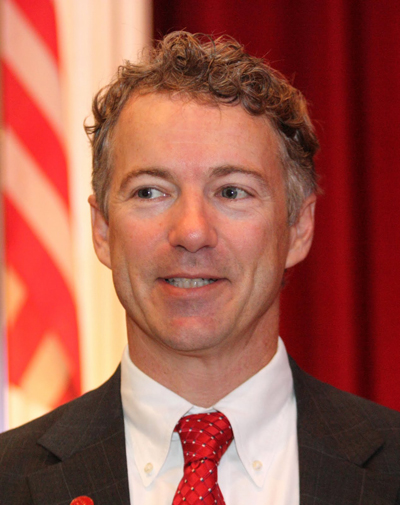 Rand Paul's (left) win is a Tea Party triumph Rand Paul's victory in the Kentucky primary election signals a change in priorities for the Republican party and the right ... Bowling Green eye surgeon Rand Paul defeated Kentucky secretary of state Trey Grayson for the Republican nomination to succeed retiring Senator Jim Bunning. Even though they weren't on the ballot, Paul also managed to beat former vice-president Dick Cheney, ex-New York city mayor Rudy Giuliani, and senate minority leader Mitch McConnell. Yesterday's primary was billed as the most significant contest yet between the Tea Party movement and the Republican establishment. Paul had never held public office before and cut his teeth as a taxpayer activist. Grayson was a rising star in the GOP who was groomed for national office by his party's leaders in Kentucky and Washington. Grayson entered the race heavily favoured, but in the end he didn't come close. Paul won 59% of the vote to Grayson's 35%, an almost anticlimactic landslide as the Tea Party favourite had led by double digits in every public poll since December. In his concession speech, Grayson pleaded for party unity: "We must unite behind Dr Paul. - UK Guardian