
Send this article to a friend:
April
24
2014

|
Send this article to a friend: April |
|
High pressure water/steam system
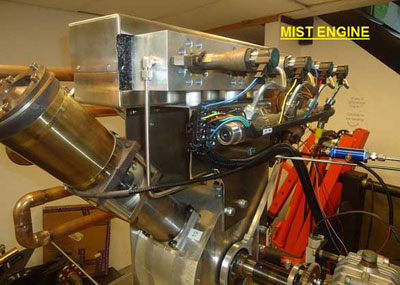
In his Mist Energy System, water is pressurized by a commercially available high pressure pump, it is then released through a nozzle into an impact chamber, where the jet hits a metal target. Heat is released and the water instantly transforms into steam. The energy spent to pressurize the water and pre-heat the impact chamber is about one tenth of the energy contained in the steam that is produced. That is a 10:1 over-unity factor, achieved with nothing but available tech and water as a medium. See a more detailed explanation in Hydrogen Bond Explosions Of course steam is what has been driving our electricity-producing machines for a long time. The heat is usually supplied by burning carbon fuels like coal, oil or gas. Even atomic power plants are little more than very expensive - and rather dangerous - steam engines fired by the heat of radioactive elements. So if we could make the needed steam without recourse to carbon based or atomic fuels, would that not be a giant step forward? I believe it would, and the technology is available. What are we waiting for? THE ENGINE MIST, which is an acronym for Molecular Impact Steam Technology, has patented a new system from creating energy. The energy is derived from exploding molecules of water impacting at hypersonic speed in a confined chamber. Our test haven proven that the energy created from high impact "dry" steam exceeds by multiples, the man-made energy required to run the system. The key word here is "man-made". We are not trying to say we are creating energy out of nothing. What we are doing is capturing the release of the energy holding the molecules of water together. Using a modified diesel injector, we were able to inject minute amounts of high-pressure droplets of water into the impact chamber. The impact literally explodes the molecules of water causing them to increase in temperature and pressure. A patent application for this technology is pending. Any free energy angel investors out there? It's proven technology that is well in hand. Needs to be scaled up and made commerce ready to replace many of our current polluting power plants ... More information on www.mistenergysystems.com/ Here is a video of a test with temperature measurements. Richard Aho's comment to the video:
After 5 minutes and 5 seconds, we have 1,525 injections, 1,525 explosions and the thermocouple inside the heater has cooled down to 306 degrees F. But the internal heat ( steam and surface temperature inside) is still 381 degrees F - exactly what you expect for 195 psi steam. This is a historic event. All the Energy comes from Impact Heating Here are some more details on the energy accounting (energy in - energy out) from a recent (August 1013) email message of Richard Aho. We are using a hydraulic accumulator to store the hydraulic oil [used to run the injectors] at 3,000 psi for this test. The hydraulic pump formula world wide is 1 h.p pumps 1 gallon per minute at 1500 PSI.. This is linear and as we use 3,000 psi our formula is 1 h.p pumps 1/2 gallon per minute. Our test at 300 injections per minute is 3.1 oz per minute of water. Our injector has a intensifier piston 5 to 1 .. so we use 15.5 oz of [the stored] hydraulic oil a minute. ( 15,000) psi. In 1 hour we convert 12 lbs of water into 195 PSI steam, The average electric steam generator uses 1,169 BTU per pound.. Our output per hour is 14,028 btu Input energy is 12 times our intensifier ratio of 5 to 1 or 60 lbs of hydraulic oil at 3,000 psi. This equals 1/8 GPM. or 1/4 h.p 186.5 watts per hour or 635.965 BTU. 1 hp times 1 GPM is 480 GPH for 746 Watts. 1 hp times 1/2 GPM is 240 GPH at 3,000 psi is also 746 watts 1 hp times 1/4 GPM is 120 GPH at 3,000 psi is 373 watts. 1 hp times 1/8 gpm is 60 GPH at 3,000 psi or 186.5 watts per hour This is the mechanical formula, except for any energy used to heat the feed water. In Florida it was 80 BTU per pound. 12 pounds times 80 is 960 BTU added to 635.965 total 1,595.965 BTU. Thermal energy output per hour 14,028 BTU Exceeds Mechanical energy Input of 1,595.965 BTU. This is 8.789 to 1 over unity.
|
|---|
Send this article to a friend:
 |
 |
 |
 Richard Aho of