|
False Flag Attack 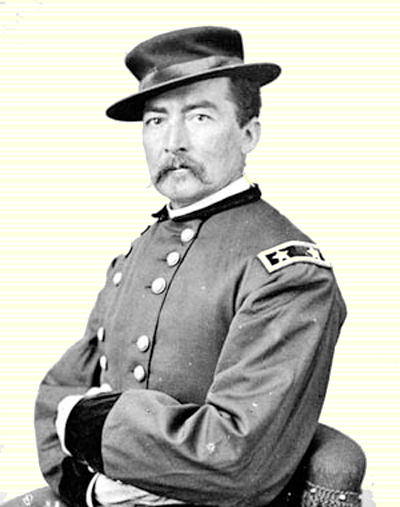
The stagecoach bounced along the uneven trail through Indian lands. A year ago there would have been danger from Indians. But Ulysses Grant had sent General Philip Henry Sheridan, who had brought the horrors of war to Confederate civilians, to annihilate the plains Indians. In his winter campaign of 1868-69, Sheridan attacked the Cheyenne, Kiowa, and Comanche tribes in their winter quarters, killing women and children and taking the Indians’ supplies and livestock. In Congressional testimony, Sheridan advocated the slaughter of the vast herds of bison in order to deprive Indians of food. Having turned professional hunters loose on Indian lands, Sheridan wrote: “Let them kill, skin and sell until the buffalo is exterminated.” For his proficiency in war crimes, Sheridan was made commanding general of the U.S. Army. When the first thud of the arrows hit the stage, the passengers screamed, “Indians, we will be scalped.” Among the passengers was a grizzled, hardened man. He retrieved an arrow and noting the metal arrowhead realized that it was not an Indian arrow and that the stage was being attacked by outlaws posing as Indians. False flag attacks are as old as history. “Bowie” Johnston had fought Indians all his life. He had more respect for them than he had for most white men. Unlike the other passengers, he understood that Indians would be blamed when whites preyed upon whites. He also understood that seized with fear, the stage driver would urge the horses onward. The rough trail would mean no accurate shooting from the coach and likely a broken axel or lost wheel. An overturned and wrecked stagecoach would be easy pickings for the outlaws. Bowie opened the stage door and swung up on top of the coach. With his Colt at the driver’s head, he ordered the driver to stop the coach. He seized the Winchester from the guard. When the coach stopped, he commenced firing. His two shots took two of the raiders out of their saddles. The rest, realizing they were facing an experienced fighter, rode off. The stage driver and guard and the other passengers were both angry and relieved. “We thought you were with the Indians,” they exclaimed, “but you drove them off!” “They weren’t Indians,” Bowie replied. Those were outlaws after the payroll, knowing that they would be home clear with the robbery blamed on Indians.” One of the self-important passengers ejaculated, “Why are you shielding those murdering savages. We know it was Indians. Look at all the arrows.” “Mister,” replied Bowie, “I have been fighting Indians all my life. Look at this arrow. The feathers are not representative of any tribe. The arrowhead is metal. Indians have flint arrowheads. No Indian nation has a foundry or blacksmith. Come with me. Let’s go look at the two I killed.” Reluctantly, the passengers accompanied Bowie, who wiped the war paint and grease from the dead men’s faces. A uniform gasp was emitted from the driver, guard, and passengers. All could see that a false flag attack had been perpetrated upon the stagecoach. Bowie told his now attentive audience, ” this attack was intended to bring retribution upon demonized Indians. Innocent Indians would have been massacred while white men rode away with the money. Bowie removed the arrows from the stagecoach and put the metal tips into his pocket. We will take the bodies with us as evidence against further depredations against the Indians. Bowie contemplated his life. He had been a man ever since a plains grizzly had struck down his horse and ripped him and his saddle off his horse’s back. Faced with a massive killing machine, the 185 pound man armed with a bowie knife felt small indeed. Bowie had been able to inflict enough wounds that the grizzly abandoned the attack. Bowie’s steadfastness had saved his life, and now it had saved the lives of the stage passengers. Where did this steadfastness originate? Why hadn’t Bowie screamed, “we will be scalped!” Experience. Bowie had experience. He knew.
He was Distinguished Fellow at the Cato Institute from 1993 to 1996. From 1982 through 1993, he held the William E. Simon Chair in Political Economy at the Center for Strategic and International Studies. During 1981-82 he served as Assistant Secretary of the Treasury for Economic Policy. President Reagan and Treasury Secretary Regan credited him with a major role in the Economic Recovery Tax Act of 1981, and he was awarded the Treasury Department's Meritorious Service Award for "his outstanding contributions to the formulation of United States economic policy." From 1975 to 1978, Dr. Roberts served on the congressional staff where he drafted the Kemp-Roth bill and played a leading role in developing bipartisan support for a supply-side economic policy. In 1987 the French government recognized him as "the artisan of a renewal in economic science and policy after half a century of state interventionism" and inducted him into the Legion of Honor. Dr. Roberts' latest books are The Tyranny of Good Intentions, co-authored with IPE Fellow Lawrence Stratton, and published by Prima Publishing in May 2000, and Chile: Two Visions - The Allende-Pinochet Era, co-authored with IPE Fellow Karen Araujo, and published in Spanish by Universidad Nacional Andres Bello in Santiago, Chile, in November 2000. The Capitalist Revolution in Latin America, co-authored with IPE Fellow Karen LaFollette Araujo, was published by Oxford University Press in 1997. A Spanish language edition was published by Oxford in 1999. The New Colorline: How Quotas and Privilege Destroy Democracy, co-authored with Lawrence Stratton, was published by Regnery in 1995. A paperback edition was published in 1997. Meltdown: Inside the Soviet Economy, co-authored with Karen LaFollette, was published by the Cato Institute in 1990. Harvard University Press published his book, The Supply-Side Revolution, in 1984. Widely reviewed and favorably received, the book was praised by Forbes as "a timely masterpiece that will have real impact on economic thinking in the years ahead." Dr. Roberts is the author of Alienation and the Soviet Economy, published in 1971 and republished in 1990. He is the author of Marx's Theory of Exchange, Alienation and Crisis, published in 1973 and republished in 1983. A Spanish language edition was published in 1974. Dr. Roberts has held numerous academic appointments. He has contributed chapters to numerous books and has published many articles in journals of scholarship, including the Journal of Political Economy, Oxford Economic Papers, Journal of Law and Economics, Studies in Banking and Finance, Journal of Monetary Economics, Public Finance Quarterly, Public Choice, Classica et Mediaevalia, Ethics, Slavic Review, Soviet Studies, Rivista de Political Economica, and Zeitschrift fur Wirtschafspolitik. He has entries in the McGraw-Hill Encyclopedia of Economics and the New Palgrave Dictionary of Money and Finance. He has contributed to Commentary, The Public Interest, The National Interest, Harper's, the New York Times, The Washington Post, The Los Angeles Times, Fortune, London Times, The Financial Times, TLS, The Spectator, Il Sole 24 Ore, Le Figaro, Liberation, and the Nihon Keizai Shimbun. He has testified before committees of Congress on 30 occasions. Dr. Roberts was educated at the Georgia Institute of Technology (B.S.), the University of Virginia (Ph.D.), the University of California at Berkeley and Oxford University where he was a member of Merton College. He is listed in Who's Who in America, Who's Who in the World, The Dictionary of International Biography, Outstanding People of the Twentieth Century, and 1000 Leaders of World Influence. His latest book, HOW THE ECONOMY WAS LOST, has just been published by CounterPunch/AK Press. He can be reached at: PaulCraigRoberts@yahoo.com |
 |
 |

 Hon. Paul Craig Roberts is the John M. Olin Fellow at the Institute for Political Economy, Senior Research Fellow at the Hoover Institution, Stanford University, and Research Fellow at the Independent Institute. A former editor and columnist for The Wall Street Journal and columnist for Business Week and the Scripps Howard News Service, he is a nationally syndicated columnist for Creators Syndicate in Los Angeles and a columnist for Investor's Business Daily. In 1992 he received the Warren Brookes Award for Excellence in Journalism. In 1993 the Forbes Media Guide ranked him as one of the top seven journalists.