Send this article to a friend:
March
15
2014

|
Send this article to a friend: March |
|
Garretts HHO Carburetor
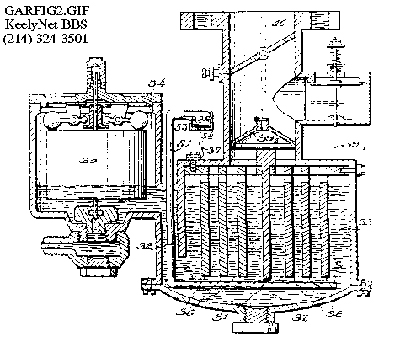
From my Garrett article posted on the BBS in 1993 - A public demonstration was held at White Rock Lake in Dallas somewhere around 1934. The event was covered by news media of the day and we understand there was a Pathe' or Movietone newsreel. An automobile was towed to the lake site. We do not know the type of automobile or whether it was a 4, 6 or 8 cylinder engine (probably 4 at that time). A gallon of water was removed from the lake and put into the gas tank. The car was then started and driven around the lake with no problems. Several months back, I decided to do whatever it would take to dig up this patent, if it existed. I knew from the article that a Dad Garrett and his son Charles had invented this "something". I did not know the year of this alledged patent and so had to go through several volumes looking for anything relating to Garrett. Sometimes inventors assign their invention to companies and that posed an additional problem if such was the case. I finally did find a patent issued to Charles H. Garrett on July 2, 1935 and called an ELECTROLYTIC CARBURETOR. The number was 2,006,676. Since the microfiches only go back to about the mid-40's, I had no option except to order it from the patent office. A letter was sent to them with $2.00 ($1.50 for the patent and .50 for mailing costs). After almost 3 months, I got a letter saying that patents had now gone up to $3.00. So, another letter with the extra $1.00 FINALLY got me the patent about 3 weeks later. I have been calling it a HYDROLYTIC CARBURETOR because of WHAT it is combusting and have been totally amazed at the simplicity of the technology. Several of our associates have received advance copies of it and are quite impressed, saying they will build and test it...
This is old news but interesting because Garrett was one of the first to use a mix of both hydrogen and oxygen along with outside air to fuel an internal combustion engine in a car. These days this is called HHO (2 parts hydrogen, 1 part oxygen) and you can find plans and kits and modules all over the net. Garrett ran his car ONLY with this mix of gases with no gasoline. Basically you get a bigger bang by mixing nitrogen and hydrogen and mixing it with air which is about 78% nitrogen. Nitrogen + Hydrogen = Ammonia which slows down the burn rate for engines. From video #3 below; Ammonia is the primary fuel of Stanley's Water Powered Car while Hydrogen plays a supportive role in regulating the burn-rate of Ammonia, and also in creating Ammonia from the available Nitrogen from the engine's air intake. Hydrogen, alone, burns too fast without enough expansion to drive the pistons at a rate comparable to gasoline. Herman Anderson could not drive at speeds fast enough to keep up with the flow of traffic down the freeway (so his car was more appropriately driven on surface streets), while Donald Brisbee couldn't get his RPM up faster than a mere idle, because both guys were not utilizing the benefit of ammonia. Their's were a hydrogen fired engine, strictly speaking. Ammonia is difficult to burn without something fast-burning, like Hydrogen, to increase the overall burn-rate when the two are mixed together. Ammonia is made on the fly from the air intake mixed with a little recycled exhaust. Water Vapor is also needed, plus a Disruptive Discharge from either a sparking arc (in Stanley's and Donald's case) or from a corona (in Herman's version). 'Non-combustible gases' is patent-speak for hiding what it really is, namely: nitrogen - N2, and other trace gases other than oxygen, such as: carbon dioxide. 'Superimpose' is another instance of patent-speak for 'chemically react'. So Stan's patent phrase: 'nitrogen superimposes upon the hydrogen' really means that nitrogen is chemically reacting with hydrogen to make ammonia. An incomplete reaction takes place -- on purpose -- to retain residual hydrogen for regulating the overall burn rate of this Ammonia and Hydrogen mixture. The two inlet ports of Stan's Gaseous Transformer, or EPG - also known as: Energy Production Generator, each separately charge/ionize to a positive potential the two inlet ports of: (1) The Intake Air plus a little Exhaust containing nitrogen, oxygen, and water vapor, and (2) Hydrogen (with or without the Oxygen) also containing water vapor. Now that the gases entering both ports are both positively charged (ionized), the hydrogen will not reunite with oxygen to reform water. Instead, the nitrogen will unite with hydrogen to form ammonia. If the oxygen and hydrogen had been allowed to remain ionized with opposite charges (one positive, the other negative, resulting from their electrolysis), then they will unite to form water. Since this is not desirable for achieving optimum thrust from the engine, we force one more process to take place. So, there are four -- not three -- steps, involved here: (Step 1) is to split water to make hydrogen and oxygen, (Step 2) make ammonia from nitrogen and hydrogen, (Step 3) burn ammonia and hydrogen in the presence of oxygen, and finally (Step 4) produce water exiting the tail pipe. Making ammonia from nitrogen contained in our air is the extra step missing from our mainstream understanding of how Stanley Meyer achieved his fantastic results. - Garretts HHO Carburetor |
|---|
Send this article to a friend:
 |
 |
 |