
March
09
2013
|
March |
Coming Clean Beyond the Fiscal Cliff
Washington's negotiations to address the fiscal cliff of automatic tax increases and spending cuts legislatively triggered at the close of 2012 are the latest in an ongoing effort to address increasing U.S. federal government deficits and debt levels. Enormous monetary and fiscal stimulus has failed to produce an economic recovery. In short, the U.S. government and central banks have failed to dig out. Instead, they are now dug in deeper. What to do now? What is missing from this and other debates on the reengineering of the U.S. federal finances is an understanding or discussion of the structural problems in the federal finances that have been accumulating since WWII, when the United States - with 6% of the world’s population - found itself the master of 50% of the world’s resources. The purpose of this article is to provide an overview of some of these structural issues in the hope that more citizens will be encouraged to consider how the federal finances flow through the immediate world around us - our household budget, our business, farm or place of work, our municipality - and the government-sponsored organized crime and fraud draining us, so we can begin to implement real solutions. Ultimately, the fiscal cliff is the tip of the iceberg of our economic and cultural woes. Our problems are deeper. The more of us there are, who are prepared to look honestly at our situation and take responsibility for it, the sooner authentic solutions will become possible and emerge. As we look over the fiscal cliff into our financial abyss, now is a good time to “Come Clean” about the real state of our lives, our communities, and our economy, starting with the U.S. federal finances that flow deeply and intimately throughout every aspect of our lives. First, a StoryImagine that you live in a historical mansion in a large, privileged family on a fine property -- rich with good land, good water and natural resources that your ancestors originally acquired through surreptitious means. Imagine that the mansion and estate have serious structural problems that accumulated over many years. The reasons are complex. There is enormous distrust within the family. As the vigor of the generations dissipated, expenses rose and numerous members have turned to activities that are unproductive at best, or fraudulent and criminal at worst.
Almost no one in the family objected as allowances continued to be funded, even increased and promises continued to be made. As long as everyone was getting his or her check, most everyone was willing to ignore the deterioration of the real human and physical assets and equity on the family balance sheet. They were also willing to ignore the harm done to their neighbors. The occasional relative who demanded a financial accounting of what was happening, or was not satisfied with petty bribes of various kinds, was sent packing or to work abroad, or even occasionally dealt with in a way that we pretend never happens - they developed diseases, were admitted to mental institutes, were said to have committed suicide or just disappeared. These instances were sufficient to strike terror throughout the family, leaving those in command of the family trusts unquestioned, as their offshore accounts and numerous enterprises grew. The result was a fragile peace that grew thin, as the deterioration in the infrastructure of the estate and the structure of the mansion accelerated. Innovation was not encouraged. The managers were interested in their own global competition. They did not want any pesky entrepreneurs taking risks that could in any way attract attention or create liabilities for their grand plans. Indeed, young members were encouraged to use student loans to get their advanced education, thus ensuring their dependence on their allowance and reluctance to branch out on their own. Thus the family members' general understanding of the world around them and how to navigate it deteriorated rapidly. So now the day has come when the deterioration in the management of the estate, the growing debt, the structural problems in the mansion and the diminution of the family trusts has necessitated a dramatic reduction in allowances.
A task force was commissioned of family lawyers and counselors to make recommendations as to what could be done. They were instructed by the controlling family members to only make recommendations that involved cutting allowances or required contributions from those receiving them. Under no circumstances were they to ask for a real accounting, delve into the issues related to where family capital had been shifted abroad, the fundamental flaws in the family governance systems, property infrastructure needs, or the need for serious investment in the mansion foundation, let alone how to reinvigorate the prosperity of the land and property and the productivity and health of family members. They were to deal only with whose allowance were to get cut and by how much,and how much various family members should contribute to a fund to restore the property. The family lawyers and counselors wanted to keep their jobs and they certainly did not want to be "suicided." So for months, they argued over proposals -- none of which addressed the real problems, let alone solved them. After months of this, the family members reached a unique consensus. Their lawyers and counselors were incompetent and should be replaced by new ones. Who would, of course, be subject to the same restrictions.... U.S. Federal Finances: 22 ChallengesHere are the most significant challenges we must address to put our federal fiscal house in order. Each includes a brief description. Click on the link that follows for more discussion of the particular challenge, including examples and stories from my experience as well as other recommended references. DisclosureWe do not have reliable financial information about federal financial operations which provides government officials or citizens with the data they need to easily understand federal operations, to make informed choices or to hold their legislative representatives and their fellow taxpayers accountable. The current government budgets and financial statements reflect "overt" operations. They exclude a significant amount of classified or illegal government activities - "covert operations" - whether paid for out of classified intelligence agency and military budgets or the "black budget." The financial statements that reflect "overt operations" have not been able to pass independent audits for almost two decades (as required by law) and report that trillions of dollars have gone missing in transactions that are "undocumentable." This has included years when such "undocumentable" transactions exceeded total annual tax receipts. As a government official, I struggled with the problems of trying to understand the origination of government mortgage credit by place without basic financial information. If reliable government budgets and financial statements were easily accessible to citizens by county or congressional district, mortgage fraud would never have become as bad as it did during the last few decades. "When I joined the Bush Administration in 1989 as Assistant Secretary of Housing, I read the budget for the Federal Housing Administration (FHA). It described a $300 billion portfolio of mortgage insurance in force with about $50-100 billion a year of annual originations. I asked the person responsible for the comptroller function to direct me to the place in the budget where it explained how much we were making and losing. I was told there was no such place. I asked where the financial statements were. I was told that the accountants had them, that they reported to a different Assistant Secretary and that I was not allowed to speak with them. The Government Accounting Office (GAO) had audited our financial statements several years ago. We could not afford an outside auditor, let alone every year. Besides, we operated on a cash basis. The Office of Management and Budget (OMB) would never permit accrual statements. After months of working with a variety of parties at HUD, OMB and in the Administration, and with much support from GAO, the accounting group was moved over to my area and legislation was introduced and passed that required a comptroller for the FHA Funds, a chief financial officer for the department, and a legal requirement for annual audited financial statements and actuarial statements. When we got access to our financial information, it turned out that we were losing $11 million a day in the single-family fund, the Mutual Mortgage Insurance Fund, and more in the multifamily and special risk fund called the General Insurance Fund. What is more, I discovered that we had never tracked our financial results on a place-based basis. In other words, ten regional and eighty field offices had no idea how they were doing. So we put together crude place-based cash flows. What we found was simply astonishing. First, the national data on which the portfolio was based turned out to be the irrelevant product of averaging. A look at all ten regions and eighty field offices showed that no one part of the portfolio fit the image depicted by the national averages. Our vision of our business had been substantially distorted by the way in which the data had been presented. Second, it turned out that over 100% of our losses were generated in two regions. The first was headquartered in Texas, and included Oklahoma, Louisiana and Arkansas. We discovered that the Texas region had lost over $2 billion the year before. They had no idea. The second was headquartered in Colorado. What the numbers showed was that S&L fraud and HUD fraud were perpetrated by the same networks and in the same places involving the use of federal credit." Catherine Austin Fitts, "The Myth of the Rule of Law" How does Congress make choices or educate and align constituencies without reliable, independent feedback regarding their financial and economic decisions? It's difficult - and in turn many decisions are made based on inaccurate information. More... LegalityA significant portion of federal government spending operates in violation of the laws governing federal financial management and reporting and the United States Constitution which stipulates that no payments can be made that are not provided for in an appropriations bill approved by Congress. Specifically, Article 1, Clause 7 states: "No Money shall be drawn from the Treasury but in Consequence of Appropriations made by Law; and a regular Statement and Account of the Receipts and Expenditures of all public Money shall be published from time to time. Let me give you some examples my own experience: We [my company, Hamilton Securities Group] were blessed with an advisory board of very capable and committed pension fund leaders. In April 1997, we had an advisory board meeting....I gave a presentation on the extraordinary waste in the federal budget. As an example, we demonstrated why we estimated that the prior year's federal investment in the Philadelphia, Pennsylvania area had a negative return on investment. It was, however, possible to finance places with private equity and then reengineer the government investment to a positive return and, as a result, generate significant capital gains. Hence, it was possible to use U.S. pension funds to increase retirees' retirement security significantly by investing in American communities, small business and farms — all in a manner that would reduce debt and improve skills and job creation. This was important as one of the chief financial concerns in America at that time was ensuring that our retirement plans performed financially to a standard that would meet the needs of beneficiaries and retirees. It was also critical to reduce debt and create new jobs as we continued to move manufacturing and other employment abroad. If not, we would be using our workforce's retirement savings to finance moving their jobs and their children's jobs abroad. The response from the pension fund investors was quite positive until the President of the CalPers pension fund — the largest in the country — said, "You don't understand. It's too late. They have given up on the country. They are moving all the money out in the fall (of 1997). They are moving it to Asia." He did not say who "they" were but did indicate that it was urgent that I see Nick Brady (former Chairman of Dillon Read and former U.S. Secretary of the Treasury) — as if our data that indicated that there was hope for the country might make a difference. I thought at the time that he meant that the pension funds and other institutional investors would be shifting a much higher portion of their investment portfolios to emerging markets. I was naive. He was referring to something much more significant. The federal fiscal year starts on October 1st of each year. Typically the appropriation committees in the House and Senate vote out their recommendations during the summer. When they return from vacation after Labor Day, the various committees reconcile and a final bill is passed in September. Reconciling all the various issues is a bit like pushing a pig through a snake. Finalizing the budget each fall can make for a tense time. When the new bill goes into effect, new policies start to emerge as the money to back them starts to flow. October 1st is always a time of new shifts and beginnings. In October 1997, the federal fiscal year started. It was the beginning of at least $4 trillion going missing from federal government agency accounts between October 1997 and September 2001. The lion's share of the missing money disappeared from the Department of Defense accounts. HUD also had significant amounts missing. According to HUD OIG reports, HUD had "undocumentable adjustments" of $17 billion in fiscal year 1998, and $59 billion in 1999. The HUD OIG refused to finalize audited financial statements in fiscal year 1999, refused to find out the basis of the undocumentable adjustments or to get the money back and refused to disclose the amount of undocumentable adjustments in subsequent fiscal years. Catherine Austin Fitts, Dillon Read & Co. Inc. & the Aristocracy of Stock Profits See Also: Here is more I wrote in the process of trying to hold a Congressman on the budget and appropriations committees accountable: In June 2001 the Senate Governmental Affairs Committee, published its study, "Government at the Brink." The study describes the failure of federal government agencies to maintain reliable financial systems and/or to publish as independent annual audited financial statements as required by law. The President's initial 2002 budget (before increases for 9-11) proposed that approximately 85% of all federal appropriations be awarded to the very same agencies the Thompson study states either (a) fail to maintain reliable financial systems, (b) fail to publish trustworthy or, in some cases, any, independent certified financial statements (as required by law), or both. At that same time, Congressman Steve Horn (R-Calif.), Chairman of the House Government Reform subcommittee on Government Efficiency, Financial Management and Intergovernmental Relations issues a report card regarding attempts by federal agencies to produce reliable annual audited financial statements. We [my company, Hamilton Securities Group] were blessed with an advisory board of very capable and committed pension fund leaders. In April 1997, we had an advisory board meeting....I gave a presentation on the extraordinary waste in the federal budget. As an example, we demonstrated why we estimated that the prior year's federal investment in the Philadelphia, Pennsylvania area had a negative return on investment. It was, however, possible to finance places with private equity and then reengineer the government investment to a positive return and, as a result, generate significant capital gains. Hence, it was possible to use U.S. pension funds to increase retirees' retirement security significantly by investing in American communities, small business and farms — all in a manner that would reduce debt and improve skills and job creation. This was important as one of the chief financial concerns in America at that time was ensuring that our retirement plans performed financially to a standard that would meet the needs of beneficiaries and retirees. It was also critical to reduce debt and create new jobs as we continued to move manufacturing and other employment abroad. If not, we would be using our workforce's retirement savings to finance moving their jobs and their children's jobs abroad. The response from the pension fund investors was quite positive until the President of the CalPers pension fund — the largest in the country — said, "You don't understand. It's too late. They have given up on the country. They are moving all the money out in the fall (of 1997). They are moving it to Asia." He did not say who "they" were but did indicate that it was urgent that I see Nick Brady (former Chairman of Dillon Read and former U.S. Secretary of the Treasury) — as if our data that indicated that there was hope for the country might make a difference. I thought at the time that he meant that the pension funds and other institutional investors would be shifting a much higher portion of their investment portfolios to emerging markets. I was naive. He was referring to something much more significant. The federal fiscal year starts on October 1st of each year. Typically the appropriation committees in the House and Senate vote out their recommendations during the summer. When they return from vacation after Labor Day, the various committees reconcile and a final bill is passed in September. Reconciling all the various issues is a bit like pushing a pig through a snake. Finalizing the budget each fall can make for a tense time. When the new bill goes into effect, new policies start to emerge as the money to back them starts to flow. October 1st is always a time of new shifts and beginnings. In October 1997, the federal fiscal year started. It was the beginning of at least $4 trillion going missing from federal government agency accounts between October 1997 and September 2001. The lion's share of the missing money disappeared from the Department of Defense accounts. HUD also had significant amounts missing. According to HUD OIG reports, HUD had "undocumentable adjustments" of $17 billion in fiscal year 1998, and $59 billion in 1999. The HUD OIG refused to finalize audited financial statements in fiscal year 1999, refused to find out the basis of the undocumentable adjustments or to get the money back and refused to disclose the amount of undocumentable adjustments in subsequent fiscal years. Catherine Austin Fitts, Dillon Read & Co. Inc. & the Aristocracy of Stock Profits See Also: Here is more I wrote in the process of trying to hold a Congressman on the budget and appropriations committees accountable: In June 2001 the Senate Governmental Affairs Committee, published its study, "Government at the Brink." The study describes the failure of federal government agencies to maintain reliable financial systems and/or to publish as independent annual audited financial statements as required by law. The President's initial 2002 budget (before increases for 9-11) proposed that approximately 85% of all federal appropriations be awarded to the very same agencies the Thompson study states either (a) fail to maintain reliable financial systems, (b) fail to publish trustworthy or, in some cases, any, independent certified financial statements (as required by law), or both. At that same time, Congressman Steve Horn (R-Calif.), Chairman of the House Government Reform subcommittee on Government Efficiency, Financial Management and Intergovernmental Relations issues a report card regarding attempts by federal agencies to produce reliable annual audited financial statements.
Other reports from sources like agency inspectors general and government whistleblowers charge that the problems are much deeper than mere accounting: they allege stolen and missing inventory (planes, tanks, etc.) and in some cases actually admit that they rely on black budget funding (i.e., funding that is "off balance sheet" and not subject to Congressional oversight). The existence of such reports requires that we ask whether the very government officials and contractors who are paid handsomely to protect and manage our resources in accordance with the law are looting the federal government. Total undocumented accounting adjustments for reported periods for the Department of Defense (fall of 1997 to date) amount to a whopping $3.3 trillion, or $11,700 for every American. (Many American families don't even have $11,700 in savings in their bank accounts.) The Department of Defense has failed to produce independent audited financial statements since the requirement went into effect in 1995. HUD's Inspector General refused to certify HUD's fiscal 1999 financial statements. Since both agencies have refused to explain the undocumented adjustments in adequate detail for some years and declined to report or make public undocumented adjustments, we have no evidence to document that large amounts of assets or money are not being stolen. Catherine Austin Fitts, Saving Tennessee The missing money problem is systemic and bipartisan. In "Treasury Checks and Unbalances," that appeared in the April 2004 edition of Insight magazine, Kelly Patricia O'Meara demonstrated this fact quite conclusively. As she reports, according to the GAO (General Accounting Office), the year end financial reports submitted by four U.S. Secretaries of the Treasury were unreliable and essentially "unauditable" despite the assurances of the accuracy of these reports by these Treasury officials.
So the books can't be audited and what information is made available "may not be reliable." Contrast this with the statements of the various Secretaries of the Treasury.
Remember — these unreliable and essentially "unauditable" financial reports from the U.S. Treasury were being issued before the bailouts. A Congressman, who was on the budget and appropriations subcommittee in 2002, told me that he was helpless to address trillions in unconstitutional transactions. How then is Congress supposed to grapple with them in 2013? OperationsA significant portion of governmental accounting functions, payment systems, and financial operations have been outsourced to private banks and corporations. Indeed, the government has become so dependent on outside corporations, that government officials do not have the knowledge or operational capacity and independence to assert control. And worse yet, the same private contractors and banks that control the government's data and financial operations also control access to the bond markets that finance the government's operations? So who is really in charge? It is critical to understand that government officials who are technically responsible for financial operations do not have control, nor can they necessarily rely on the government for "protection." So how can they fulfill their fiduciary responsibility to the citizenry? The NY Fed member banks serve as depository for the U.S. federal accounts and manage the U.S. Treasury Exchange Stabilization Fund. The Treasury is also dependent on them for an enormous number of servicing functions, such as for processing bonds, mortgages and foreclosures. Finally, the NY Fed member banks and the other primary dealers market Treasury and agency debt to fund ongoing deficits. Within the agencies, private defense contractors provide the primary information and payment systems. Hence, the largest contractor at DOD, where over $3.3 trillion has gone missing, runs many of their accounting and payments systems while it is also selling large weapons systems to DOD. The DOD's supplier of accounting software and systems is also their largest supplier of weaponry and services, as well as the manager of numerous highly classified and secret weapons programs. As agents, these banks and contractors are the custodians of vast amounts of data from scores of federal agencies, including military and intelligence agencies, and in turn have access to the full range of confidential data about citizens, their taxes and transactions. In effect, the sovereignty of the United States Government and its citizens has been transferred to those who control the data and telecommunication systems. There has been a financial coup d'etat. The largest defense contractor at HUD on several occasions refused to give senior government officials or me access to data on HUD subsidies that they were managing and for which they operated the payment systems. In essence, the defense contractor was in control and the government officials were subservient to them. I assume this was because the HUD subsidies were being run in a manner that was very different from the budget and financial statements described. In March 2000, the HUD Inspector General testified that HUD would not publish financial statements for fiscal 1999 and that the undocumentable adjustments made so far to balance the books was $59 billion. A close reading of the undecipherable preliminary audit indicated that, in fact, the number was $17 billion in fiscal 1998 and $70 billion on the asset side and $59 billion on the liability side in fiscal 1999. As a practical matter, since HUD was assuring us that their systems did not work and that they had simply not bothered to check their accounts and cash balances in the old fashioned way using paper and pencil, we had no numbers of any meaning. In fact, anything was possible. Worse yet, GAO reports of the Treasury accounting systems both as to their reliability and control by private contractors are also disturbing. With little or no information sovereignty, the internal controls are insufficient to assure that cash balance reconciliation between an agency such as HUD and Treasury are accurate. When an agency can issue government guarantees and not record what they have issued correctly and then write checks that are not recorded correctly, then one or more of the players that handle the money, namely the US Treasury, the Federal Reserve Bank of New York, AMS and Lockheed, may be in a position to steal literally hundreds of billions of dollars with no one the wiser except those enjoying the fruits. Such a thought seemed far-fetched not that long ago. Indeed, in 1994 after the first FHA/HUD financial audit was published, a mortgage banker came to see me. He was a serious engineering type who clearly worked hard and mastered the details of his business. He was distressed, he said. For decades he had been keeping a tally of total outstanding FHA/HUD mortgage insurance credit. He had brought printouts of his database for me. It turned out that the government's published financial statements showed the amount outstanding was substantially less than the actual amount outstanding. He was sure. I assumed that the guy was crazy. If what he said were true, then the US Treasury and the Federal Reserve would have to be complicit in significant fraud, including securities fraud. This was inconceivable. To this day, I regret not accepting a copy of the printouts from his databases. I wonder if they might have illuminated what our [Community] Wizard and other portfolio tools were about to find. They might have helped explain why our efforts to distribute information on the HUD outstanding mortgage and defaulted mortgage portfolios inspired such opposition and distress. The indications are growing that Treasury and OMB are engaging in fraudulent transactions and that the key financing, accounting and payments systems are run by contractors who are either in on the deal or turn a blind eye. What this means is that the financial disclosure provided by the federal government may be essentially meaningless. It does not take long to realize that in a world with no financial controls with the fox in control of the chicken coop anything is possible. Life in the federal government is an endless series of shortcuts under impossible political stress and risk. With no internal financial controls, things can go far off course with no way for reasonable people to stop it. Catherine Austin Fitts, The Myth of the Rule of Law There are several other issues regarding government contracts that present challenges to anyone wanting to reengineer the federal budgetary process. The first is that much of defense contracting has been organized and priced on a "cost plus basis." That is, contractors are reimbursed for their stated costs plus a set mark up. Experts familiar with the defense procurement process believe that this has resulted in ballooning expenses, poor performance and less innovation. Second, government contractors are rarely disqualified despite criminal behavior or corporate malfeasance or even criminal conviction. One of the more infamous cases, concerned a government contractor that was sued on multiple occasions for sex slave trafficking, including by the project contract manager - accusations confirmed by defense department criminal investigators. The contractor in question continued on as the largest contractor at the U.S. State Department, was protected by senior state officials and then awarded a sole source contract to manage the criminal justice system in Iraq. Third, there is often no more carefully hoarded information within a federal agency than the agency contract budgets. If our government is going to be run by government contractors, then we need to know who they are, what they are responsible for and how that relates to any financial reporting and accounting problems we are having. David Walker was head of the GAO, chief auditor to the U.S. Congress, while the U.S. government consistently failed to comply with laws requiring audited financial statements and over $4 trillion went missing. One reporter with whom I was working was promised by Walker that he would publish the names of government contractors associated with these losses. This was after petitions under the Freedom of Information Act to the agencies failed to result in even basic disclosure of the relevant contractors and their contracts. Mr. Walker failed to ever honor that commitment. Today, with the names of those contractors still invisible, Mr. Walker serves as the CEO of the Pete Peterson Foundation, where he pontificates on fiscal accountability and the need for American's to tighten their belts. Fourth, perhaps the greatest risk of all is the outsourcing of our military capacity. Overall, federal employment has declined in recent decades. One reason for this is the increased dependency of the military on outside contractors. Given the importance of the U.S. active and reserve military for national defense, the idea that these functions are dependent on private corporations whose investors also control governmental purse strings, is truly frightening to contemplate. Fifth, private contractors often operate without legal liability, creating governmental and military operations for which no one is liable. One famous example of this "nether world" came out when Gary Webb published his Dark Alliance news series and book on government narcotics trafficking in South Central Los Angeles. In response to citizen concern inspired by Webb's story, then Director of the CIA, John Deutsch, agreed to attend a town hall meeting in South Central Los Angeles with local Congressional representatives in November 1996. Confronted by allegations in support of Webb's story, Deutsch promised that the CIA Inspector General would investigate the "Dark Alliance" allegations. This resulted in a two volume report published by the CIA in March and October of 1998 that included disclosure of one of the most important legal documents of the 1980s — a Memorandum of Understanding (MOU) between the Department of Justice (DOJ) and the CIA dated February 11, 1982 in effect until August 1995.... No history of the 1980s is complete without an understanding of the lawyers and legal mechanisms used to legitimize drug dealing and money laundering under the protection of National Security law. Through the MOU, the DOJ relieved the CIA of any legal obligation to report information of drug trafficking and drug law violations with respect to CIA agents, assets, non-staff employees and contractors. Presumably, this included the corporate contractors who, by executive order, were now allowed to handle sensitive intelligence and national security outsourcing. With the DOJ-CIA Memorandum of Understanding, in effect from 1982 until rescinded in August 1995, a crack cocaine epidemic ravaged the poorer communities of America and disenfranchised hundreds of thousands of poor people into prison who, now classified as felons, were safely off of the voting roles. Meantime, the U.S. financial system gorged on what had grown to an estimated $500 billion-$1 trillion a year of money laundering by the end of the 1990s. Not surprisingly, the rich got richer as corporate power and the concentration of investment capital skyrocketed on the rich margins of state sanctioned criminal enterprise. Catherine Austin Fitts, Dillon Read & Co. Inc. & the Aristocracy of Stock Profits Sixth, there are numerous reports that government contractors are being allowed to use tax avoidance mechanisms that reduce their tax liability substantially. So while taxpayers provide their revenues these contractors avoid their fair share of taxes. Finally, while the government is becoming more dependent on corporate America, corporations are becoming more dependent on government subsidies, contracts and purchases – thus radically increasing the dependency of the commodities, bond, mortgage, stock and derivatives markets on the federal budget. The financial markets have become a "proprietary" for various government agencies (i.e. a business secretly owned by and run as a cover for an intelligence organization). Hence, it is not surprising in the second Bush Administration that the National Security Council invented their right to exempt corporations that they specify from obligations to comply with SEC disclosure laws. Very few investors are aware of this, let alone that their retirement savings and personal assets are deeply dependent on ever increasing government borrowings because the corporations and banks in which they or their pension funds are investing are primarily U.S. government contractors. On and Off BudgetAssets, revenues and expenses can be accounted for on-budget or off-budget, or simply not accounted for at all. Decisions as to what is on and off-budget are often crafted in a way that is not in the best interests of the citizenry. Rather, they are designed to benefit insiders at the expense of everyone else. Let's look at some examples:
Essentially, the U.S. federal budget is designed to absorb liabilities (risk and expense) into the public sector while transferring assets to the private sector. This imbalance must be addressed to make the federal budget and finances economically viable. Globally, the process of "piratization" is pushing federal finances in the opposite direction from accountability and viability – see my popular blog post, "Financial Coup d' Etat". Currently, there is no political process to facilitate fiscal responsibility, short of war, wholesale tax revolt or collapse. RestorationThere are trillions of dollars missing from federal accounts, as documented by the federal government itself. The reports of significant money missing from the United States government over the years are many, including Kelly Patricia O'Meara's series for Insight Magazine on money missing from the U.S. government and Donald L. Barlett and James B. Steele's investigative reporting published in Vanity Fair on monies missing in US operations in the Middle East. For a time, there were so many stories on monies disappearing from the US government that we kept track of them on a part of the Solari website dedicated to stories about money missing from the federal government: Solari: The Missing Money Kelly O'Meara's series on the missing money attracted significant attention in 2000 and 2001. Things seemed to be coming to a head on September 10, 2001, when Donald Rumsfeld conceded in a press conference that DOD was missing trillions. However, that fact was not to attract much attention given 9-11 events the following day. Rather, the tragedy was used to justify the loss of financial records at the Pentagon (we are apparently to presume that the Pentagon is incapable of making or keeping backups) and the inability of the Army to produce financial statements in 2001. One Tennessee congressman on the House Budget and Defense Appropriations Subcommittee confirmed to me that these billions were missing, but said that he was helpless to do anything about it, despite being a member of the budget committee and defense appropriation subcommittee. (See Letter to Congressman Van Hilleary) The missing money phenomenon was overwhelmed by the bailouts that began in the second Bush administration and continue through the Federal Reserve today (see QE3- Pay Attention if You Are in the Real Estate Market). Catherine Austin Fitts, "The Housing and Economic Recovery Act of 2008: An Analysis" Perhaps, the military-industrial-intelligence complex saw the opportunity to bypass the complexity of using dummy corporations and criminal enterprises to steal trillions covertly in order to fund their black operations and insider perks, and decided to take advantage of the bubble in the mortgage markets where knowledge of the fraudulent securities positions and the derivatives piled on top could be used to blackmail the banksters - resulting in money flowing out the front door through bailouts and the deflection of Fannie Mae's and Freddie Mac's liabilities to the taxpayer. Or perhaps that is why the bubble was created in the first place – the military-industrial-intelligence complex needed the cash – and as always, the banking system was there to accommodate (for their cut of course). I have always said, "crime that pays is crime that stays." We need restoration of assets that have been stolen, whether by identifying them and reclaiming them or asserting liability of the parties involved and simply claiming ownership to their assets or asserting a common right of offset of any government or taxpayer liabilities to them. Ultimately, the federal budget is like a milk bucket with a hole in the bottom of the bucket. The folks who milk the cows are tired of hearing that the bucket is empty and there is not enough milk. They do not want to put more milk in the bucket until they understand where the milk has been going and they are persuaded that the hole has been repaired. Now do you appreciate why the federal government is increasingly interested in deploying drones domestically and promoting gun control as they contemplate the fiscal cliff? Legacy EconomicsThe budget and the federal regulatory structure operate in accordance with a legacy industrial-based economic paradigm that is increasingly outmoded in the face of technological advances and globalization. Despite these trends, significant technologies continue to be suppressed. The world is changing. Washington is often lobbied by a wide group of constituencies that want government to protect them from the risks and expense of that change. So, for example, as video on the Internet shifts market share away from Hollywood, the entertainment industry lobbies for greater control of the Internet. This often puts Washington on the wrong side of numerous highly sensitive technology questions – involving both mistakes in adaptation or suppression. For example, Washington is leading the charge in the U.S. and globally to adopt GMO technology - corrupting the global seed supply, destroying agricultural diversity and paving the way for both the industrialization and control of the global food supply. My guess is that the suppression of breakthrough energy technologies cannot last. As we move away from fossil fuel for which the U.S. dollar is the exchange currency, the pressure is on to backstop the U.S. dollar with an asset other than oil – thus the push for GMO's. This means that the general economy is paying for the U.S. governmental mechanism to engineer control for a private syndicate with the compromising of the fundamental nature of life. Globalization has been engineered through international agreements that are then used to supersede national laws and national sovereignty. The result has been global devaluation of the value of labor relative to capital that has centralized wealth in a manner that has shrunk total wealth. One of the most persuasive descriptions of this process was provided by Sir James Goldsmith in 1994, when he came to the United States to lobby Congress against the adaptation of the Uraguay Round of GATT. Goldsmith Interview - International Agreements? Sir James Goldsmith's 1994 Globalization Warning Integration of new technology is expected to significantly increase middle class unemployment over the new decade. As I write this, the latest Kiplinger Letter, is warning of the danger of a significant squeeze on middle class incomes as a result of robotics and other automation trends. Expect this to put additional stress on the federal budget without a parallel effort to use technology to lower expenses and increase the productivity and self sufficiency of individual households and small businesses. HealthFederal laws and regulations encourage or require practices affecting nutrition, health and pharmaceuticals that significantly and adversely impact the health and well-being of the general population, causing heath care costs to explode, resulting in economic stress and damage to households and small business. These issues along with an aging baby boomer generation are at the heart of the politics surrounding Social Security and Medicare. Catherine on Federal Health Care Policy in 2010: If you want to understand the fundamental problem with the American health system, watch my favorite food documentary, "Fat, Sick and Nearly Dead." Australian Joe Cross heals himself of an autoimmune disease on a juice fast as he drives across America, engaging with the people he meets about diet and nutrition. At a truck stop in Arizona he meets Phil Staples, an Iowan trucker with the same autoimmune disease. Persuaded by Joe, Phil starts a juicing regimen and within six months is also healed, along with losing half his body weight and transforming into the picture of vibrant health. Near the film's end, Phil sits with his brother who has just returned from the hospital as part of his recovery from a heart attack. Juicing costs $14 a day with conventional vegetables, $28 a day for organic. Phil's brother's heart attack cost $55,000. He sits and describes his pile of pharmaceuticals to Phil. It is relatively easy to add up the dramatic difference in health care costs between Phil and his brother resulting from a their vastly different diet and lifestyle choices. The deterioration in the quality of the food and water supply is a driving force in exploding health care costs, particularly as the baby boomers age. See documentaries Obesity: Killer at Large and Sugar: The Bitter Truth and our interview on the Solari Report with Dr. Robert Lustig. One of the most important factors is the increase of genetically modified organisms (GMOs) in the seed and food supply. See Jeffrey Smith's documentary, Genetic Roulette, as well as our Solari Report interview with Jeffrey. This is exacerbated by the deterioration of household purchasing power, forcing a significant number of people onto food stamp subsidy, where dependency on highly processed foods to achieve the necessary caloric intake within a limited budget is typical. The number of food stamp beneficiaries grew from 33,489,975 in fiscal 2009 to 46,609,075 in fiscal 2012. Over the same time period, according to the U.S. Treasury, spending on the program increased from $55.6 billion to $80.4 billion. This development is not unrelated to increases in regulatory and compliance pressures on small farmers, which in turn helps to consolidate agricultural profits into large corporations. There are numerous additional factors as well:
To the extent that these factors are reducing life expectancy of older Americans, they may be also reducing some of the stress on the budget. A recent study shows that the life expectancy of the least educated Americans have fallen 5 years among women and 3 years among men since 1990. See http://solari.com/blog/life-spans-shrink-for-least-educated-whites-in-the-u-s/ The issue of life expectancy is a critical issue for the federal budget. For many years, the baby boomer generation has been paying funds into the Social Security Trust Fund. Those funds have been used to purchase Treasury securities that have financed government operations (yes the Social Security Trust Fund has been spent). In short, the U.S. government needs a continual inflow of these funds to keep going. Now that the boomers are retiring or need Social Security payments to fund living expenses in the face of declining incomes, those cash flows are turning negative. This presents a serious problem. The government needs an inflow of the next dollar. Instead of getting that inflow, it is getting a request for a dollar. That is a $2 dollar problem. Where is it going to raise sufficient capital to finance the replacement of the inflow and to fund the outflow? The pressure to implement higher retirement ages and to access private and public pension funds, including 401k's and IRAs is growing. Black BudgetSignificant funds have been diverted into the "Black Budget" since WWII -- with no public accountability in terms of amounts, sources or uses. The black budget has numerous sources. First there is funding allocated in secret by Congressional "oversight" committees. Second there are funds clawed from other agency appropriations. Third there are an endless series of other sources of funding include seizures, proceeds from the marketing of hard narcotics and engineering of mortgage and other financial fraud in your community and from many other illicit businesses operated globally by the intelligence cartel. Finally, I suspect one of the largest sources and uses has become market manipulations through the Exchange Stabalization Fund. [George H. W.] Bush climbed through Republican politics to become Director of the Central Intelligence Agency (CIA) during the Ford Administration. After spending four years displaced by the Carter Administration, Bush was now Reagan's Vice President with Executive Order authority for the National Security Council (NSC) and U.S. intelligence and enforcement agencies. Bush's new authority was married with expanded powers to outsource sensitive work to private contractors. Such work could be funded through the non-transparent financial mechanisms available through the National Security Act of 1947, and the CIA Act of 1949. This was a secret source of money for funding powerful new weaponry and surveillance technology and operations owned, operated or controlled by private corporations. Carter's massive layoffs at the CIA had created plenty of private contractor capacity looking for work. An assassination attempt on President Reagan's life two months after the inauguration meant that Vice President Bush and his team were called on to play an expanded role Catherine Austin Fitts, Dillon Read & Co. Inc. & the Aristocracy of Stock Profits The federal mortgage funds have long been subject to significant fraud with the full help and support of the U.S. Treasury, Department of Justice and NY Fed and its member banks. I believe that this fraud has been used to finance the black budget. "In 1994, after the first FHA/HUD financial audit was published, a mortgage banker came to see me. He was a serious engineering type who clearly worked hard and had mastered the details of his business. He was distressed, he said. For decades he had been keeping a tally of total outstanding FHA/HUD mortgage insurance credit. He had brought printouts of his database for me. It turned out that the government's published financial statements showed the amount outstanding was substantially less than the actual amount outstanding. He was sure. I assumed that the guy was crazy. If what he said were true, then the U.S. Treasury and the Federal Reserve would have to be complicit in significant fraud, including securities fraud." Catherine Austin Fitts, The Myth of the Rule Of Law. For more on this topic see my online book, Dillon Read & Co. Inc & the Aristocracy of Stock Profits as well as excellent Solari Report interviews with Joseph Farrell, Adam Trombly and Richard Nolan and audio seminars on the housing bubble. The opportunities for financial abuses and the impact on the general economy are beyond significant. Given the amounts involved, very advanced technologies undoubtedly have been developed, mostly to the benefit of the private contractors who have been paid to develop them. The value is literally in the trillions of dollars. Monetary PolicyThe federal government has delegated the management of monetary policy to a privately controlled central bank, resulting in the debasement of $20-30+ trillion of U.S. savings since its creation. This is a significant topic that is well worth exploring. Much of global geopolitics is driven by what the U.S. government and miltary must do to ensure that the dollar's status as reserve currency is maintained. Currency debasement is an especially sensitive issue as Congress approaches the fiscal cliff. Managed inflation has produced profits and increased asset valuations that do not reflect an increase in real wealth. If the money supply is growing at 10% and a real estate value is increasing at 2%, then in fact, real value is falling. Hence, paying an increased capital gains tax to the government on what is in effect a nominal increase but really a decrease in the purchasing value of real assets engineered by the government, is quite frustrating. To better understand how debasement of the U.S. currency has drained you and your family: Or how this has drained your community: Or what you can do about it: Building EmpireGlobal "Empire Building" and the deployment of our military to support that effort, has resulted in a huge loss of domestic investment, GNP and tax revenue. Since the end of the Cold War, the deployment of military, intelligence and special forces assets globally has increased significantly, as have related expenditures. This has shifted expenditures from domestic economic activity to global activity as the army, contractors and support functions move abroad. This is compounded by the fact that the most recent U.S. invasions of Afghanistan and Iraq have exceeded their original costs by many multiples, with numerous reports of monies disappearing mysteriously along the way. Trying to limit the "mission creep" of this part of the budget has seemed impossible and has been the subject of numerous books, including Top Secret America: The Rise of the New American Security State by Dana Priest and William Arkin and Blank Check by Tim Weiner. Congress is now in the position of trying to rein back an insatiable security state - a dangerous thing to do. Economic HealthThe vast majority of the people lobbying the federal government are focused on what is in the specific interest of those who are paying their way, as opposed to what makes the pie bigger for everyone. Unfortunately, those lobbyists and the interests they serve have become our elected officials' real "constituency". Consequently, we find few in government or elsewhere whose primary focus and concern is the overall economic health of the domestic economy or the welfare of those they have been entrusted to represent. The Housing Bill that nationalized Fannie Mae and Freddie Mac in 2008 was a perfect example of the political allocation of federal resources with complete indifference to the economic health of the country. The Peter G. Peterson Foundation is now marketing a new documentary called "I.O.U.S.A." I have only seen the trailer. Based on my reading the website and watching the trailer, I'd say that it is slick, Orwellian hogwash. If the national debt was almost ten trillion dollars before the housing bill and, if my estimate is right, approximately ten trillion dollars has been stolen since 1997, then do we have a debt problem or do we have an aristocracy problem? One of the beauties of "I.O.U.S.A." is that all the luminaries interviewed as experts on this "debt problem" were in a position to stop or warn us that the $10 trillion dollars was leaving. They did not. The implication is that the American people are slobs who are irresponsible and wrecked the place while the leaders who ran the country were helpless to do a thing about it. Let's set the record straight:
I once had a wonderful employee when I was the Assistant Secretary of Housing. He told me that the way to clean up a big mortgage mess was to view the problem as the solution. He said, "In the destruction of the old, let there be the creation of the new." America does not have a debt problem. We have a political problem. We have created a system where secret governments can steal and have Congress, the U.S. Treasury, and the Federal Reserve replace whatever they stole. The theory is that the end of the world will come unless we bail them out. That is not true, for all the reasons you learned in kindergarten about letting bullies have their way. The implication of the trailer for "I.O.U.S.A." is that we must turn to these great financial leaders to lead us out of our mess. But if they were truly leading, how did we get in this mess in the first place? How did billions of fraudulent securities get sold around the world? Why were several generations of Americans fraudulently induced to take on student debt and mortgage debt they could not afford? Catherine Austin Fitts, "The Housing and Economic Recovery Act of 2008: An Analysis" Federal EnforcementFederal enforcement is focused on centralizing political control and generating revenues for itself, increasingly placing it into profit-sharing arrangements with successful managers of money laundering, financial fraud and organized crime. Here is one story from one of my personal experiences with this phenomenon: We were warned that the HUD Inspector General's office had a very negative response to the "neighborhood networks" model of community learning centers, with one of the enforcement team members referring to such efforts as "computers for niggers." Essentially, the vision we were proposing was in competition with their enforcement business, which consisted of dropping 200 person "SWAT" teams into a neighborhood to round up and arrest lots of young people who were in the wrong place at the wrong time and could not afford an attorney. This required a fundamentally different approach and philosophy. One model proposed helping the people in a place improve. The target=other proposed rounding them up and pushing them out so that new people could be moved in. The highly successful HUD loan sales had also run into a problem with the staff of the HUD Inspector General's Office. According to HUD staff, the HUD OIG staff wanted the HUD loan sale staff to withdraw loans from sale portfolios so they could pursue civil money penalties against the building owners. If the loans were sold, it would be better for the FHA fund and for building residents and the surrounding communities. However, it would make less money for the "Sheriff of Nottingham" business in HUD OIG. The IG and General Counsel staff were apparently indifferent to overall best interests of the government on a government wide basis let alone taxpayers and communities. Years later, when HUD Inspector General Susan Gaffney was asked during a deposition what the recovery rates were on HUD's defaulted mortgage portfolio before, during and after the loan sale program that The Hamilton Securities Group pioneered, she said she had no idea. Her attitude suggested that this was not an important piece of information. Which suggests that she found something that had billions of dollars of impact on the FHA Funds each year to be of no interest. The focus in federal enforcement was on activities that made money and garnered funding support and headlines directly for the enforcement teams. This "for-profit" philosophy was surprisingly blatant. I was reminded of the Congressman who jumped up from dinner to cast his vote in appropriations committee and as he rushed off said to me, "Let's face it, honey, I'm only here to protect my shit." Catherine Austin Fitts, Dillon Read & Co. Inc. & the Aristocracy of Stock Profits The implosion of the latest housing bubble in recent years has focused many Americans on the complete absence of any prosecution of the extensive financial fraud involved. The most recent outrageous example is a $1.92 billion settlement with HSBC for money laundering, including sizeable laundering with Mexican drug cartels, in which not even one corporate officer was held legally responsible by the Department of Justice. Meanwhile, 1.5 million people were arrested in America for non-violent drug charges in 2011. How does the U.S. government go about asking its citizens to pay more taxes to fund a financial operation that depends on being the global leader in money laundering and keeping American communities accessible for narcotics trafficking? Have we crossed the line between a sovereign government and a racketeering operation? Managed MarketsThe U.S. stock, bond and commodities markets - and therefore global markets - are all deeply dependent on cash flows and credit flowing from the federal budget and, in turn, cash flows from fraudulent and criminal activities. Agricultural subsidies set the cash flows for all of the farm futures. Government contracts and purchases set the income for an endless series of corporations with stock and bonds trading in those markets. The U.S. government is the largest issuer of currency and debt in the world, with those markets organizing around its actions and those actions of the Federal Reserve which functions as its agent in these areas. The federal credit insures directly or indirectly most U.S. mortgage credit and a significant portion of U.S. bank deposits. The U.S. Treasury Exchange Stabilization Fund managed by the NY Fed, has broad authority to intervene in the markets backstopped by U.S. government credit. In one sense, the capital markets have become a securitization of the U.S. federal budget. This situation is further complicated by the fact that all the major markets have become significantly dependent on interest rate derivatives to help engineer a low cost of capital across many markets. Consequently, reengineering the federal budget means having to reengineer the capital markets and a highly unregulated, complex derivatives book of many trillions of outstanding derivatives, much of which the U.S. government appears to be financially backstopping whether through the Exchange Stabilization Fund or through bailouts. If the ability of the interest rate swap marketing to hold down interest rates should blow up and/or interest rates rise significantly, the U.S. budget as well as budgets throughout the developed world have the potential to blow wide open in scenarios that could easily lead to a financial meltdown more serious than what we experienced in 2008 or World War III. Thus the advocacy for continued market management by the federal government and global central banks and tight coordination between that management of markets and the management of the federal budget (this is not a complete sentence). In 2008, with the collapse of AIG, the U.S. Treasury had to confront the risk of not bailing out a company that was intimately involved in the black budget, mortgage fraud and the derivatives market. While managed markets have served a number of strategic geopolitical goals (for example, see the excellent interviews on the Solari Report with Jim Norman on the management of the global oil price) and have advantaged large banks and corporations "in the know" (see our interviews on the Solari Report on the management of the gold price) it has been exceptionally damaging to household and small business productivity and wealth. Managed markets misallocate capital, create perverse incentives and break down trust. Bottom line: think of a tornado of financial paper and derivatives full of collateral fraud that is sucking up all of the federal cash flows and an increasing amount of all other assets and incomes flows in a drive towards securitization to keep the ball rolling and to prevent global financial markets from imploding-- and in the process destroying the fundamental conditions of real wealth. How, exactly, does Congress address this inherent conflict between the centralization of wealth into the securitized tornado and creating the conditions of creating a healthy, decentralized economy? Derivatives dependency and blackmail are at the heart of the Congressional fiscal cliff conundrum. MilitaryFederal finances depend on the U.S. dollar's status as the global reserve currency and the ability of the Treasury and federal agencies to borrow from and transact in financial markets despite their not complying with the basic standards required of state and local governments and private companies to access those same markets. This is made possible by the tactical threat and use of force. Essentially, the U.S. military, with its strategic control of sea lanes and space and global trade and communications, is the enforcement arm for the banking cartel run by the Federal Reserve, as proxy for the U.S. Treasury. These dependencies of the central banks on the military and the military on the central banks make it extremely difficult for the central banks and the military to hold each other to standards of efficient and accountable use of resources. This makes reengineering defense appropriations a very necessary, yet delicate task. Small BusinessThe use of the federal budget to centralize political and economic control has had devastating consequences for small business and farms, resulting in significant decreases in employment, income and household wealth, and therefore, tax revenues. Government regulation and enforcement (including antitrust policy, health care, food safety rules, and Agenda 21), as well as policies that impact the allocation of capital, are designed to benefit the government and large agribusiness and corporations at the cost of small business. This is not unrelated to the fact that the greatest source of political contributions comes from capital gains – profits on corporate stocks and bonds, on securities and financial assets and on real estate. Consequently, facilitating large corporate access to federal largesse or promoting policies that allow corporations to increase local market share, result in corporate profits that generate campaign contributions. Not surprisingly, one recent study, based on data compiled by the Organization for Economic Cooperation and Development, placed the United States second to last out of 22 rich nations in the percentage of workers who run their own businesses. The growth of student loan debt is related to this phenomenon, leaving graduates in a position they feel pressured to work for the military or large banks and corporations instead of taking entrepreneurial risks and starting or joining small businesses. For a very interesting description of the relationship of the health of small farmers to the domestic GNP, see Charles Walters' fascinating book on the U.S. economy, Unforgiven. Corporate TaxesWhile benefits and contracts to private corporations from the federal budget have risen, the corporate portion of U.S. tax receipts has not risen. In 1995, business tax receipts equaled 27% of individual tax receipts. In 2011, business tax receipts equaled 17% of individual tax receipts. However, the political process has become so dependent on corporate contributions and in turn serving corporate interests, there is barely a mention of increasing corporate taxes or of making sure that corporate behavior is not shrinking the health of the pie from which taxes are drawn.
War & Organized CrimeThe dependence of the U.S. economy and the federal finances on war and organized crime is significant and to date enjoys the popular support of the general population. I have written about the federal governments involvement in narcotics trafficking and financial fraud, and support in the general population for that involvement. Here are four excerpts: To: The Wall Street Journal Ladies and Gentlemen: In his article on your opinion page, "The Fed Didn't Cause the Housing Bubble," Alan Greenspan attributes the housing bubble to lower interest rates between 2002 and 2005. That's amazing to me. My company served as lead financial advisor to the Federal Housing Administration between 1994 and 1997. I watched both the Administration and the Federal Reserve aggressively implement the policies that engineered the housing bubble. These are described at my website and in my on-line book, Dillon Read & the Aristocracy of Stock Profits. One story, for example, is the following:?"In 1995, a senior Clinton Administration official shared with me the Administration's targets for Fannie Mae and Freddie Mac mortgage volumes in low- and moderate-income communities. We had recently reviewed the Administration's plans to increase government mortgage guarantees — most of these mortgages would also be pooled and sold as securities to investors. Even in 1995, I could see that these plans would create unserviceable debt loads in communities struggling with the falling incomes expected from globalization. Homeowners would default on mortgages while losses on mortgage-backed securities would drain retirement savings from 401(k)s and pension plans. Taxpayers would ultimately be hit with a large bill . . . but insiders would make a bundle. I looked at the official and said that the Administration was planning on issuing more mortgages than there were houses or residents. "Shut up, this is none of your business," the official snapped back. From: "Sub-Prime Mortgage Woes Are No Accident" One of the dirty little secrets behind the housing bubble is the long standing partnership of narcotics trafficking and mortgage fraud and the use of the two in combination to target and destroy minority and poor communities with highly profitable economic warfare. This model is global. It is operating in counties throughout the world as well as in US communities.
Alan Greenspan is a liar. The Federal Reserve and its long standing partner, the US Treasury, engineered the housing bubble, including the fraudulent inducement of America as part of a financial coup d'etat. Our bankruptcy was not an accident. It was engineered at the highest levels. Your publication of Greenspan's breezy and bogus history of the housing bubble insults your readership. Best Regards, The power of the killing machine rests in part in the broad based popular support it receives through the investment system and the financial markets. How are we to plead ignorance if the profits and growth in our 401(k) plans and investment portfolios have been enriched from prison stocks and the securities of the banks, homebuilders, property managers, mortgage bankers and other groups who managed this process of ethnic and economic cleansing and the gentrification it made possible? What can our "socially responsible" investment managers say when they invest in the stocks of banks, like Citibank and JP Morgan-Chase, and government contractors, like IBM and AT&T, who are running critical parts of government as these manipulations occur — including the disappearance of $4 trillion from government bank accounts and the manipulation of the gold markets and inventory in a silent financial coup d'etat? What can all those who benefited financially in the stock market, or from cheap mortgage and consumer loans or reduced ATM and checking fees say? We disassociated the source of our financial benefits from what we saw happening around us that we knew was wrong. In the summer of 2000, I asked a group of 100 people at a conference of spiritually committed people who would push a red button if it would immediately stop all narcotics trafficking in their neighborhood, city, state and country. Out of 100 people, 99 said they would not push such red button. When surveyed, they said they did not want their mutual funds to go down if the U.S. financial system suddenly stopped attracting an estimated $500 billion-$1 trillion a year in global money laundering. They did not want their government checks jeopardized or their taxes raised because of resulting problems financing the federal government deficit. Our financial profiteering and complicity is not limited to aristocrats and the elites who do their bidding. Our financial dependency on unsustainable economics is broad, ingrained and deep. Catherine Austin Fitts, Dillon Read & Co. Inc. & the Aristocracy of Stock Profits Shortly after arriving at HUD in April 1989, I began to learn about the FHA Coinsurance program. Since 1984, HUD/FHA had allowed private mortgage bankers to issue federal credit to guarantee multi-family apartment projects. After issuing $9 billion in mortgage guarantees, HUD/FHA was to lose something approaching 50% of the value of the portfolio — a level of losses hard to explain with mortal logic. When my staff approached me with a proposal to bail out a mortgage company so they could continue to lose money for us, I asked why we should spend money to lose more money in a way that would harm communities. After a long silence during which 30 staff members intently studied their feet, one brave soul explained to me that the mortgage bank was owned and run by a major Republican donor. Shocked, I said. "I am a major Republican donor," and pointing to my presidential cufflinks that were adorning my French cuffs, "I got a pair of cuff links. You get cuff links. You don't get $400 million of federal credit to throw down the drain." My staff looked at me like I was so naive and clueless that there was no point in trying to communicate with me — better to let me learn the hard way. Within minutes, a screaming [Secretary of HUD] Jack Kemp, furious that I had not provided illegal subsidy to keep the mortgage banking company going (despite his orders to stop anything corrupt or illegal), called me on the carpet. Catherine Austin Fitts, Dillon, Read & Co. Inc & the Aristocracy of Stock Profits My favorite description of HUD was to come many years later from staff to the Chairman of the Senate HUD appropriation subcommittee — Senator Kit Bond. When asked what was going on at HUD, the Congressional staffer said, "HUD is being run as a criminal enterprise." Catherine Austin Fitts, Dillon, Read & Co. Inc & the Aristocracy of Stock Profits Part of the push for global empire reflects a use of force to expropriate global assets, ensure access to cheap natural resources and to market, as well as force global institutions to pay a global tax through the debasement of the U.S. debt and currency. As the U.S. grapples with its budget problems, the pressure to resolve these problems with more aggressive force will increase. ForceThe political process has devolved into a competition between people who are above the law and have the ability to kill with impunity, and those who respect the rule of law and the sanctity of life. Money is being allocated based on brute force as opposed to competition between constituencies who respect and subscribe to the rule of law and ethical behavior. Because it is difficult for many people to understand the extent to which politics has become legally, financially, physically invasive, and violent in the United States, I have made an effort to expose this problem on the Solari Report - both on our weekly interviews and on our blog. Here is one excerpt from the Solari Report blog:
Catherine Austin Fitts, Financial Ecosystems, Capitalism 3.0 I highly recommend reading my blog post on control files and the related interview on the Solari Report with Nick Bryant, author of The Franklin Scandal: A Story of Powerbrokers, Child Abuse and Betrayals, with touches on the use of pedophilia to create control files on politicians. Remember J. Edgar Hoover's "dirty pictures?" I also recommend my article "The Databeast" and interviews we have done with Katherine Albrecht on protecting your privacy and public and private efforts to compromise. Best of all, we did an excellent interview with Adam Trombley on "Entrainment Technology, Subliminal Programming and Financial Manipulation." Here is an excerpt: Catherine: One of the questions we got is: "Praying that you can give us real examples of what the techniques are so we can recognize them. Is it public knowledge that casino pump out oxygen to increase gambling?" I didn't know that. Have you ever heard that? Adam: Oh yes. There are all kinds of things casinos do. I have a friend who's an expert in it, but I'm not. There's definitely a constant broadcast going on. You can go in with a high resolution digital recorder, take it someplace where somebody knows how to see a signal and just look for repeating wave forms and look for them in the alpha range, look for them in the stimulation pleasure areas of the brain. People who are scientists or engineers who are listening to this who want somebody to check what I'm saying and what you're saying about this, hook up your instrumentation to the cable of your television, hook up your instrumentation to the harness of your house, and see for yourself what's happening in terms of entrainment. This is not rocket science but it's very sophisticated. Catherine: Let me move on to another kind of financial fraud issue. One of the things I've noticed is that certain internet radio shows focused on investment — particularly precious metals — are using this kind of technology through the internet to push, for example, gold going to the moon, gold going to $12,500. They have all these wild scenarios but their sites are always juicy and you feel a lot of resonation that you don't in a lot of the other sites. Is my intuition legitimate? Adam: Yes, it is. If you go to a website with music playing turn off the sound, is my recommendation. With a website where there is music playing there is no entrainment being used, but you can turn off the sound. The fact is that yes, it can be done over the internet; it can be done over your computer, just as easily as anything else. It's something that you inter-modulate with the signal. It's not your imagination. They can make people feel like that. That gold will be some ridiculous price, that is even beyond what it's really worth. The fact is that they can convince you that something that you know is bad for you is actually good for you. This happens all the time. Gold may go up to $12,000 and it may not. In the same way these people can do this pump and dump, which you illuminated us when you sat down with [us] all those years ago, and informed us of what was really happening in the marketplace in ways we had no idea about. People are stimulated to buy something, buy, buy, buy. And they literally know that a signal that they squeak through a certain window of frequencies can create a pleasure sensation in your body, as we talked about over and over again tonight. And it's pleasurable. Right now it's gold, so let's pump gold up and then they have the other signal that says sell, and all of a sudden there's anxiety. So they get people to sell, to buy; it's like puppets on a string.... Catherine: One other pattern that really makes me nervous, because I've experienced it, is the use in conjunction with the telephone to market either an investment or a person who then persuades you to go along with that investment. You're falling prey to the technology and not to the investment that's attractive. How do they do it over the phone? I don't understand how that works. Adam: Same thing. It's always a simple process of frequency entrainment. One of the first places I saw it in my own life, entrainment being used over the phone, when I was CEO and President of a computer company in the early 80s and I started noticing a weird thing happening when I was on the phone, and I had some friends come over from UC Berkeley and they brought their instrumentation and they tested my phone line and said, "Holy mackerel there's these entrainment carriers on your phone line." So it just came across the same way; sub-audio, sub-conscious, and dictating my state of mind. There were people who wanted me to be compliant with certain programs they had in their agenda, and I turned out to be a bad candidate, like your listener who doesn't get hypnotized easily. We don't have to be hypnotized. Let's be really clear about that. Catherine: I think the key with investments is to always sleep on it and do the math. Math is a wonderful tool, do the numbers. I constantly say to my clients, you can't be too careful about the quality of the people you do business with and you really want to be very careful over a multi- year period and do business with people you trust. Or the people you know, know and trust. Between math and careful networking you can protect yourself from a lot of it. I think that step number one is, knowing that it exists and knowing that you really need to do your homework and have intellectual mastery of what you're doing and why you're doing it. Intuition is wonderful but you have to sleep on it with this kind of technology around. Adam: Thank God that you're telling the truth about this, I really want to say this to you and all your listeners, I really am grateful that you are speaking the truth about what's actually happening. I've seen the impact on people who cheer you when you say the way that this is organized, it's really organized crime. The people in the United States have just had more than 15 trillion dollars stolen from us just by a slight of hand, by both Republican and Democratic Administrations. I think it's extremely important and thank God for you because you're the only person I know who's really telling the truth about this. And I thank you for that. Catherine: I appreciate it but I'm still trying to find the truth! Adam: That's the beautiful thing about it. Anybody who's got any wisdom at all knows that the first thing you've got to do in the morning is say, "I don't know exactly what's going on?" Everyday Plato said the first step on the Corporate Taxes 2002Adam:path of wisdom is the confession of ignorance. And every morning I wake up and I remind myself that I don't know everything. There's so much I don't know it's embarrassing. Catherine: I just can't get over the fact that we live on this planet struggling as we do, and we know 3% of what there is to know and understand about how our planet works. Catherine Austin Fitts and Adam Trombly, "Entrainment Technology, Subliminal Programming and Financial Manipulation," on The Solari Report. Arguably, the most significant problem that Congress now faces in reengineering the budget is that there are significant number of people who are beneficiaries of those who have control files on most politicians and are prepared to use dirty tricks and violence to get their way. What this means is that the only people who can be taxed or cut are the lawful - the people who don't play dirty. Now is the push for gun control making more sense? The Great Governance MysteryWho is really in charge? And why are they behaving this way? The reality is that we really don't know. The federal finances are a symptom of a governance system with secret goals that are very different from the ones publicly stated by the front men. Those who are benefiting the most from that system consider themselves above the law. From their perspective, the system is working perfectly and as designed. Any financial system is merely part of a human governance system. It is inconceivable that we can reform a financial system without addressing the overarching governance system and a general agreement on a systems of laws and practical enforcement of those laws. Jon Rappoport and I recently discussed this issue on the Solari Report: Catherine: Well, I want to talk a little bit about sort of that control – just enough so we can see it. And one of the reasons that I was so keen to have the conversation with you that we're having tonight – that we had when I saw you in California – was I had an unbelievably frustrating time in San Francisco because I kept bumping into people with grand solutions for the problems of everything that were going to make things worse. For example, we did a series of financial salons for Sea Lane when I was in the Bay Area, and at one salon somebody came and was talking about the importance of B corporations and impact investing for solving the world's ills. And B corporations are a kind of corporation where the founders agree to all sorts of terms and conditions, and it's audited and approved by a not-for-profit, which is separate. And the long and short of it is it's a way of making the world much more complicated for the honest guys and significantly increasing the risks. And since the honest guys didn't create the problem in the first place, the last person who needs more complexity and risks up against the bad guys are the good guys. So to me, t's something that can be terribly misused, and it just makes matters much worse, because the last thing we need is more complexity and more rules and regulations. We need less. Impact investing is the idea that I'm going to take my money and help clean up the mess created by the people who just stole $40 trillion. To me a real solution is, "Well, let's get the $40 trillion back." But not taking my money and using it to finance their next scam, which I fear is the way some of this is going to be used. And so I said to the person in the middle of the salon – I said, "Wait a minute." I said, "We have a problem, and that problem is that there is a group of people governing the planet. We're not allowed to know who it is. That's a guessing game. We don't know, but we know they're free to act outside the law, and they're free to kill with impunity whenever they want. That's got everybody scared to death, and that's why all these horrible things in the financial system are happening. And the reality is you can't solve that problem by more complex financial engineering." And the person looked at me and said, "I know, but that's too depressing to deal with. I just want to do something positive." Jon: Wow! Wow! Catherine: I heard that again and again – I went through the same thing – several conversations on county banks, which ultimately I'll do a Solari Report or write an article about. It was at the next salon that we had the county bank argument, and I said to somebody, "You know, all you're going to do is make fascism easier to implement." And they said, "Well, I just want to do something positive. I don't want to get into the dangerous people who have the" – you know. And I thought, "Oh, this is really scary, because we're trying to solve a political problem with a financial solution. You can't solve a political problem with a financial solution." And all you can do is make life more complicated for the honest people and just load more up on the – I mean, it's amazing the honest people are getting anything done at all. It's quite remarkable what they're able to accomplish without support and at great risk. So there's an upside-down thinking, and as I was striving to see when I was thinking about this. I have this little matrix of who and what and global and local. It's your rows are local and global, and then your columns are who and what. And so everybody keeps talking about what – you know, so what things – so banking or community currencies as opposed to, "Well, who's really doing this, and how do we change that?" My theory is you can have the stupidest financial system in the world, and if you have really people of great character and intelligence and ability leading it, they'll get it to work. It's not ideal, but they'll get it to work. And if you put criminals on top of the most eloquently and beautifully designed financial system, you're going to get slaughtered. So you can't solve this with financial engineering, because that ain't the problem. The problem we have is who's running it and how they're running it, and the reality is we don't even know why they're behaving the way they're behaving. We can guess, but we don't really know. So it's very hard. This is like your doctor deciding to operate and do surgery on you when he really doesn't know what's wrong. It's like, "Well, you know, I don't really know why you're sick, but I'm going to cut off your arm because I want to do something positive." It doesn't make any sense. Jon: No. Catherine Austin Fitts and Jon Rappoport, The Power of It, The Solari Report The more we can understand about who is really running things and what their goals and concerns are, the more we can determine the pathways to building new, more positive alignments. PerformanceThe remarkable and miraculous secret is that if our governmental resources were invested to optimize return on investment, the wealth creation possibilities would be exponential. Investment of federal resources is driven by a cocktail of political considerations focused on centralizing control of resources, as opposed to economic performance and fiduciary responsibility. This means that return on investment to taxpayers is ignored. This also means there are limited criteria and incentives to ensure that federal resources optimize human and environmental resources. Essentially, the federal budget is the vehicle used to engineer a financial system that is not aligned, reported or optimized in tandem with our living ecosystems. Combined with fiat currencies, this is the single greatest reason for damage to our living ecosystems globally. The wealth potential that could result from a reengineering of the current governmental investment model is compelling. Consequently, it is worth giving serious consideration to structural changes that will make the pie bigger instead of merely liquidating our world. The current state of performance standards for government spending and investment was best described to me in by Richard Ravitch, real estate developer and Chairman of the AFL-CIO Housing Trust and later Lieutenant Governor of New York, who said to me over dinner at the Jockey Club in Washington in 1997: "As long as I can get government subsidies, what do I care if people have education or jobs?" The challenge of envisioning, let alone implementing, performance or reporting standards for government finances is not an academic one. The current government budget is successfully operating according to performance goals – those goals are merely outside the law and the "official reality" as we believe them to be. Government finances are propping up a 500 year-old global central banking–warfare model whereby the centralization of control of global resources by global banks and corporations is being facilitated. To put it simply, the federal budget manifests the current state of affairs, i.e. ongoing global economic, whereby unproductive and unhealthy behavior in the private and public sector, whether in the "military-industrial complex" or at the municipal and household level, is subsidized with our nation's equity as well as equity drained globally. (The previous sentence is very difficult to follow. The "i.e" and "whereby" make it very convoluted. This means that a negative return on investment to taxpayers is facilitating an increasingly negative total economic return throughout the economy. This has resulted in an entire economy and various markets increasingly becoming dependent on government money. Consequently, a reengineering of the federal budget to performance standards designed to optimize economic health would necessitate a fundamental reengineering of the entire economy. That is a tall order - one that likely explains the decision to shift all of the capital promised to retirees offshore and into other economic entities before the boomers started to retire. Appreciating the absence of economic performance standards is a prerequisite to appreciating the extent to which the government budget is centralizing control of wealth in a manner that destroys wealth and, therefore, the tremendous wealth potential of real change. Change requires hope and there is plenty to be hopeful for once you understand that there is never enough money when returns are negative, but money is increasing where returns are positive. I have several writings that describe use of the federal budget to prop up uneconomic private activities and the potential for changing the investment model:
In these writings, I describe the economics involved in government housing, welfare, prison and municipal programs in the early 1990's. Federal spending seemed intentionally designed to insure that there could be no flexibility between categories. We were spending $55,000 a year for a woman and 1.8 children to live in a place and in a manner such that they would and indeed could never become taxpayers and get off the dole. We were spending $150-250,000 to build public housing while HUD foreclosed homes that could be bought and fixed up for $50,000 were available a block away. We were paying large corporations $35-150 dollars an hour to do things that people who lived in those neighbourhoods could be trained to do. The implications were enormous: theoretically, at least, there was the opportunity, using more accurate place based information, to place public finances on a sounder footing in which the tax payers' investment returns were positive. Therein lay a problem however, because there was no political constituency for place-based financial statements. Return on investment to special interests was not compatible with a positive return on investment to taxpayers. There were two kinds of special interests. The first were technically legal. The second were illegal. The second was growing. My refusal to follow illegal orders and success at cleaning up Iran Contra fraud ultimately led to my leaving the Administration in 1990. I was told the day after I left that the preparation of place-based financial accounting and statements had been terminated. Catherine Austin Fitts, The Myth of the Rule of Law In late 1995, The Hamilton Securities Group began work on Community Wizard, a software tool designed to facilitate community Internet access to all public data and some private data on local resource use, including federal tax, expenditures and credit data. The initial response to the tool from Congress, HUD and our technology networks was astonishing. People were ecstatic to realize that they did not have to continue to live and work in the dark financially. It was a relatively easy thing for new software tools to help people learn about the flow of money and resources in their community. Additional software tool development also resulted in numerous tools to analyze subsidized housing in a place-based context, including detailed pricing tools that combined significant databases on government rules and regulations with all of our pricing data from the various loan sales, with databases about mortgage, municipal and stock market financing of homebuilding and home ownership. Such tools would allow people to take a positive and proactive role in insuring that government resources were well used. Such tools would allow investors to improve the performance of local investments. Catherine Austin Fitts, Dillon, Read & Co. Inc & the Aristocracy of Stock Profits Luis Mendez, one of my partners at Dillon Read, visited me in Washington in 1996. Explained to him that there was currently no mechanism to optimize government investment and operations within a place. There was no political constituency for place based financial statements. Return on investments to special interest was directly contradictory to return on investment to taxpayers. [I explained that we were making a software tool that would allow individuals to see and manipulate government financial data within their county or Congressional district called Community Wizard] He said that Wizard was a stupid idea, that would not work. Things were hopeless, he said. I showed Luis a printout of the Comprehensive Annual Financial Reports for his community of Bronxville, New York. When he saw the figures, he exploded in rage. The first item was $4 million of flood insurance. This was the worst form of corruption, Luis said. Apparently, Bronxville was on a hill. The next day Luis spent two hours on the phone with the Deputy Mayor of Bronxville going through each item and informing him this was all going to stop. Apparently, things were far from hopeless, once one had the information. It just took one good map to see how to fix thousands of little things, one at a time. Catherine Austin Fitts, The Myth of the Rule of Law HUD has a program called Hope VI, which is the construction of new public housing. Here is how the money works on Hope VI. We tax people who make $36,000 a year. We then take the money and use it to build housing that costs $150 -250,000 (inclusive of all overhead, etc) per apartment unit, which we use to warehouse people who make $10,000 a year or less in a manner in which they re unlikely to become taxpayers. This generates a large number of jobs, profit, and private equity for a group of lawyers, accountants, developers, consultants and others who tend to make substantially in excess of $36,000, say anywhere from $75,000 to $500,000 or more a year. In the HUD programs, a surprising number of them went to Harvard, Harvard Business School, the Harvard Kennedy School, and last but most special, Harvard Law School. If not Harvard, someplace more like it than the University of Tennessee agricultural school. A few years back I took the pricings on the HUD defaulted mortgage portfolio to the [assistant to the ]head of Hope VI. I explained that HUD had substantial single-family inventory in those same communities. Empty single-family homes could be bought and repaired at a fraction of the price of new construction of public housing by private developers. The HUD official said, "but then how would we generate fees for our friends?" You just have to love a woman who is that honest. The result of this situation is summed up by this statistic: twenty or thirty years ago, 70 cents of every dollar of federal pending went into the pocket of someone in the neighbourhood it was targeted at. Today that number is less than 30 cents. What that means is that investment in community development has enjoyed about a 300 - 400% increase in overhead, at the same time that technology has actually made it possible for overhead to drop dramatically The public policy solution has been to outsource government functions to make them more productive. In fact, this jump in overhead is simply a subsidy provided to private companies and organizations that receive hereby a guaranteed return regardless of performance. We have subsidies and financing to support housing programs that make no economic sense except for the property managers and owners who build and manage it for layers of fees. We have a horde of service providers to federal programs who are "expert" at helping communities of people who rarely show signs of improvement.... The truth is that the private sector is eating government programs and administration alive. This means that fundamental economic productivity is decreasing while government investment earns a constantly decreasing rate of return to taxpayers. This has been going on for a long time. For example, in 1988, I was invited to a budget briefing for business leaders by Secretary of Defense Weinberger at the Pentagon. For eight hours he and his corporate guests painted a clear and detailed picture as to how the top corporations in America would protect themselves during globalization. This would be accomplished by substantially increasing the amount of cost-plus fixed price contracts they would be guaranteed from Washington. I had little appreciation then for what this meant Wall Street might be cooking up in the mortgage and mortgage securities market. Catherine Austin Fitts, The Myth of the Rule of Law In the 1990's I helped HUD institute a network of computer centers in HUD housing. My company also started a data servicing company, Edgewood Technology Services, in a residential community in the Washington, DC area. We were able to document that a woman living on welfare and HUD housing subsidies with an average of 1.8 children who was costing the US taxpayers approximately $55,000 a year could become a taxpayer with a relatively modest investment of time and effort. I provided the resulting documentation to the White House Budget office (OMB0 that a portion of the welfare and unemployed population could learn marketable skills and become taxpayers working from residential communities with sufficient telecommunications access. Given the federal governments explosion of data servicing needs there was a pathway to improve both the economy and save significant costs for the federal budget. This model was rejected for a model that was both harmful to the overall economy and significantly drove up the expense on the budget. What was adopted was predatory subprime mortgage lending, a significant expansion of the War on Drugs, and mandatory sentencing and private prisons which I describe at length in Dillon, Read & the Aristocracy of Stock Profits. Now, instead of a woman with 1.8 children costing the federal taxpayers $55,000, she, or one of her children, would be rounded up and sent to prison at a cost, according to GAO in 1996, of an average $154,000 per year (reflecting system wide costs for criminal justice and prisons). If one or more children then were turned over to foster care, the costs would be far greater. I served as a managing director and member of the board of Dillon, Read & Co. Inc. After I left to serve in the first Bush Administration and then started Hamilton Securities in Washington, Dillon Read invested in a start up private prison company Cornell Corrections whose success depended entirely on a rush of federal prison companies issued after legislation to increase mandatory sentencing. The costs to taxpayers were significant. Here is one example of how an uneconomic activity propped up with government money can make Wall Street rich: I estimate Dillon's total profits for their stock investment in Cornell to have been $6.7 million for Dillon employees who invested and $19.4 million for the investors in Dillon's funds, which also included Dillon officers and directors. This represented an annual return on investment of approximately 35-45%. These are the kind of profits you get when you buy stock for a price of $3.8 million and several years later sell that stock for $29.9 million — or an almost 800% increase on your investment. In addition, I estimate that Dillon also generated at least $6 million in fees for investment banking and investment advisor services. This results in an estimated total of $32.1 million in profits for Dillon, its leaders and its investors over a seven-year period. I remember reading some of the Carlyle Group's marketing material about their success in leveraged buyouts of companies that did lots of contracts and business with the federal government. They claimed to have achieved annual investment returns of 35%, in the range of the returns that I estimate Dillon to have made on Cornell Corrections. If you understand the story of Cornell Corrections, you will get a good understanding of the type of investment that achieves 35% investment returns for private investors on the stocks of companies that enjoy growth in government contracts and the fruits of "privatization." It is imperative in understanding investments like these to look not just at the companies involved, but to look through to the individuals who make the critical decisions. In Dillon Read's case, the key leaders were also personal investors. We do not know if, as sometimes happens in cases like this, the firm financed or arranged financing for their purchases in an arrangement where, in essence, they can buy for "no money down." An estimate of their personal profits is as follows: Estimated Personal Profits of Seven Largest Dillon Direct Investors *
To generate these profits for Dillon and the Dillon leadership at a stock market valuation of $25,962 (the value "per bed" at the time of the October 1997 offering) when Dillon had invested when Cornell had no prisons and prisoners, the following table estimates how many people had to go to prison for an extended period: Estimated Number of People Incarcerated for Extended Period to Generate Dillon Stock Profits = 210 All Dillon Read Officers and Directors Investing 11,523 Catherine Austin Fitts, Dillon, Read & Co. Inc & the Aristocracy of Stock Profits The potential for capital gains in the stock market made this process quite popular at the time, well beyond a handful of insiders: I walked into the Colony Club to a birthday celebration in New York in 1998. A rush of friends wanted to know what I thought of prison REITS. They were all in them, the brokers were pushing them, they were the "new hot thing" and they were anticipating delicious profits. I said get out, the pricings assumed incorrectly that piling people into prisons—the innocent and the guilty alike—was like warehousing people in HUD housing. Sure enough, the stocks were to later plummet. But not until the Wall Street Journal ran a story about decorators using prison equipment to do bathrooms and kitchens on Park Avenue and Esquire ran a fashion layout in front of a series of jail cells. Catherine Austin Fitts, Dillon, Read & Co. Inc & the Aristocracy of Stock Profits The phenomenon of government money propping up fundamentally uneconomic activities is a theme that works throughout our economy today. Food stamps are another good example: In November [2012], the U.S. Department of Agriculture reported that a record 47,102,780 individuals receive food stamps. According to US. Census Bureau data, that figure exceeds the combined populations of: Alaska, Arkansas, Connecticut, Delaware, District of Columbia, Hawaii, Idaho, Iowa, Kansas, Maine, Mississippi, Montana, Nebraska, Nevada, New Hampshire, New Mexico, North Dakota, Oklahoma, Oregon, Rhode Island, South Dakota, Utah, Vermont, West Virginia, and Wyoming. Since January 2009, the number of individuals on food stamps has skyrocketed from 31.9 million to the current record high 47.1 million. By comparison, in 1969 just 2.8 million Americans received food stamps. By Wynton Hall In approximately 37 states if you receive food stamps and you call in on the hotline, you are not connected to somebody in your state, or even in the United States, you are connected to somebody in India working for JP Morgan Chase. This means that the government is paying a significant number of people unemployment compensation while it is also paying somebody in India to do a job with a large government markup that many of the people drawing unemployment (and some of the people drawing welfare) could be doing. This means that the taxpayer is paying twice. This also means that government safety rules are shutting down a significant number of small farming operations at the same time that land goes fallow and people eat highly processed food shipped in at long distance, paid for by food stamps. In essence, the government is paying people to eat corporate food as opposed to allowing them to economically grow food for themselves and their neighbors. That is a control system – one that is fantastically expensive for taxpayers, not to mention costly in terms of health expense of people not having access to local, fresh food. My story about Dillon Read begins with an old New Jersey street saying that, sadly, describes the U.S. economy today: "Make a law, make a business." TrustFinancial systems operate on trust - on faith in the laws and their enforcement as well as general morality. The growing loss of faith in the government is having a profoundly corrosive impact on the US economy. From the point of view of many entrepreneurs, small farmers, and business people, the U.S. government offers them two options: complete dependence or financial warfare. The message is "crime pays" and "lawful people are a target to be kept in the dark and harvested financially." This is hardly the basis for the kind of trust that leads to reinvestment in the long-term economy and the creation of productive employment. Who's The Leader?Ultimately, we must each decide what kind of leader we choose to be and what leaders we choose to follow. Will leadership be defined by force - by those who have the ability to kill with impunity? Or will it be defined according to contribution to civilization and economy -- that is, by standards of excellence in intention, performance, and ethical conduct? Ultimately, we must each decide who is the leader. Lest you consider that this is all a problem created by our leadership, examine the following story. In 1999, I was at a revival for Christian women. One of the presidential candidates made a guest appearance. A friend of mine, an Afro-American minister, who used to work for the Drug Enforcement Agency (DEA), leapt to her feet to applaud him with tremendous enthusiasm. I was surprised at her response given that she understood his success in attracting narco dollars - not to mention his and his colleague's silence on Gary Webb's Dark Alliance reports and the subsequent CIA admission of drug dealing by the government. She looked at me and said, "He is going to be the winner." So I said, "You mean, I am a loser because I tried to stop the corruption and he is a winner because he profited from it and helped it grow. So you will clap for him and not for me." She replied, "That's right. You are a loser. He is a winner" Catherine Austin Fitts, Narco Dollars for Beginners There is no more important question than what leaders we each choose in our daily lives with our actions, transactions and votes to support. One of the most important books I have ever read to inform solutions to our current dilemma was The Evolution of Cooperation by Robert Axelrod. It describes Axelrod's research to determine whether or not it is possible to build an economic model in which cooperation is more profitable than other forms of competition. The book's promotional description says: "The Evolution of Cooperation provides valuable insights into the age-old question of whether unforced cooperation is ever possible. Widely praised and much discussed, this classic book explores how cooperation can emerge in a world of self-seeking egoists -- whether superpowers, businesses, or individuals -- when there is no central authority to police their actions. The problem of cooperation is central to many different fields. Robert Axelrod recounts the famous computer tournaments in which the 'cooperative' program Tit for Tat recorded its stunning victories, explains its application to a broad spectrum of subjects, and suggests how readers can both apply cooperative principles to their own lives and teach cooperative principles to others." In a series of computer simulations, Axelrod discovered that a player adopting a "Tit for Tat" strategy emerged the winner. In a "Tit for Tat" strategy, a player always cooperated unless aggressed upon, at which point he or she would counter aggressively. However, if given the option to cooperate, the player would return to cooperating. The reason that the "tit for tat" player won over time was that he or she attracted the highest quality players as potential partners. A necessary condition to the success of this practice of cooperation was transparency. The general society or market had to be able to clearly identify the various players. They needed to be able to understand the historical record of the players – those who cooperated productively and those who did not. In other words, the market needed information to be able to sort the ethical, competent players from the pack. Which brings me to the point of writing this article. If those who engineer fraudulent inducement of debt] can be socially acceptable given the source of their wealth, then there are no solutions. Whether moral or legal - crime pays and crime that pays is crime that stays. If the dirty players are consistently presented to the market as ethical, competent players, as "winners," then the market cannot choose. Ultimately, the enforcement that counts in our society is who is honored, who is accepted and who is shunned. This is why transparency of government money, credit and regulations that impact the general economy is essential. Facing that fact while learning what is happening to the young people of America is part of facing the intimacy of the evil with which we are all struggling -- as neighbors, family and friends continue to believe that it is socially acceptable to create financial wealth for themselves by poisoning our food system, originating debt bubbles, destroying our ecosystems and building a global surveillance and war machine. As a professional investment advisor, I find it challenging to invest in an economy in which so many powerful people are financially dependent upon human failure. Worst among them are those who are financially vested in the failure of our young people, for that is ultimately the failure of the future itself. Catherine Austin Fitts, The Financial Hit Man of Student Loans Right now, the majority of Americans choose to support, admire, and follow the very people engineering the machinery that is harming their families and themselves. Until that changes, our society will remain "married to the mob." What Can I Do?Facing the challenges of the reengineering of the federal budget can seem overwhelming and can even reduce us to a sense of hopelessness. You ask yourself, "I am only one person, what can I do?" Let me assure you that indeed each one of us can do a lot. First of all we can act to protect our families and ourselves as much as possible from being drained and defrauded. Tremendous energy and resources can be gained when you stop feeding the parasite, and instead feed yourself and those whom you love. This includes putting as much distance between you, your health, and your resources and the people and institutions that are currently harming and harvesting you. It also includes shifting where we invest our time and resources, including building new skills. Second, we can save time by not pursuing fake solutions - things that make us feel good temporarily, but lead to no real change, and distract us and drain more resources. Third, our shift of consciousness can have a profound impact on the general shift in consciousness that is underway. Indeed, a shift in consciousness is required for real solutions to gain popular momentum. Finally, we can organize with family, with friends, with neighbors, with colleagues and with local organizations to bring transparency to federal finances in our area and look for ways to reengineer those finances which help rebuild the economy in a manner that serves us well and those around us. Finding ways of attracting young people and advanced technology back to Main Street and shifting current expenditures on things which drain communities - such as lottery sales and hard narcotics - back into productive activities and enterprises is critical to this effort. I call this process "Coming Clean." As each one of us comes clean and withdraws from that which is harmful to ourselves and to others and instead engages with that which brings life and vitality, the easier it is for the next person to do so as well. There is a wealth of information at the Solari website (solari.com) and available to subscribers of the Solari Report to help you explore the many options for you to Come Clean. In response to requests of subscribers, we will publish a collection on Coming Clean in book form this Spring. If you sign up for our updates, you will be notified when it is available. You can sign up for updates here: http://solari.com/updates/ and subscribe to the Solari Report here: http://solari.com/store/solari_report/ . I have found that Coming Clean is a lifelong process - a journey. Start with what saves you time, gives you energy and work out from there. Each person is different, with each of us having our own unique talents and situations. ConclusionI do not have confidence in solutions that can be crafted inside the Washington beltway. The current financial challenges in the federal budget reflect deeply ingrained conflicts and even violent tensions within our society. I do have confidence in extraordinary environmental health and financial wealth that is possible if each one of us takes responsibility to proceed to Come Clean and build our future regardless. Consider this an invitation to begin. As the composer John Cage once said, "Begin anywhere." Author: |
||||||||||||||||||||||||||||||||||||||||||||||||||||||||||||||||||||||||||||||||||||||||||||||||||||||||||||||||||||||||||||||||||||||||||||||||||||||||||||||||||||||||||||||||||||||||||||
|---|---|---|---|---|---|---|---|---|---|---|---|---|---|---|---|---|---|---|---|---|---|---|---|---|---|---|---|---|---|---|---|---|---|---|---|---|---|---|---|---|---|---|---|---|---|---|---|---|---|---|---|---|---|---|---|---|---|---|---|---|---|---|---|---|---|---|---|---|---|---|---|---|---|---|---|---|---|---|---|---|---|---|---|---|---|---|---|---|---|---|---|---|---|---|---|---|---|---|---|---|---|---|---|---|---|---|---|---|---|---|---|---|---|---|---|---|---|---|---|---|---|---|---|---|---|---|---|---|---|---|---|---|---|---|---|---|---|---|---|---|---|---|---|---|---|---|---|---|---|---|---|---|---|---|---|---|---|---|---|---|---|---|---|---|---|---|---|---|---|---|---|---|---|---|---|---|---|---|---|---|---|---|---|---|---|---|---|---|
Send this article to a friend:
 |
 |
 |
 "Information is the hardest currency."
 Those in charge of family finances were highly distrustful of the collective family intelligence and wisdom, and have mortgaged the estate and cut reinvestment in infrastructure to liquidate as much capital as possible to reinvest abroad - albeit in hidden legal forms. They have engaged in numerous criminal activities, including ones that had significantly harmed the neighborhood economy.
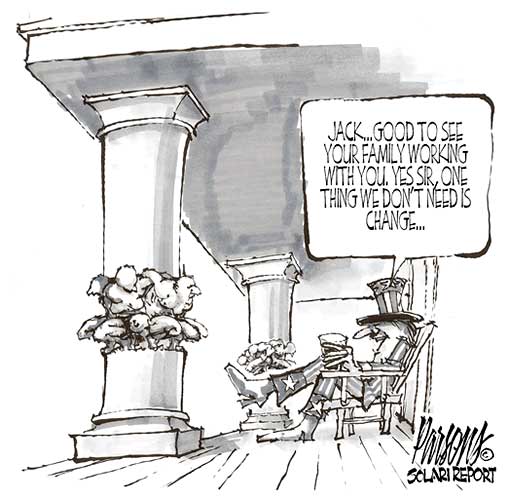 Those in control face a marketing challenge. How do they arrange a dramatic reduction in allowances without providing an accounting of where monies had gone, thus threatening their offshore holdings and enterprises, or exposing criminal liabilities to their global enemies? How do they maintain control without the continual flow of allowances to placate family members? And what would happen when the family members discover that their retirement savings and benefits are empty promises?