Send this article to a friend:
February
12
2014

|
Send this article to a friend: February |
|
Doomed If We Do, Doomed If We Don't
The point to understanding the Status Quo financial system is doomed is not to revel in the doom but to understand why we have to look past the current corrupt, predatory, parasitic system to a better arrangement. That's positive. Longtime correspondent Harun I. submitted this quote from John Ing and a commentary on simple arithmetic. In "We Are Nowhere Near The Chaos That I Expect", John Ing observes the consequences of deleveraging a highly leveraged system:
Harun then explained why it isn't amazing at all--it's entirely predictable:
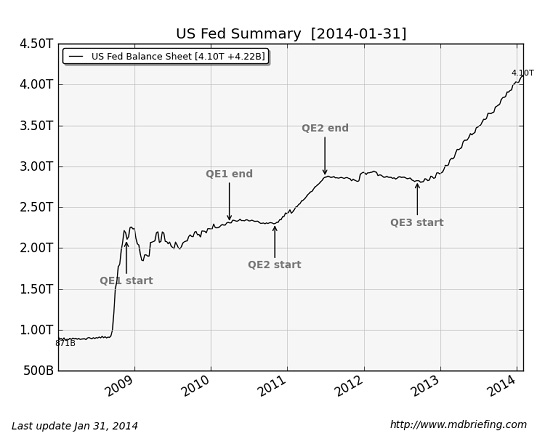
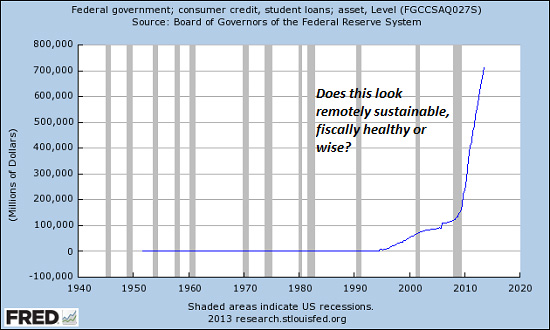
Trying to force simplistic results out of complex systems inevitably generates unintended consequences. Liquidity and credit expansion act like pressure in a closed system; central planners look at the site of the last financial break and see no leaks, so they assume they've got the system under control. But the next failure in the system will occur where no one is looking--the points in the system that everyone assumes are "safe." The system is doomed if central banks continue creating trillions of dollars in new leveraged credit and liquidity to keep the system from imploding, and it is also doomed if they cease creating new leveraged credit (i.e. taper their geometric expansion of credit). Doomed if you do taper, doomed if you don't taper. Here's the Fed balance sheet. If you get a magnifying glass, you might discern some tapering. Geometric expansion of credit is visible throughout the system. Never mind the infamous shadow banking system--look at the insane expansion of credit/debt in student loans:
|
|---|
Send this article to a friend:
 |
 |
 |
 Even if we used a 10:1 fractional reserve ratio, the Fed's
$85 billion per month QE was creating $10 trillion per year in liquidity.
Even if we used a 10:1 fractional reserve ratio, the Fed's
$85 billion per month QE was creating $10 trillion per year in liquidity.