|
The Hydrogen Dream 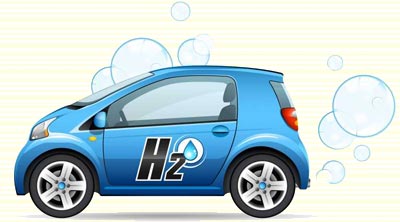
Last week I went to Longwy's university campus, the Institut Universitaire de Technologie (part of the University of Lorraine), for a conference on renewable energies and energy efficiency. It was an event integrated in an InterReg project for innovation, called Tigre, gathering institutions from Lorraine, Saarland, Luxembourg, and Wallonie. It kicked off with a session on tri-generation, and went on with parallel sessions on waste biomass, and on hydrogen and fuel cells. I opted for the latter, feeling really curious about the present state of research on this field. Home concept Today the hydrogen dream is very different from Marchetti's. It starts with a home, self-reliant and grid-disconnected, housing a micro-generation system, mostly solar and wind, that primarily feeds the electrical system. Then surplus energy is converted into hydrogen and stored in a container in a special division of the house. This hydrogen can later be used to generate electricity through a fuel cell when the micro-systems do not match the instantaneous power needs; the waste heat generated by the fuel cell can also be used to heat the house. Finally, this hydrogen can be used to feed one or more vehicles powered by fuel cells. A general presentation along these lines opened the session by Sophie Didierjean from the University of Lorraine. Going straight to the crux of the matter, I'll jump to Volker Loos, from the Fachhochschule of Trier, who gave a general presentation on the possibilities of H2 as an energy vector. I'll have to start from the finish, since it was during the Q&A session of this talk that the critical question came from the audience regarding the efficiency of hydrolysis today. At best this figure can approach 80% for a water temperature between 70 ºC and 80 ºC. Not bad, but the problem is that the process of H2 usage has just begun; after that comes compression, storage in a container, decompression and electrochemical processing through a fuel cell or by combustion. In all these steps there are mass and energy losses that further cut efficiency; the end result is far from mature electrical storage technologies like back pumping in dams or magnetic flywheels, and also far from other emerging technologies like large scale compressed air storage. And then to talk about platinum was Nathalie Job from the Universiy of Liège, an institution presently researching synthetic carbons to produce electron conductors for fuel cells. These conductors should both reduce the rate of platinum used per fuel cell and increase the life time. The details of this work can easily go into electrochemical aspects that are well outside my realm of knowledge. A read of this article may help you get a better idea of what this research is about. Then, on the chemical side of things was Yaroslav Filinchuk from the Catholic University of Louvain. He came to present a theoretical concept for the storage of H2 using borohydrides, an highly reactive, porous material that can store light gases. The basic idea is to use the hollow spaces that the molecular structures of these materials create to “lock” inside smaller molecules. The main advantage is the possibility of storing H2 at ambient temperatures, thus avoiding energy losses in compression/decompression or liquefaction/gasification processes. They may also reduce mass losses during storage, but once again my knowledge is thin on the field, so I recommend again a closer reading of a recent article on the subject. Ending the session was a host speaker, Angel Scipioni from the IUT, presenting the energy mix of France. This was mostly a generalist address with lots of interesting numbers cast here and there, clearly showing that the largest state of the EU has lagged somewhat behind on the build-up of renewable infrastructure, because it has a huge nuclear park. What struck me was a direct reference to Peak Oil, but in the past tense, as an additional reason for a transition to renewables and H2. Even though acknowledging it, Angel Scipioni seemed not give much importance to it, stating that France had so far coped well with higher petrol and diesel prices. I wonder how widespread this sort of view is; in any case it is a reminder of how far the awareness raising process still has to go. So the hydrogen dream lives on. Where will these research projects lead? Are all of them in vain? Perhaps not, but hydrogen continuously appears somewhat behind alternative technologies; for a massification of it to use as an energy carrier, nothing short of a revolution will do. In many regards, huge steps forward will have to be made in order to bring efficiency into a comfortable zone. With several other technologies closing in on maturity, there doesn't seem to be much time left. And finally, whenever I reflect upon hydrogen, I'm always somewhat baffled as to why molecules like ammonia (heavier) or methanol (heavier and less hazardous) aren't preferred as energy carriers. |
 |
 |